0:00 / 0:00
In 3D, we can resolve a force into its Cartesian vector components,
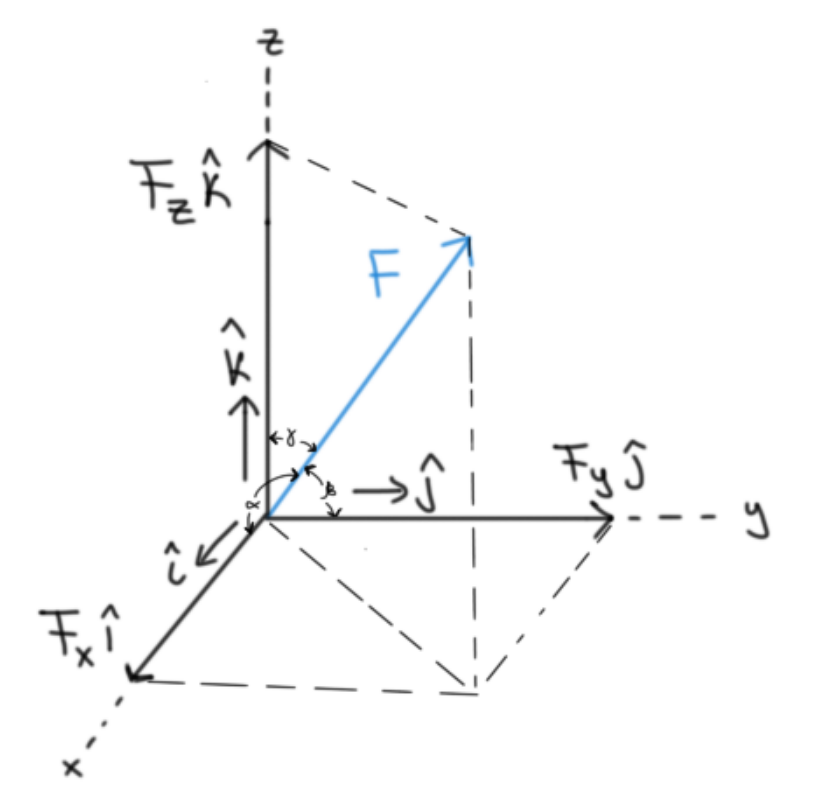


F=Fxi+Fyj+Fzk{F}=F_x\mathbf{i}+F_y\mathbf{j}+F_z\mathbf{k}

Magnitude of a Cartesian Vector force,
F=Fx2+Fy2+Fz2\left|F\right|=\sqrt{F_x^2+F_y^2+F_z^2}

A unit vector can be formulated in the direction of a force,
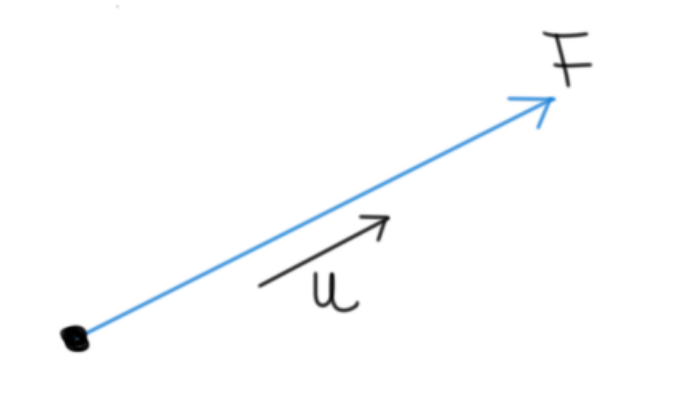
u=FF\mathbf{u}=\frac{\vec{\mathbf{F}}}{\left|F\right|}

u=FF=FxFi+FyFj+FzFk\mathbf{u}=\frac{\vec{\mathbf{F}}}{\left|F\right|}=\frac{F_x}{\left|F\right|}\mathbf{i}+\frac{F_y}{\left|F\right|}\mathbf{j}+\frac{F_z}{\left|F\right|}\mathbf{k}

u=cosαi+cosβj+cosγk     (WE WILL NOT COVER THIS!)\mathbf{u}=\cos\alpha\mathbf{i}+\cos\beta\mathbf{j}+\cos\gamma\mathbf{k}\ \ \ \ \ \left(WE\ WILL\ NOT\ COVER\ THIS!\right)

For the following case below, what is the unit vector, u=OBOB?\mathbf{u}=\frac{\vec{OB}}{\left|OB\right|}?
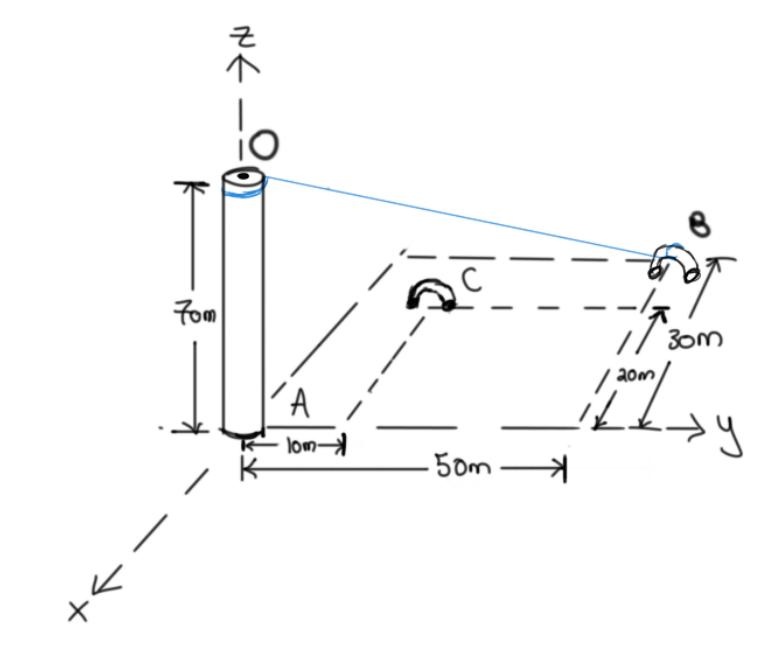
For position vectors, we find the distance and direction (between two points) that one must travel along the x, y, and z directions—going from the tail to the head of the vector.
rAB=(xBxA)i+(yByA)j+(zBzA)k\mathbf{r}_{\mathrm{AB}}=\left(x_{B}-x_{A}\right) \mathbf{i}+\left(y_{B}-y_{A}\right) \mathbf{j}+\left(z_{B}-z_{A}\right) \mathbf{k}


For the figure below, since the line of action for the force is in the same direction for the position vector r, then the position vector rAB\mathbf{r_{AB}}unit vector uu. Then we can express the force as a Cartesian Vector.
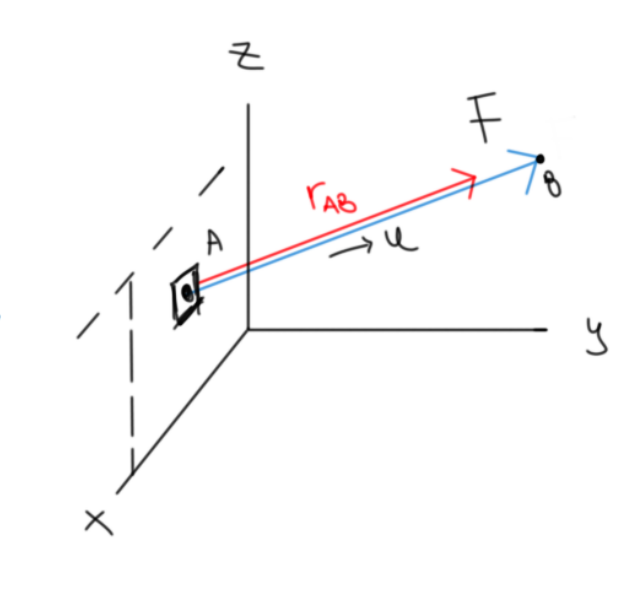
FAB=FABu=FAB(rABrAB)\overrightarrow{\mathrm{F}_{A B}}=\left|F_{A B}\right| \mathbf{u}=\left|F_{A B}\right|\left(\frac{\mathbf{r}_{\mathrm{AB}}}{\left|r_{A B}\right|}\right)


Exam Tip
At this point, we will NOT cover the 3D 1.) Blue Triangles and 2.) Directional cosines in this EXAM Prep course. YOU ARE NOT EXPECTED TO BE TESTED ON THESE TWO METHODS. I will update you instantly if things change.

The EXAM will focus heavily on understanding 3D Force Vectors using the 3.) Coordinate Method-Position Vectors. Therefore, the coordinate method will be the primary application for solving all of the example, practice problems.


0:00 / 0:00

Example

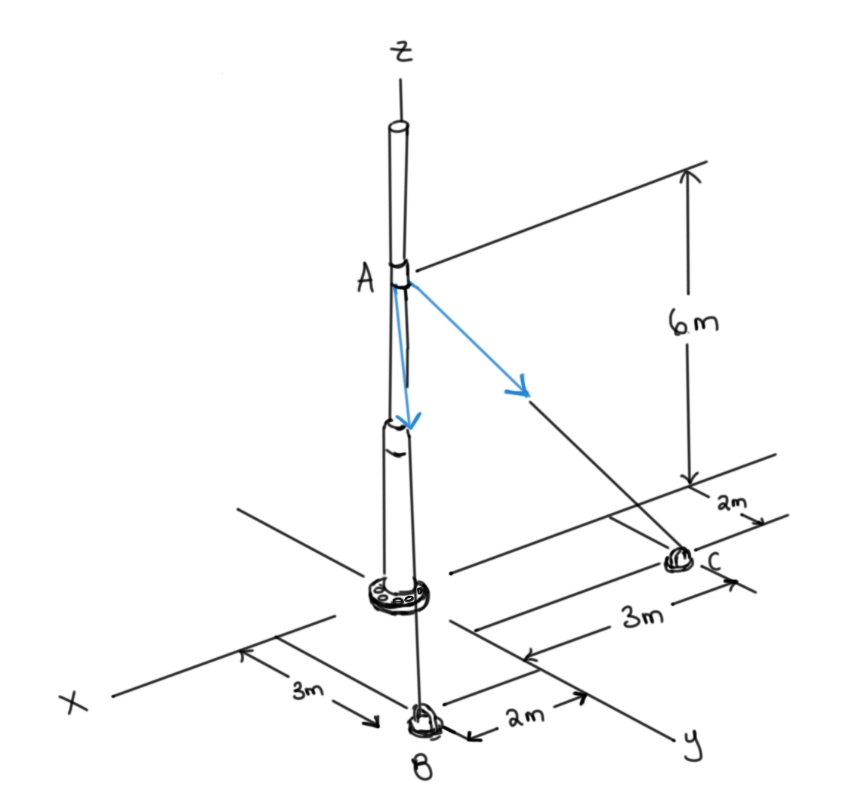
If FAB= 700 N and FAC=560 N determine the magnitude of the resultant force acting on the flag pole.


PAGE BREAK

PAGE BREAK

We have two tension forces we are trying to determine the resultant for. Thus, we need the unit vectors along AB and AC to find the Cartesian forces FAB and FAC\overrightarrow{F_{A B}} \text { and } \overrightarrow{F_{A C}}. Because,
FAB=FABuAB and FAC=FACuAC\overrightarrow{\mathbf{F}}_{A B}=\left|F_{A B}\right| \mathbf{u}_{A B} \text { and } \overrightarrow{\mathbf{F}_{A C}}=\left|F_{A C}\right| \mathbf{u}_{A C}
uAB=(rABrAB)uAC=(rACrAB)\begin{aligned} \mathbf{u}_{A B} &=\left(\frac{\mathbf{r}_{\mathrm{AB}}}{\left|r_{A B}\right|}\right) \\ \mathbf{u}_{A C} &=\left(\frac{\mathbf{r}_{\mathrm{AC}}}{\left|r_{A B}\right|}\right) \end{aligned}
We need the coordinate point for points A, B, and C to determine position vectors rAB and rAC\mathbf{r}_{\mathrm{AB}} \text { and } \mathbf{r}_{\mathrm{AC}}.

A(0,0,6)B(2,3,0)C(3,2,0)\begin{array}{l}{A(0,0,6)} \\ {B(2,3,0)} \\ {C(-3,2,0)}\end{array}
rAB=BA=(2,3,0)(0,0,6)=(20)i+(30)j+(06)krAB=2i+3j6krAC=CA=(3,2,0)(0,0,6)=(30)i+(20)j+(06)krAC=3i+2j6k\begin{array}{l}{\mathbf{r}_{\mathrm{AB}}=B-A=(2,3,0)-(0,0,6)=(2-0) i+(3-0) j+(0-6) k \rightarrow \mathbf{r}_{\mathrm{AB}}=2 i+3 j-6 k} \\ {\mathbf{r}_{\mathrm{AC}}=C-A=(-3,2,0)-(0,0,6)=(-3-0) i+(2-0) j+(0-6) k \rightarrow \mathbf{r}_{\mathrm{AC}}=-3 i+2 j-6 k}\end{array}
Finding unit vectors,
uAB=(rABrAB)=2i+3j6k(2)2+(3)2+(6)2=2i7+3j76k7uAB=0.2857i+0.4286j0.8571k\begin{array}{c}{\mathbf{u}_{A B}=\left(\frac{\mathbf{r}_{\mathrm{AB}}}{\left|r_{A B}\right|}\right)=\frac{2 i+3 j-6 k}{\sqrt{(2)^{2}+(3)^{2}+(-6)^{2}}}=\frac{2 i}{7}+\frac{3 j}{7}-\frac{6 k}{7}} \\ {\mathbf{u}_{A B}=0.2857 i+0.4286 j-0.8571 k}\end{array}

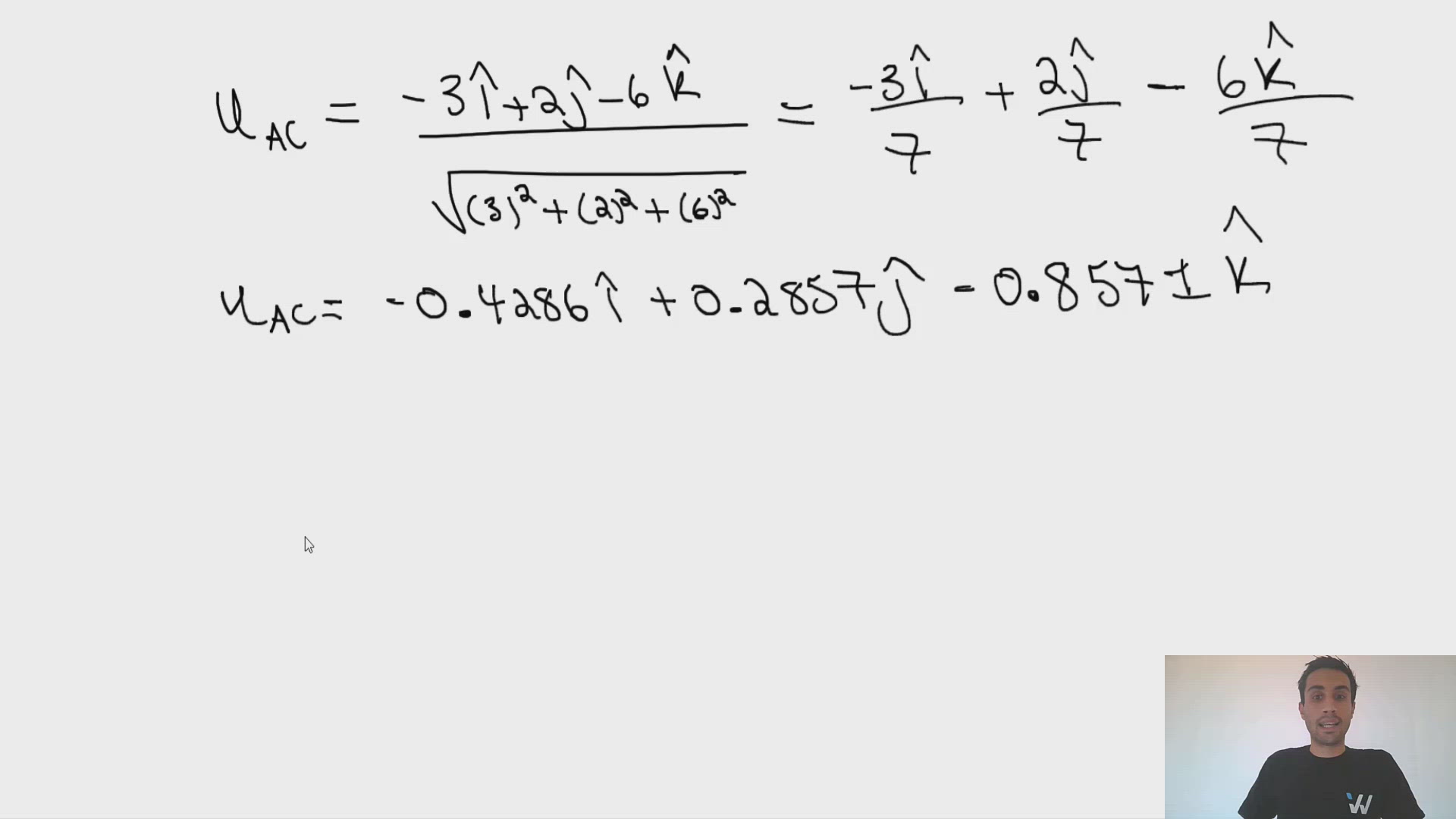
uAC=(rACrAC)=3i+2j6k(3)2+(2)2+(6)2=3i7+2j76k7uAC=0.4286i+0.2857j0.8571k\begin{aligned} \mathbf{u}_{A C}=\left(\frac{\mathbf{r}_{A C}}{\left|r_{A C}\right|}\right) &=\frac{-3 i+2 j-6 k}{\sqrt{(-3)^{2}+(2)^{2}+(-6)^{2}}}=\frac{-3 i}{7}+\frac{2 j}{7}-\frac{6 k}{7} \\ \mathbf{u}_{A C} &=-0.4286 i+0.2857 j-0.8571 k \end{aligned}
Cartesian vector forces,

FAB=FABuAB=700N(0.2857i+0.4286j0.8571k)FAB=(199.99i+300.02j599.97k)NFAC=FACuAC=560N(0.4286i+0.2857j0.8571k)FAC=(240.016i+159.992j479.976k)N\begin{array}{l}{\overrightarrow{\mathrm{F}_{A B}}=\left|F_{A B}\right| \mathbf{u}_{A B}=700 N(0.2857 i+0.4286 j-0.8571 k) \rightarrow \overrightarrow{\mathbf{F}}_{A B}=(199.99 i+300.02 j-599.97 k) N} \\ {\overrightarrow{\mathbf{F}}_{A C}=\left|F_{A C}\right| \mathbf{u}_{A C}=560 N(-0.4286 i+0.2857 j-0.8571 k) \rightarrow \overrightarrow{\mathrm{F}_{A C}}=(-240.016 i+159.992 j-479.976 k) N}\end{array}

Resultant force,

FR=FAB+FAC=(199.99i+300.02j599.97k)+(240.016i+159.992j479.976k)FR=(199.99240.016)i+(300.02+159.992)j+(599.97+479.976)kFR=40.026i+460.012j1079.946k\begin{array}{l}{\overrightarrow{\mathrm{F}_{\mathrm{R}}}=\overrightarrow{\mathbf{F}_{A B}}+\overrightarrow{\mathbf{F}_{A C}}=(199.99 i+300.02 j-599.97 k)+(-240.016 i+159.992 j-479.976 k)} \\ {\overrightarrow{\mathrm{F}_{\mathrm{R}}}=(199.99-240.016) i+(300.02+159.992) j+(-599.97+-479.976) k} \\ {\overrightarrow{\mathrm{F}_{\mathrm{R}}}=-40.026 i+460.012 j-1079.946 k}\end{array}

Magnitude of resultant force,

FR=(FR)x2+(FR)y2+(FR)z2=(40.026)2+(460.012)2+(1079.946)2FR=1174.52=1175N\begin{array}{l}{F_{R}=\sqrt{\left(F_{R}\right)_{x}^{2}+\left(F_{R}\right)_{y}^{2}+\left(F_{R}\right)_{z}^{2}}=\sqrt{(-40.026)^{2}+(460.012)^{2}+(-1079.946)^{2}}} \\ {F_{R}=1174.52=1175 \mathrm{N}}\end{array}
0:00 / 0:00

Example

If FAB= 700 N and FAC=560 N determine the magnitude of the resultant force acting on the flag pole.


PAGE BREAK

PAGE BREAK

We have two tension forces we are trying to determine the resultant for. Thus, we need the unit vectors along AB and AC to find the Cartesian forces FAB and FAC\overrightarrow{F_{A B}} \text { and } \overrightarrow{F_{A C}}. Because,
FAB=FABuAB and FAC=FACuAC\overrightarrow{\mathbf{F}}_{A B}=\left|F_{A B}\right| \mathbf{u}_{A B} \text { and } \overrightarrow{\mathbf{F}_{A C}}=\left|F_{A C}\right| \mathbf{u}_{A C}
uAB=(rABrAB)uAC=(rACrAB)\begin{aligned} \mathbf{u}_{A B} &=\left(\frac{\mathbf{r}_{\mathrm{AB}}}{\left|r_{A B}\right|}\right) \\ \mathbf{u}_{A C} &=\left(\frac{\mathbf{r}_{\mathrm{AC}}}{\left|r_{A B}\right|}\right) \end{aligned}
We need the coordinate point for points A, B, and C to determine position vectors rAB and rAC\mathbf{r}_{\mathrm{AB}} \text { and } \mathbf{r}_{\mathrm{AC}}.

A(0,0,6)B(2,3,0)C(3,2,0)\begin{array}{l}{A(0,0,6)} \\ {B(2,3,0)} \\ {C(-3,2,0)}\end{array}
rAB=BA=(2,3,0)(0,0,6)=(20)i+(30)j+(06)krAB=2i+3j6krAC=CA=(3,2,0)(0,0,6)=(30)i+(20)j+(06)krAC=3i+2j6k\begin{array}{l}{\mathbf{r}_{\mathrm{AB}}=B-A=(2,3,0)-(0,0,6)=(2-0) i+(3-0) j+(0-6) k \rightarrow \mathbf{r}_{\mathrm{AB}}=2 i+3 j-6 k} \\ {\mathbf{r}_{\mathrm{AC}}=C-A=(-3,2,0)-(0,0,6)=(-3-0) i+(2-0) j+(0-6) k \rightarrow \mathbf{r}_{\mathrm{AC}}=-3 i+2 j-6 k}\end{array}
Finding unit vectors,
uAB=(rABrAB)=2i+3j6k(2)2+(3)2+(6)2=2i7+3j76k7uAB=0.2857i+0.4286j0.8571k\begin{array}{c}{\mathbf{u}_{A B}=\left(\frac{\mathbf{r}_{\mathrm{AB}}}{\left|r_{A B}\right|}\right)=\frac{2 i+3 j-6 k}{\sqrt{(2)^{2}+(3)^{2}+(-6)^{2}}}=\frac{2 i}{7}+\frac{3 j}{7}-\frac{6 k}{7}} \\ {\mathbf{u}_{A B}=0.2857 i+0.4286 j-0.8571 k}\end{array}

uAC=(rACrAC)=3i+2j6k(3)2+(2)2+(6)2=3i7+2j76k7uAC=0.4286i+0.2857j0.8571k\begin{aligned} \mathbf{u}_{A C}=\left(\frac{\mathbf{r}_{A C}}{\left|r_{A C}\right|}\right) &=\frac{-3 i+2 j-6 k}{\sqrt{(-3)^{2}+(2)^{2}+(-6)^{2}}}=\frac{-3 i}{7}+\frac{2 j}{7}-\frac{6 k}{7} \\ \mathbf{u}_{A C} &=-0.4286 i+0.2857 j-0.8571 k \end{aligned}
Cartesian vector forces,

FAB=FABuAB=700N(0.2857i+0.4286j0.8571k)FAB=(199.99i+300.02j599.97k)NFAC=FACuAC=560N(0.4286i+0.2857j0.8571k)FAC=(240.016i+159.992j479.976k)N\begin{array}{l}{\overrightarrow{\mathrm{F}_{A B}}=\left|F_{A B}\right| \mathbf{u}_{A B}=700 N(0.2857 i+0.4286 j-0.8571 k) \rightarrow \overrightarrow{\mathbf{F}}_{A B}=(199.99 i+300.02 j-599.97 k) N} \\ {\overrightarrow{\mathbf{F}}_{A C}=\left|F_{A C}\right| \mathbf{u}_{A C}=560 N(-0.4286 i+0.2857 j-0.8571 k) \rightarrow \overrightarrow{\mathrm{F}_{A C}}=(-240.016 i+159.992 j-479.976 k) N}\end{array}

Resultant force,

FR=FAB+FAC=(199.99i+300.02j599.97k)+(240.016i+159.992j479.976k)FR=(199.99240.016)i+(300.02+159.992)j+(599.97+479.976)kFR=40.026i+460.012j1079.946k\begin{array}{l}{\overrightarrow{\mathrm{F}_{\mathrm{R}}}=\overrightarrow{\mathbf{F}_{A B}}+\overrightarrow{\mathbf{F}_{A C}}=(199.99 i+300.02 j-599.97 k)+(-240.016 i+159.992 j-479.976 k)} \\ {\overrightarrow{\mathrm{F}_{\mathrm{R}}}=(199.99-240.016) i+(300.02+159.992) j+(-599.97+-479.976) k} \\ {\overrightarrow{\mathrm{F}_{\mathrm{R}}}=-40.026 i+460.012 j-1079.946 k}\end{array}

Magnitude of resultant force,

FR=(FR)x2+(FR)y2+(FR)z2=(40.026)2+(460.012)2+(1079.946)2FR=1174.52=1175N\begin{array}{l}{F_{R}=\sqrt{\left(F_{R}\right)_{x}^{2}+\left(F_{R}\right)_{y}^{2}+\left(F_{R}\right)_{z}^{2}}=\sqrt{(-40.026)^{2}+(460.012)^{2}+(-1079.946)^{2}}} \\ {F_{R}=1174.52=1175 \mathrm{N}}\end{array}
0:00 / 0:00

Example

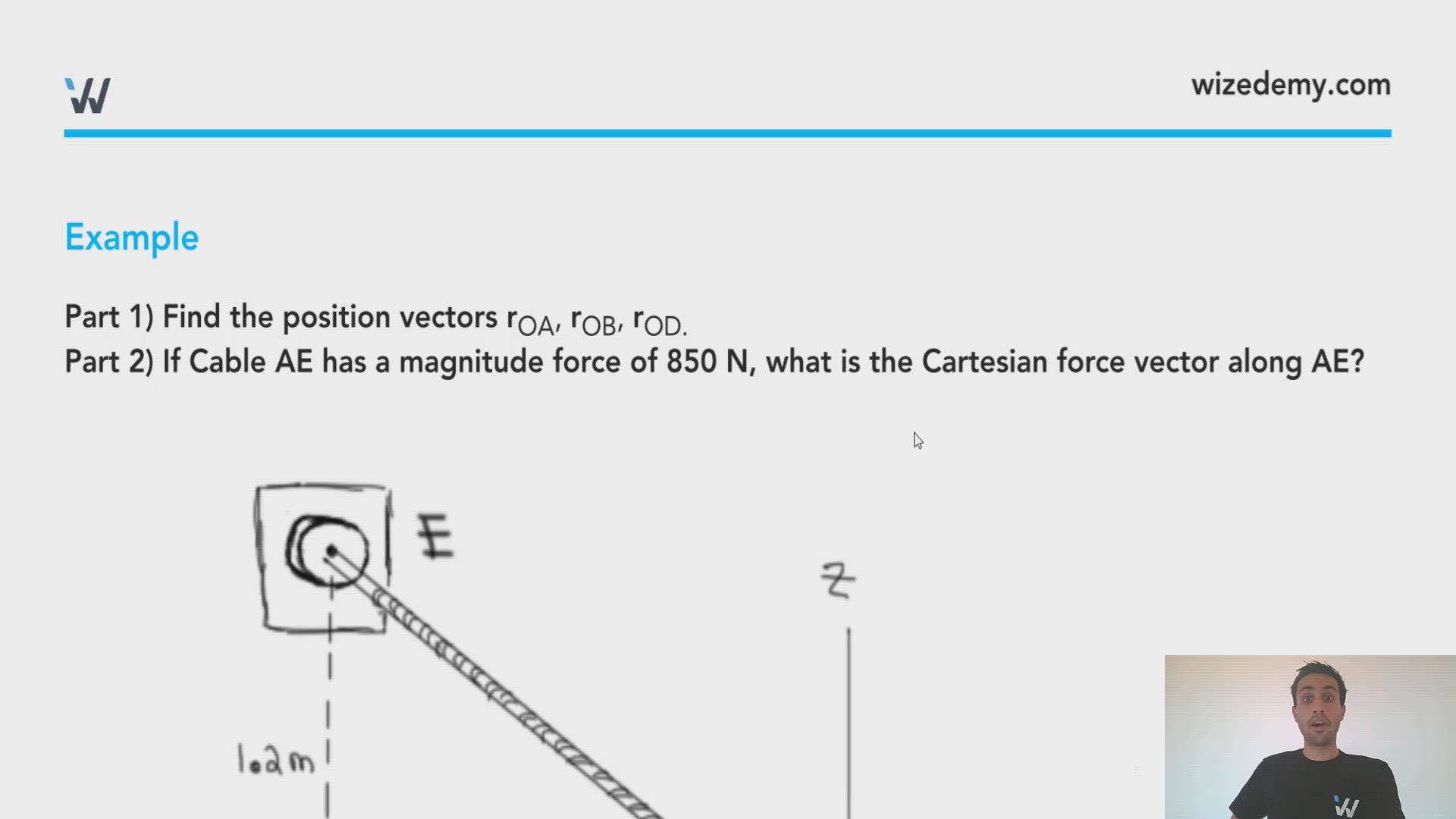
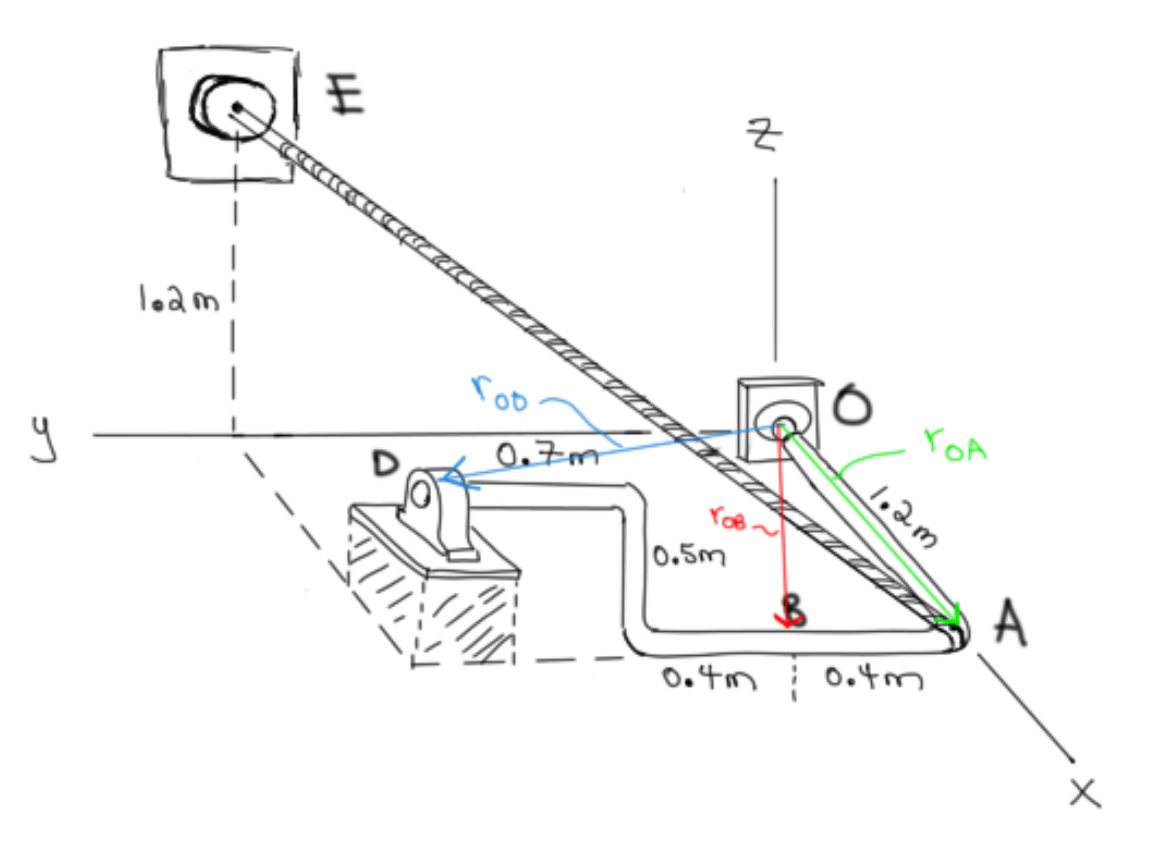
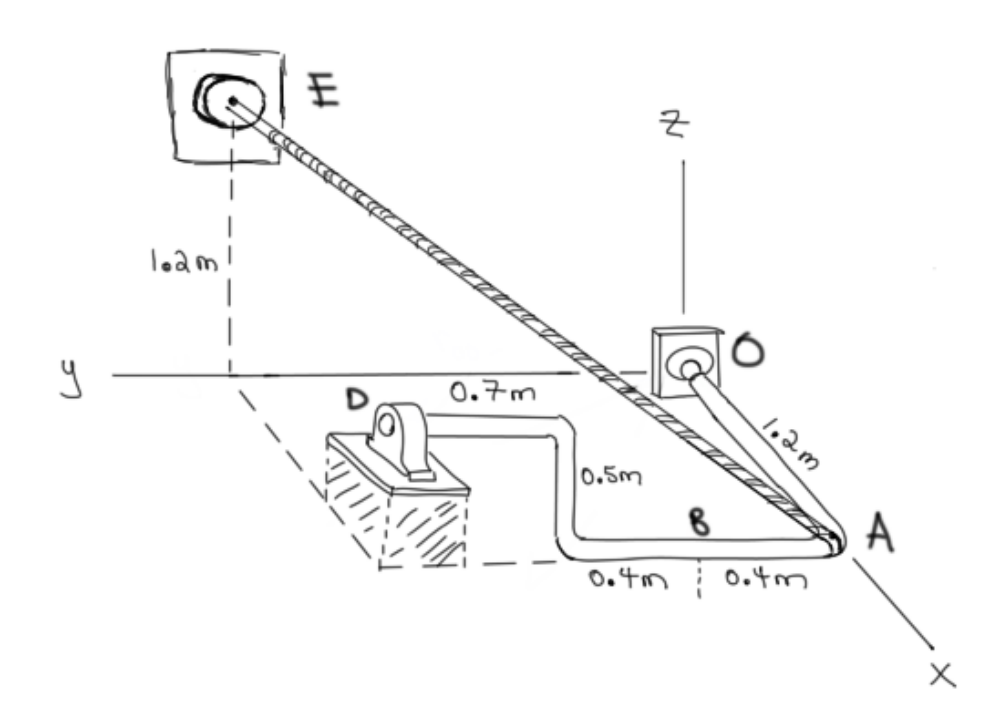
Part 1) Find the position vectors rOA, rOB, rOD.
Part 2) If Cable AE has a magnitude force of 850 N, what is the Cartesian force vector along AE?


Part 1)
To find position vectors rOA,rOB,rOD\overrightarrow{\mathbf{r}_{O A}}, \overrightarrow{\mathbf{r}_{O B}}, \overrightarrow{\mathbf{r}_{O D}} ,we need coordinate points O, A, B, and D.

Coordinate points,

O(0,0,0)A(1.2,0,0)B(1.2,0.4,0)D(1.2,1.5,0.5)\begin{array}{c}{O(0,0,0)} \\ {A(1.2,0,0)} \\ {B(1.2,0.4,0)} \\ {D(1.2,1.5,0.5)}\end{array}
Position vectors,


rOA=AO=(1.2,0,0)(0,0,0)(0,0,0)rOA=1.2i+0j+0krOB=BO=(1.2,0.4,0)(0,0,0)rOB=1.2i+0.4j+0krOD=DO=(1.2,1.5,0.5)(0,0,0)rOD=1.2i+1.5j+0.5k\begin{array}{l}{\overrightarrow{\mathbf{r}_{O A}}=A-O=(1.2,0,0)-(0,0,0) \rightarrow(0,0,0) \rightarrow \overrightarrow{\mathbf{r}_{O A}}=1.2 i+0 j+0 k} \\ {\overrightarrow{\mathbf{r}_{O B}}=B-O=(1.2,0.4,0)-(0,0,0) \rightarrow \overrightarrow{\mathbf{r}_{O B}}=1.2 i+0.4 j+0 k} \\ {\overrightarrow{\mathbf{r}_{O D}}=D-O=(1.2,1.5,0.5)-(0,0,0) \rightarrow \overrightarrow{\mathbf{r}_{O D}}=1.2 i+1.5 j+0.5 k}\end{array}


Part 2)
We have one tension force, we are trying to find the Cartesian force FAE\overrightarrow{F_{AE}}. We need unit vector uAE\mathbf{u}_{AE}because,
FAE=FAEuAE\overrightarrow{\mathbf{F}}_{AE}=\left|F_{AE}\right|\mathbf{u}_{AE}
and,
uAE=(rAErAE)\mathbf{u}_{A E}=\left(\frac{\mathbf{r}_{A E}}{\left|r_{A E}\right|}\right)

We need the coordinate point for points A and E to find rAE\mathbf{r}_{\mathrm{AE}} .

A(1.2,0,0)E(0,1.5,1.2)\begin{array}{l}{A(1.2,0,0)} \\ {E(0,1.5,1.2)}\end{array}
rAE=EA=(0,1.5,1.2)(1.2,0,0)rAE=1.2i+1.5j+1.2k\mathbf{r}_{A E}=E-A=(0,1.5,1.2)-(1.2,0,0) \rightarrow \mathbf{r}_{A E}=-1.2 i+1.5 j+1.2 k
Find unit vector,

uAE=(rAErAB)=1.2i+1.5j+1.2k(1.2)2+(1.5)2+(1.2)2=1.2i2.265+1.5j2.265+1.2k2.265uAE=0.5298i+0.6622j+0.5298k\begin{array}{l}{\mathbf{u}_{A E}=\left(\frac{\mathbf{r}_{A E}}{\left|r_{A B}\right|}\right)=\frac{-1.2 i+1.5 j+1.2 k}{\sqrt{(1.2)^{2}+(1.5)^{2}+(1.2)^{2}}}=\frac{-1.2 i}{2.265}+\frac{1.5 j}{2.265}+\frac{1.2 k}{2.265}} \\ {\mathbf{u}_{A E}=-0.5298 i+0.6622 j+0.5298 k}\end{array}
Cartesian vector forces,

FAB=FABuAE=850N(0.5298i+0.6622j+0.5298k)FAB=(450i+563j+450k)N\overrightarrow{\mathrm{F}_{A B}}=\left|F_{A B}\right| \mathbf{u}_{A E}=850 N(-0.5298 i+0.6622 j+0.5298 k) \rightarrow \overrightarrow{\mathrm{F}_{A B}}=(-450 i+563 j+450 k) N


0:00 / 0:00
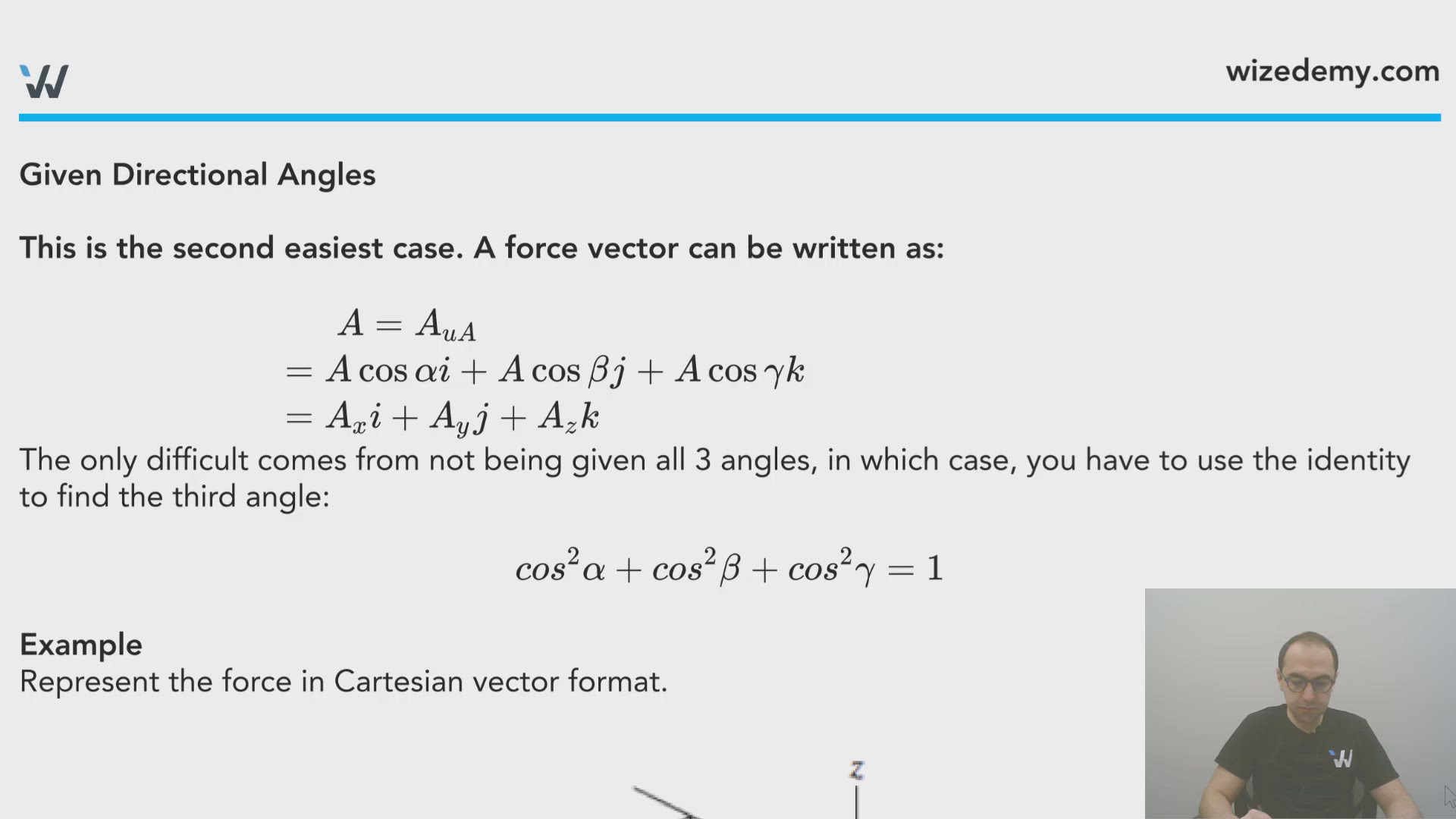
Given Directional Angles

This is the second easiest case. A force vector can be written as:
A=AuAA=A_{uA}
=Acosαi+Acosβj+Acosγk=A\cos\alpha i+A\cos\beta j+A\cos\gamma k
=Axi+Ayj+Azk=A_xi+A_yj+A_zk
The only difficult comes from not being given all 3 angles, in which case, you have to use the identity to find the third angle:
cos2α+cos2β+cos2γ=1cos^2\alpha+ cos^2\beta +cos^2\gamma=1
Example
Represent the force in Cartesian vector format.


α=?\alpha=?
β=130o\beta=130^o cos2α=1cos2βcos2γ\cos^2\alpha=1-\cos^2\beta-\cos^2\gamma
γ=120o\gamma=120^o α=60o\alpha=60^o

u=cosαi^+cosβj^+cosγk^\vec{u}= cos\alpha \hat{i}+cos\beta \hat{j}+cos\gamma \hat{k}
=0.5i^0.707j^0.5k^=0.5\hat{i}-0.707\hat{j}-0.5\hat{k}
F=500u\vec{F}=500\vec{u}
F=(250i^354j^250k^)N\vec{F}=(250\hat{i}-354\hat{j}-250\hat{k})N
PAGE BREAK
Given Planar Angles
  1. Break down the force into one axial component and one planar component using trigonometry
  2. Break down the planar component into two axial components using trigonometry
  3. Look at the geometry of the force to determine whether it’s positive or negative
Example
Represent the force in Cartesian vector format.
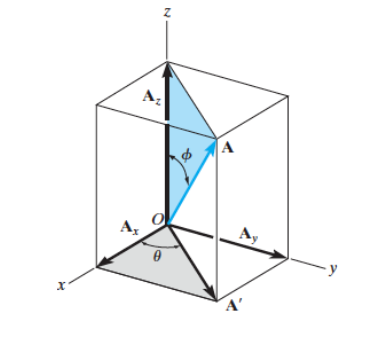
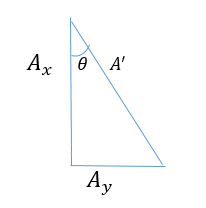
Light Blue Triangle:
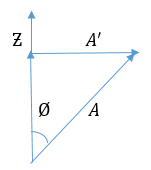

Az=AcosϕA_z=Acos\phi
A,=AsinϕA^ , =Asin\phi

xy plane:


Ax=A,cosθ=AsinϕcosθA_x=A^ , cos \theta =A sin \phi cos \theta
Ay=A,sinθ=AsinϕsinθA_y=A^ , sin \theta =A sin \phi sin \theta

A=A(sinϕcosθi^+sinϕsinθj^+cosϕk^)\vec{A} =A(sin\phi cos\theta\hat{i}+sin\phi sin\theta \hat{j} +cos\phi\hat{k})
PAGE BREAK
Given Distances
  1. Find the coordinates of the points that the force acts between
  2. Determine the distance vectors between the two points
  3. Determine the magnitude of the distance vector
  4. Find the unit vector along the distance vector
  5. Multiply the magnitude of the force by the unit vector to find the force vector
Example
Represent the forces in Cartesian vector format.
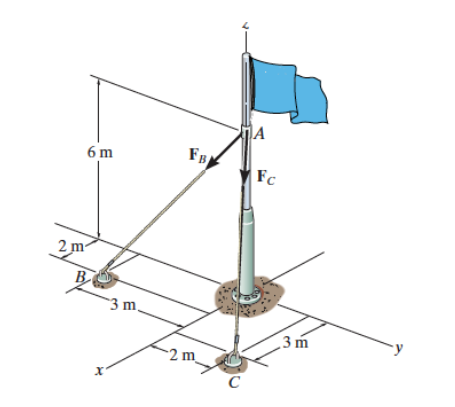
1) Coordinator:

A(0,0,6)A(0,0,6)
B(2,3,0)B(2,-3,0)
C(3,2,0)C(3,2,0)

2) rAB=2i^3j^6k^\vec{r}_ AB=2\hat{i}-3\hat{j}-6\hat{k}
rAC=3i^+2j^6k^\vec{r}_{AC}=3\hat{i}+2\hat{j}-6\hat{k}

3) rAB=7||\vec{r}_{AB}||=7
rAC=7||\vec{r}_{AC}||=7

4) uAB=27i^37j^67k^\vec{u}_{AB}=\frac{2}{7}\hat{i}-\frac{3}{7}\hat{j}-\frac{6}{7}\hat{k}
uAC=37i^+27j^67k^\vec{u}_{AC}=\frac{3}{7}\hat{i}+\frac{2}{7}\hat{j}-\frac{6}{7}\hat{k}

5) FAB=FB uAB\vec{F}_{AB}=F_B\vec{\ u}_{AB}
FAB=FcuAC\vec{F}_{AB}=F_c\vec{u}_{AC}
PAGE BREAK
Given Similar Triangles
This is sometimes the case in planar forces (in 2D only). There are two ways to solve these questions:
  1. Use trigonometry to find the angle of the triangle, then solve as a planar angle question
  2. Use ratios of similar triangles to determine components of the force
Example
Represent the 325N force in Cartesian vector format.

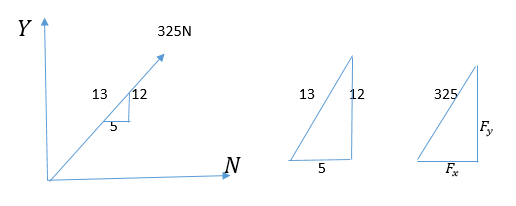


Fxy=32513   Fx=125N\frac{Fx}{y}=\frac{325}{13}\ \rightarrow\ \ Fx=125N

Fy12=32513     Fy=300N\frac{Fy}{12}=\frac{325}{13}\ \ \rightarrow\ \ \ Fy=300N
F=(125i^+300j^)N\vec{F} =(125\hat{i}+300\hat{j})N
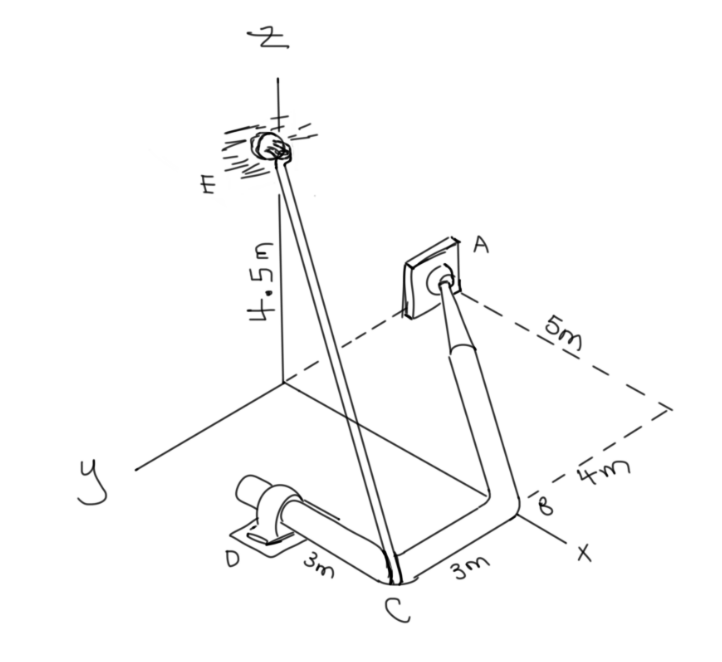
Part 1) Find the position vectors rAC, rBD, rEC.

Part 2) If the cable FEC is 430N, determine the Cartesian Force vector for the cable.


PAGE BREAK


Determine all the force vectors.


FAB=( a i+ b j+ c k)TAB\vec{F_{AB}}=\left(\textcolor{red}{\underline{\ a\ }}i+\textcolor{red}{\underline{\ b\ }}j+\textcolor{red}{\underline{\ c\ }}k\right)T_{AB}

Round all values of a, b, c to 3 sig figs.
Determine all the force vectors.
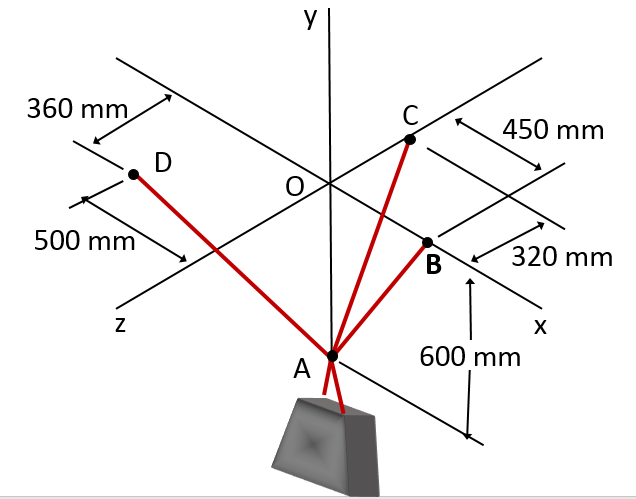

FAB=( a i+ b j+ c k)TAB\vec{F_{AB}}=\left(\textcolor{red}{\underline{\ a\ }}i+\textcolor{red}{\underline{\ b\ }}j+\textcolor{red}{\underline{\ c\ }}k\right)T_{AB}

Round all values of a, b, c to 3 sig figs.