Wize University Statics Textbook (Master) > Force Vectors
Similar Triangles / “That Small Triangle” / Pythagorean Triples
Popular Courses
ENGG 130
University of Alberta
CIV100H1
University of Toronto
PCS 211
Toronto Metropolitan University
ENGG 202
University of Calgary
ENGSCI 1022A/B/Y
Western University
GNG 1105
University of Ottawa
PHYS 124
University of Alberta
APSC 111
Queen's University
PCS 120
Toronto Metropolitan University
ENGR 242
Concordia University
PHYS 117
University of British Columbia
PHYC 1190
Dalhousie University
ENGG 212
University of Calgary
ENGR 141
University of Victoria
PHYS-1300
University of Windsor
PHY 1121
University of Ottawa
CE 221
Michigan State University
PHY 1124
University of Ottawa
PHYS 121
University of Waterloo
PHYS 227
University of Calgary

0:00 / 0:00
What about that small TRIANGLE with #'s?
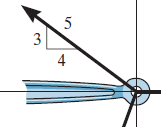
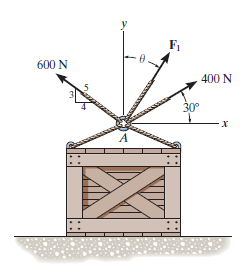
On occasion you will see vectors presented as above. Students often miss the EASY way to handle this when finding x & y components of the 2D vector. They will want to find the angle using SOHCAHTOA, which is fine, but is "one more calculation and one more place to possibly make an error" that would carry through the rest of the solution.
OPTION #1: use this trick: using the example above, cos(theta) = adjacent/hypotenuse = 4/5.
Instead of solving for the angle theta (which you will only reuse in cos(theta) or sin(theta)), why not just use the "4/5" instead of cos(theta).
For example, if the vector above was 10N, then:
Fx = -10 cos(theta) N
Instead, just write as:
Fx = -10(4/5) = -8N And then Fy = 10(3/5) = 6N
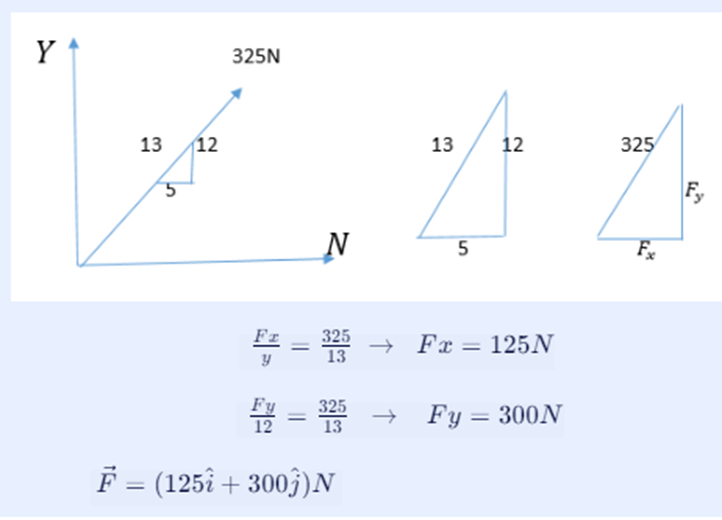
OPTION #2: Use ratios of similar triangles to determine components of the force as in the example below
Example: Represent the 325N force in Cartesian vector format.
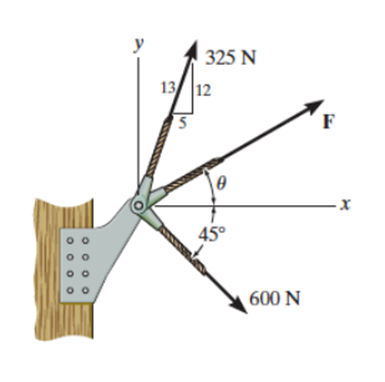
Write F3 in cartesian vector form using the Pythagorean Triple method.
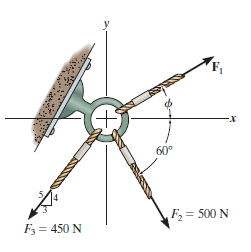
F3 = -450(3/5)i - 450(4/5)j = ]-270i - 360j] N

Mark Yourself Question
- Grab a piece of paper and try this problem yourself.
- When you're done, check the "I have answered this question" box below.
- View the solution and report whether you got it right or wrong.
Write the 600N force in Cartesian Vector Form using Pythagorean Triple Method.