Popular Courses
MCAT
General Course
Intro to Physiology
University Study Guides
PHYSIOL 1021
Western University
PHYS*1080
University of Guelph
PHYSIOL 2130
Western University
Intro to Physiology
University Study Guides
PSL300H1
University of Toronto
PHYSL 210
University of Alberta
PHGY 210
McGill University
PHGY 215
Queen's University
KNES 259
University of Calgary
PHGY 216
Queen's University
BIOL 273
University of Waterloo
BIOL 260
University of British Columbia
PHYSIOL 3120
Western University
KNES 260
University of Calgary
BIOL 116
Case Western Reserve University
PPT 301
University of North Dakota
ANAT 212
McGill University
HTHSCI 2FF3
McMaster University
0:00 / 0:00
Osmosis and Osmotic Pressure
Simply put, osmosis is the diffusion of water.
- Water is a polar molecule that diffuses into the cell through aquaporins (channels).
- There must exist a concentration gradient - addition of solute decreases water concentration
- Solute is added to intracellular or extracellular space
- Degree to which the concentration of water is decreased depends on the number of particles of solute
- Osmolarity is the number of particles a solute dissociates into when in solution (per liter)
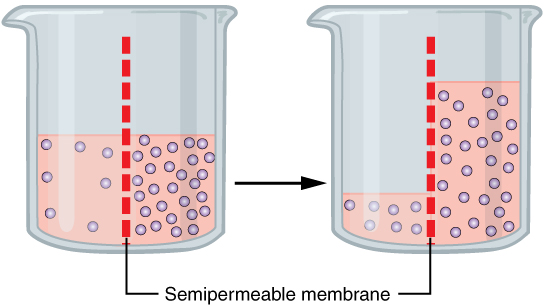
Osmotic pressure is the pressure that must be applied to the solution to prevent the net flow of water across a semipermeable membrane.
- The greater the osmolarity, the greater the osmotic pressure
- The lower the water concentration, the higher the osmotic pressure
Osmolarity and Cell Volume
Molecules that cannot cross the cell membrane are called nonpenetrating solutes. Water can always diffuse through the membrane to establish diffusion equilibrium (intracellular = extracellular osmolarity).
- Although Na+ and K+ can enter/leave the cell through channels, the Na+/K+ ATPase pumps them back where they came from almost immediately. Therefore, they are considered nonpenetrating solutes.
- A similar situation occurs with Cl- and it is also considered a nonpenetrating solute.
- Large organic molecules inside the cell are also nonpenetrating.
Exam Tip
Understand the following concepts very well! They show up on exams in various ways and are very important in human physiology!
0:00 / 0:00
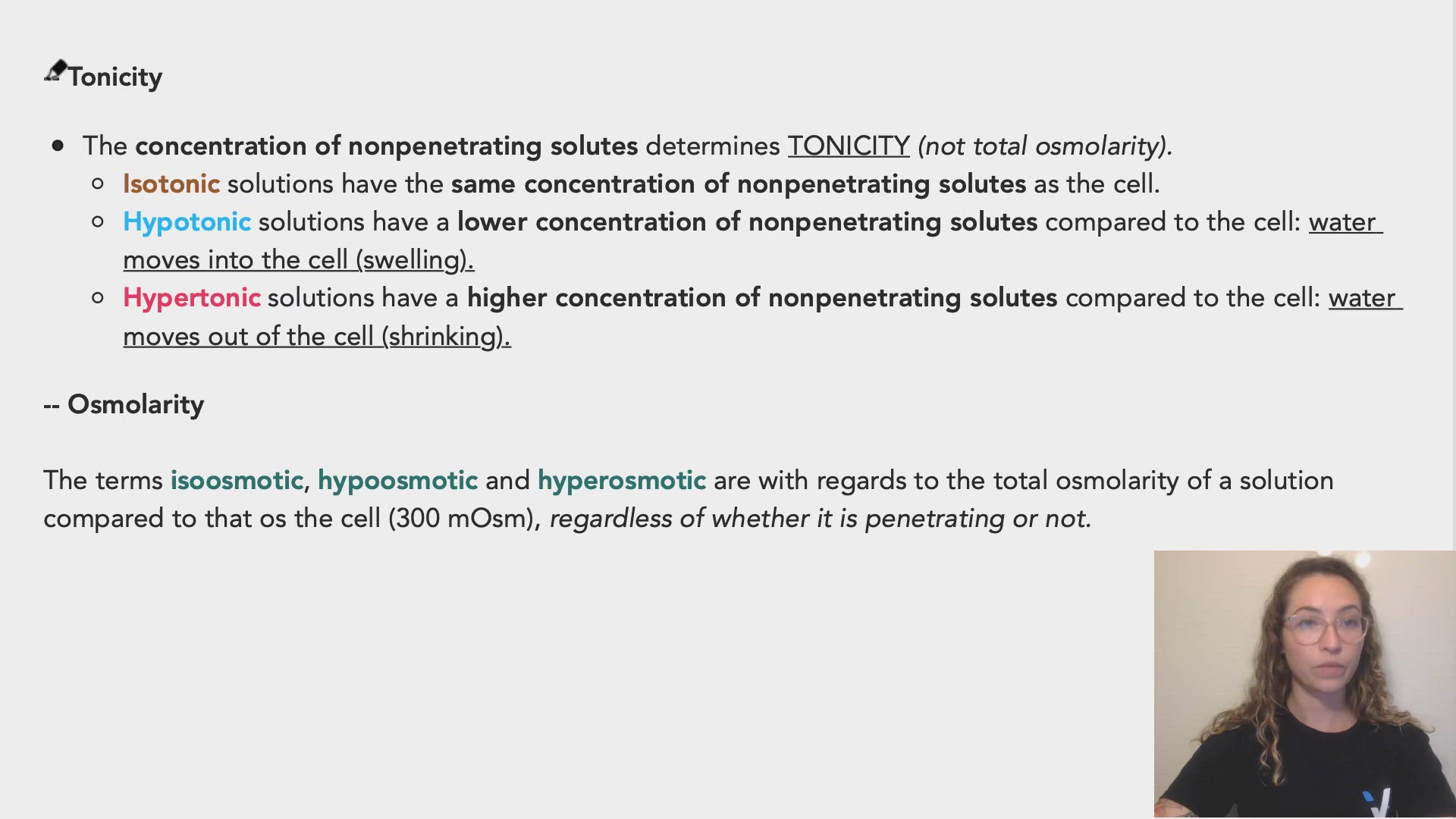
-- Tonicity
- The concentration of nonpenetrating solutes determines TONICITY (not total osmolarity).
- Isotonic solutions have the same concentration of nonpenetrating solutes as the cell.
- Hypotonic solutions have a lower concentration of nonpenetrating solutes compared to the cell: water moves into the cell (swelling).
- Hypertonic solutions have a higher concentration of nonpenetrating solutes compared to the cell: water moves out of the cell (shrinking).
-- Osmolarity
The terms isoosmotic, hypoosmotic and hyperosmotic are with regards to the total osmolarity of a solution compared to that os the cell (300 mOsm), regardless of whether it is penetrating or not.
0:00 / 0:00
If 9 g of NaCl are added to 1 L of water, what is:
A) the weight/volume % and osmolarity of the final solution?
B) If this solution is given intravenously to a patient, what will happen to their cells?
A) 9 g of NaCl solution equates to:
Thus, this is a 0.9% solution.
Given the molecular weight of NaCl = 58.44 g/mol
Since NaCl dissociates into Na+ and Cl- (2 particles), a 0.15 M solution gives an osmolarity of 0.30 Osm solution, or 300 mOsm.
B) If the numbers above seem familiar it is because this solution is normal saline. Since the osmolarity of this solution of nonpenetrating solutes is isotonic to that of blood and cells (~300 mOsm), the volume of the cells will remain the same (no shrinking or swelling).
0:00 / 0:00
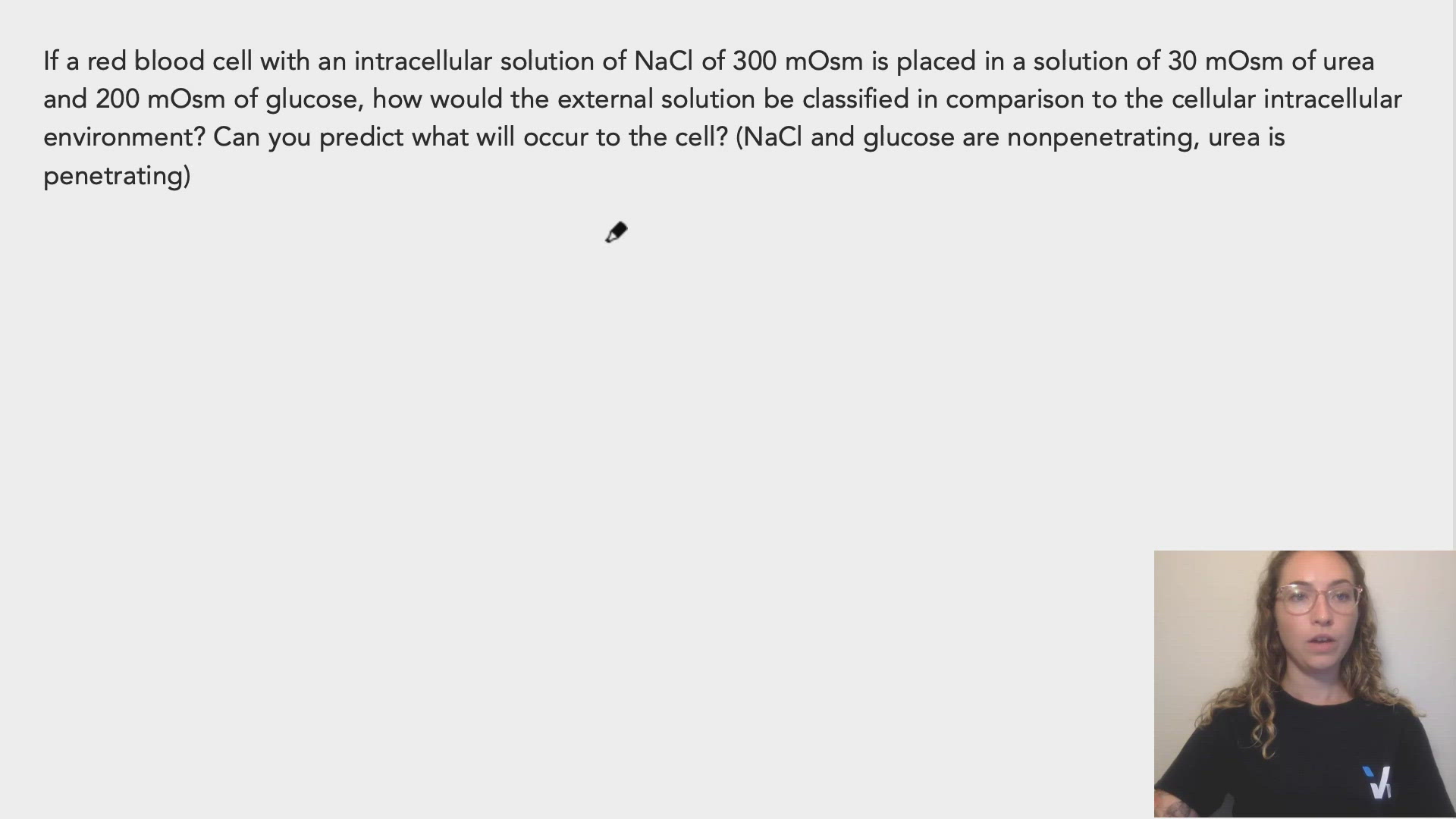
If a red blood cell with an intracellular solution of NaCl of 300 mOsm is placed in a solution of 30 mOsm of urea and 200 mOsm of glucose, how would the external solution be classified in comparison to the cellular intracellular environment? Can you predict what will occur to the cell? (NaCl and glucose are nonpenetrating, urea is penetrating)
Osmolarity: Since the solution inside the cell is composed only of 300 mOsm of NaCl, that is the total cell osmolarity. The osmolarity outside the cell is 30 mOsm (urea) + 200 mOsm (glucose) = 230 mOsm. Therefore, since the extracellular environment has a lower osmolarity than the cell, the solution is hypoosmotic.
Tonicity: The tonicity of the solution is given by the osmolarity of nonpenetrating solutes. In this case, glucose is nonpenetrating and there are 200 mOsm of it. This is less than the intracellular osmolarity, and thus this solution is hypotonic.
Cell behaviour is determined by the tonicity of the extracellular solution. Since the extracellular solution is hypotonic, the cell will swell.
Which of these solutions would exert the greatest osmotic pressure?
When a cell is placed in a solution containing 300 mOsm urea and 200 mOsm NaCl, it is expected to: