Wize University Physiology Textbook > Cellular and Membrane Physiology
Cell-Cell Communication
Popular Courses
MCAT
General Course
Intro to Physiology
University Study Guides
PHYSIOL 1021
Western University
PHYSIOL 2130
Western University
Intro to Physiology
University Study Guides
PSL300H1
University of Toronto
PHYSL 210
University of Alberta
PHGY 210
McGill University
PHGY 215
Queen's University
KNES 259
University of Calgary
PHGY 216
Queen's University
BIOL 273
University of Waterloo
BIOL 260
University of British Columbia
PHYSIOL 3120
Western University
KNES 260
University of Calgary
BIOL 116
Case Western Reserve University
PPT 301
University of North Dakota
ANAT 212
McGill University
HTHSCI 2FF3
McMaster University
KNES 323
University of Calgary
0:00 / 0:00
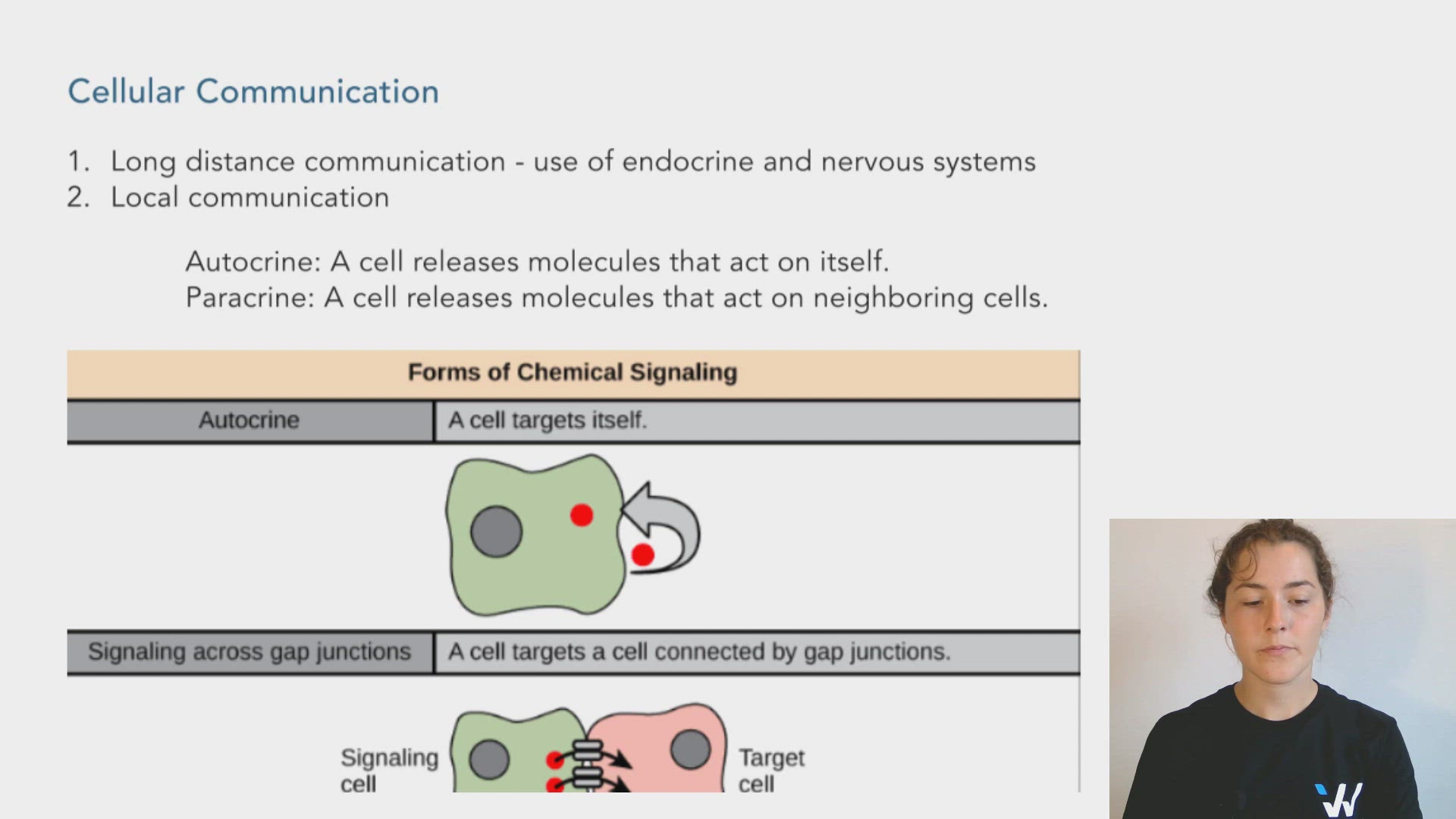
Cellular Communication
- Long distance communication - use of endocrine and nervous systems
- Local communication
Autocrine: A cell releases molecules that act on itself.
Paracrine: A cell releases molecules that act on neighboring cells.

Short Distance Communication (all Paracrine)
Chemical Mediated Cell-Cell Communication: When one cell needs to tell the cells around it something important, it can release a chemical that can be picked up by its neighbors by a receptor.
Contact Dependant Signals: This type of communication requires the cells to be right beside each other. We know that cell membranes have surface receptors and proteins in them. These components can be used to pass signals if the cell needs to communicate with its neighbor. The receptor of one cell binds to the surface protein of another.
Gap Junctions: This type of communication also requires the cells to be right beside each other. The protein channels in the membranes actually form bridges between the two cells. This allows direct transfer of chemical signals from one cell to the other.
Long Distance Communication
Nervous System: Signals sent through nerves from brain to other parts of the body, or vice versa. Very fast communication
Endocrine: Chemical signals (hormones) sent through the blood to act on distant organs. Slower than nervous system communication.