Popular Courses
MCAT
General Course
DAT
General Course
Intro to Physiology
University Study Guides
PHYSIOL 1021
Western University
PHYSIOL 2130
Western University
Intro to Physiology
University Study Guides
PSL300H1
University of Toronto
PHYSL 210
University of Alberta
PHGY 210
McGill University
PHGY 215
Queen's University
BIOLOGY 2601A/B
Western University
KNES 259
University of Calgary
PHGY 216
Queen's University
BIOL 273
University of Waterloo
BIOL 260
University of British Columbia
PHYSIOL 3120
Western University
KNES 260
University of Calgary
BIOL 116
Case Western Reserve University
PPT 301
University of North Dakota
ANAT 212
McGill University
0:00 / 0:00
Functional Anatomy
Functions of the Kidney
- Regulation of ECF volume
- regulation of osmolarity
- maintenance of ion balance
- maintenance of body pH
- excretion of waste products
- Production of hormones
- Gluconeogenesis
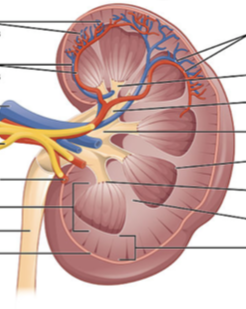
Label the structure with the following terms.
- Renal Artery
- Renal Vein
- Smaller blood vessels
- Cortex
- Medulla
- Nephron
- Minor Calyces
- Major Calyces
- Renal Pelvis
- Ureter
0:00 / 0:00
Water/Ion Balance
- this lesson will cover water and ions and their concentrations in our blood/plasma
- too much water = swelling = hypertension
- not enough water = shriveling = hypotension
- high ion concentrations will draw water to that area by osmosis (more water reabsorbed into our bodies)
- low ion concentrations will have a higher water concentration to begin with, but will need to gain more ions to be within the "normal" range for our body (more ions reabsorbed by our body
Wize Concept
The system of our body that is most important in regulating water and ion levels is the KIDNEY!
The Nephron
- major functional unit of the kidney
- causes re-absorption of water or ions if needed, or secretion if we have too much.
- ANALOGY: the nephron is like a dumpster diver - it picks through the trash to find the treasures!
- major responsibilities include
- Excreting waste
- Regulating concentrations of solutes in the blood
- Regulating blood volume/ water concentration
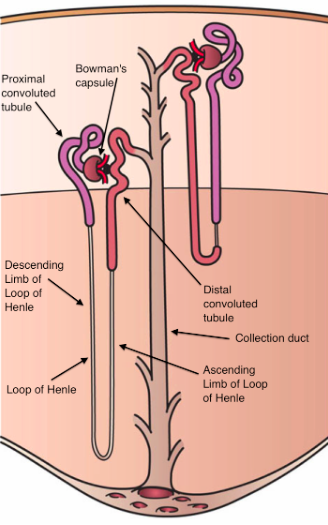
Important parts of the Nephron
- glomerulus corpuscle - capillary bed where blood contents enters the nephron. located inside Bowmans capsule
- proximal convoluted tubule
- loop of Henle
- distal convoluted tubule
- cortical collecting duct
commons.wikimedia.org
Filtration Process
- Filtration - waste products are filtered out of the blood and into the nephron
- Reabsorption - products that the body still needs are reabsorbed back into the blood
- happens in the majority of the nephron. look at the figure below to see what gets reabsorbed and where reabsorption occurs.
- Secretion - whatever is left in the nephron after reabsorption is secreted as waste
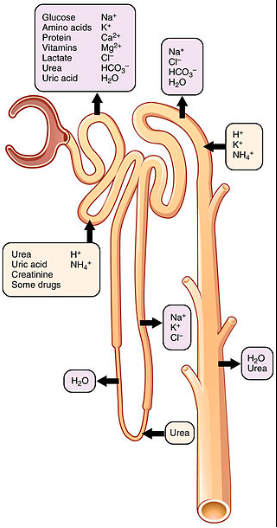
commons.wikimedia.org
0:00 / 0:00
Write down the location in the nephron where each of the following are reabsorbed back into the body and why they would be reabsorbed.
- water (H2O)
- ions (Na+, K+, etc)
H2O taken back through the collecting duct. This happens because our blood pressure is low, or the solute concentration in our blood is too high (it needs to be watered down)
Na+ and K+ are taken back through the ascending loop of Henle. This happens when we have low ion concentrations in our blood.
0:00 / 0:00
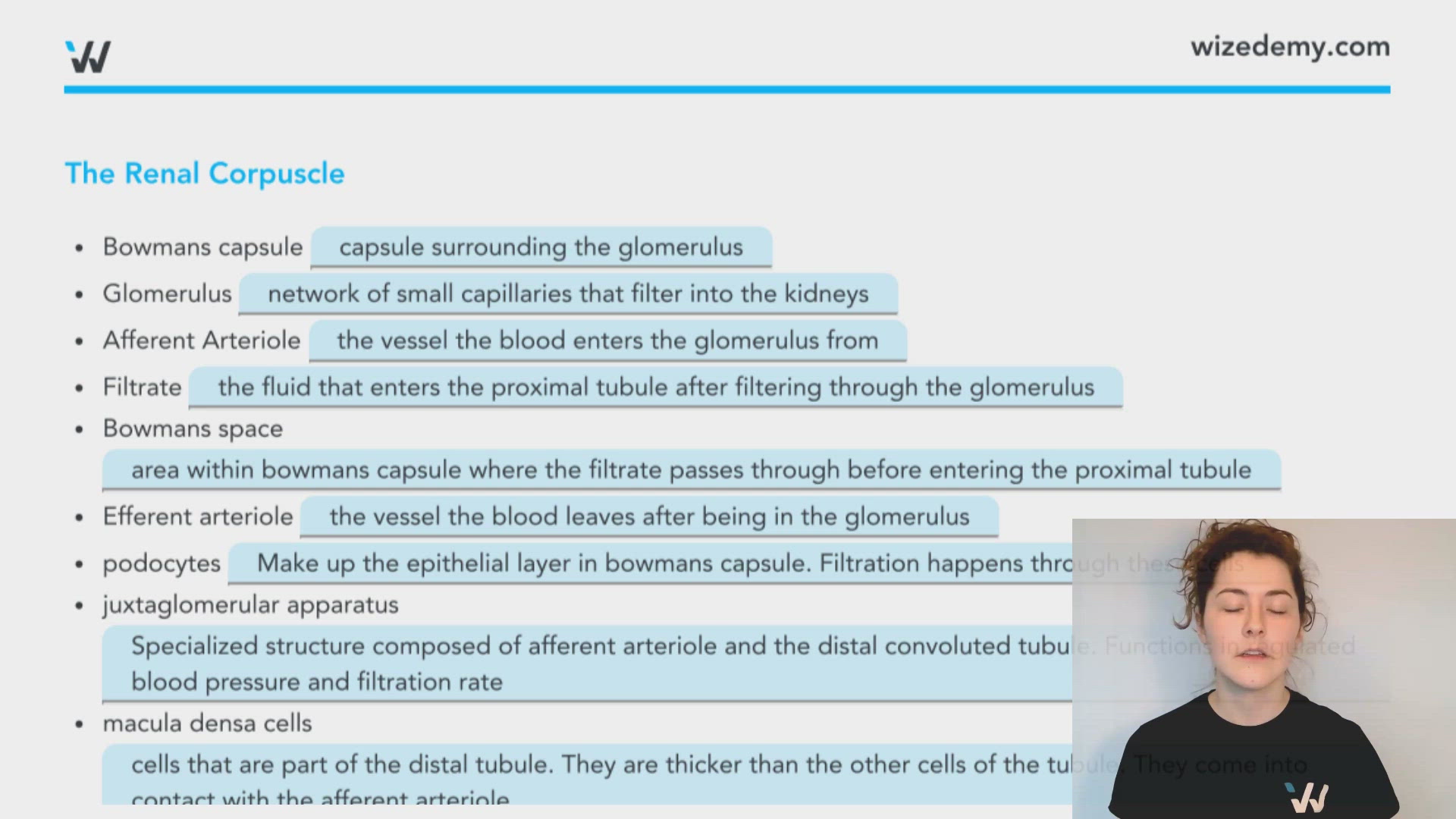
The Renal Corpuscle
- Bowmans capsulecapsule surrounding the glomerulus
- Glomerulusnetwork of small capillaries that filter into the kidneys
- Afferent Arteriolethe vessel the blood enters the glomerulus from
- Filtratethe fluid that enters the proximal tubule after filtering through the glomerulus
- Bowmans spacearea within bowmans capsule where the filtrate passes through before entering the proximal tubule
- Efferent arteriolethe vessel the blood leaves after being in the glomerulus
- podocytesMake up the epithelial layer in bowmans capsule. Filtration happens through these cells
- juxtaglomerular apparatusSpecialized structure composed of afferent arteriole and the distal convoluted tubule. Functions in regulated blood pressure and filtration rate
- macula densa cellscells that are part of the distal tubule. They are thicker than the other cells of the tubule. They come into contact with the afferent arteriole
- Juxtaglomerular (granular) cellsmake and release the enzyme renin

commons.wikimedia.org
Barriers to Filtration
Blood is filtered into the nephron in 3 stages
- Blood passes out of the capillary through the small, negatively charged openings. This keeps many large proteins in the blood.
- Filtrate passes through the basement membrane (also negatively charged)
- Filtrate passes between podocyte cells (cells that wrap around leaky glomerulus and preventing some filtration)
