Popular Courses
MCAT
General Course
DAT
General Course
Intro to Physiology
University Study Guides
PHYSIOL 1021
Western University
PHYSIOL 2130
Western University
Intro to Physiology
University Study Guides
PSL300H1
University of Toronto
PHYSL 210
University of Alberta
PHGY 210
McGill University
PHGY 215
Queen's University
BIOLOGY 2601A/B
Western University
KNES 259
University of Calgary
PHGY 216
Queen's University
BIOL 273
University of Waterloo
BIOL 260
University of British Columbia
PHYSIOL 3120
Western University
KNES 260
University of Calgary
BIOL 116
Case Western Reserve University
PPT 301
University of North Dakota
ANAT 212
McGill University
0:00 / 0:00
Filtration Factors
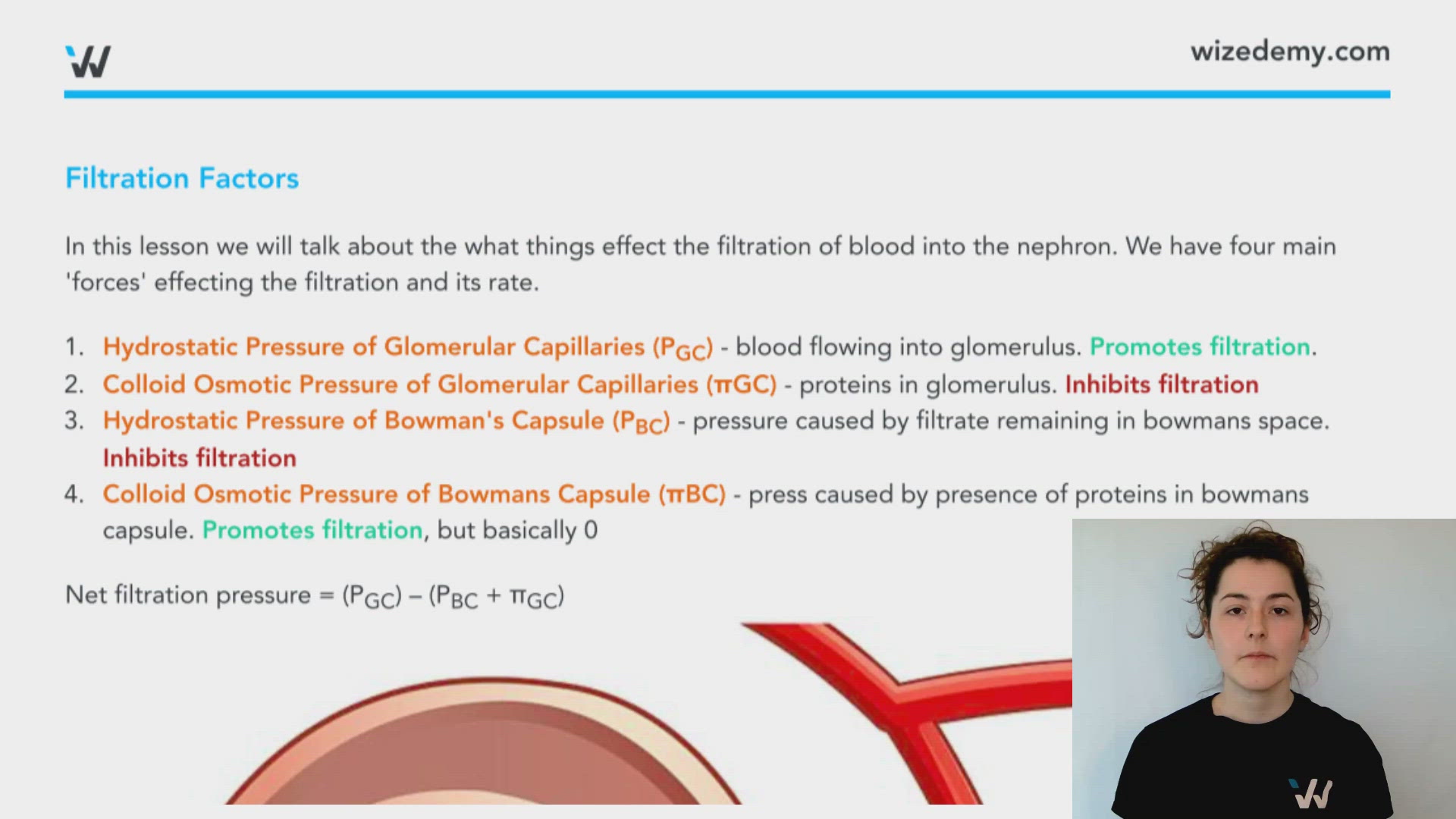
In this lesson we will talk about the what things effect the filtration of blood into the nephron. We have four main 'forces' effecting the filtration and its rate.
- Hydrostatic Pressure of Glomerular Capillaries (PGC) - blood flowing into glomerulus. Promotes filtration.
- Colloid Osmotic Pressure of Glomerular Capillaries (πGC) - proteins in glomerulus. Inhibits filtration
- Hydrostatic Pressure of Bowman's Capsule (PBC) - pressure caused by filtrate remaining in bowmans space. Inhibits filtration
- Colloid Osmotic Pressure of Bowmans Capsule (πBC) - press caused by presence of proteins in bowmans capsule. Promotes filtration, but basically 0
Net filtration pressure = (PGC) – (PBC + πGC)
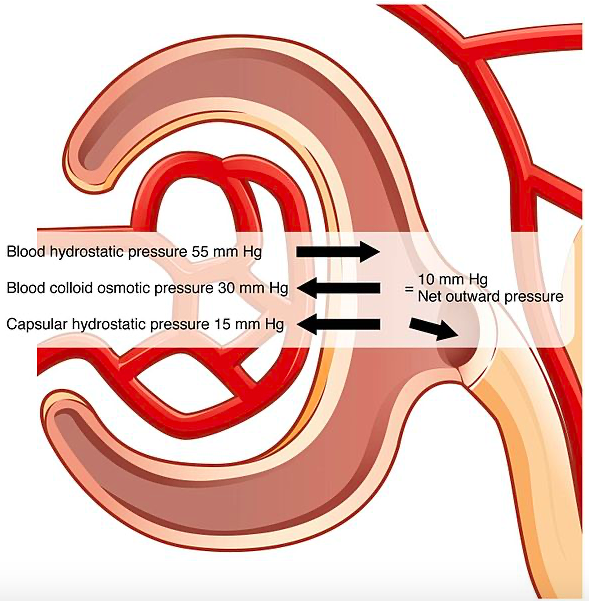
What would happen to the Glomerular filtration if you increased the colloid osmotic pressure in the capillaries?
0:00 / 0:00
Glomerular Filtration Rate
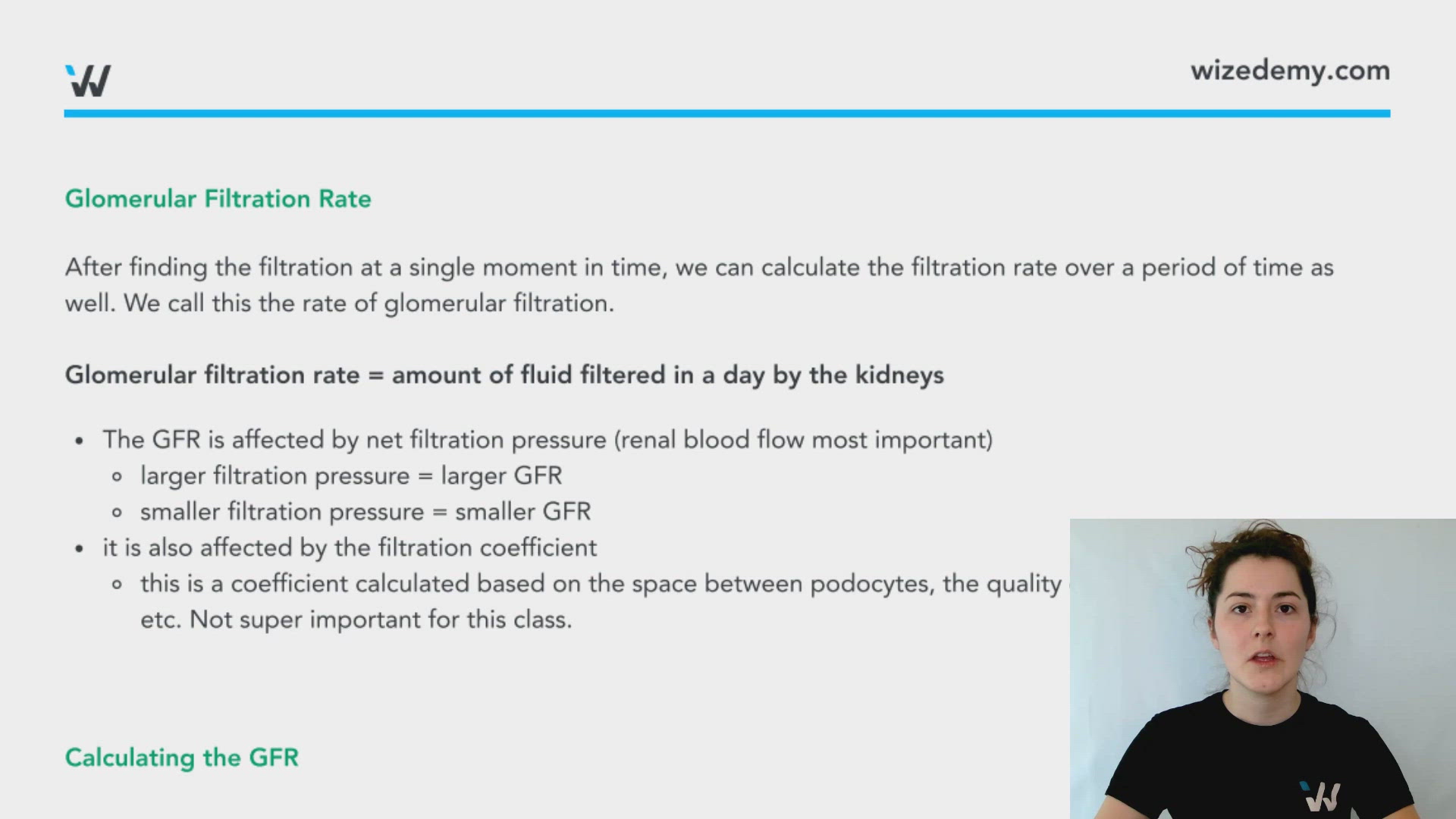
After finding the filtration at a single moment in time, we can calculate the filtration rate over a period of time as well. We call this the rate of glomerular filtration.
Glomerular filtration rate = amount of fluid filtered in a day by the kidneys
- The GFR is affected by net filtration pressure (renal blood flow most important)
- larger filtration pressure = larger GFR
- smaller filtration pressure = smaller GFR
- it is also affected by the filtration coefficient
- this is a coefficient calculated based on the space between podocytes, the quality of the basement membrane, etc. Not super important for this class.
Calculating the GFR
- If we choose a single substance in the blood to measure , we can measure how much of it is filtered from the blood into the kidney in a given time.
- This calculation only works of the substance is NOT reabsorbed by the kidney. Usually when we do this test on an individual, we administer a radioactive substance that can be tracked and will not be reabsorbed by the kidneys (ex. chromium-51)
- To calculate GFR we need to know:
- the concentration of _________ in the blood before filtration
- the concentration of the _________ in the urine after excretion
- the total volume of the urine
How can we change the GFR?
GFR is regulated by itself. We say that it is autregulated. It auto regulates itself using two functions:
- Myogenic Response
- Tubuloglomerular Feedback
Myogenic Response
- afferent arteriole stretches
- stretch sensitive ion channels open
- smooth muscle cells depolarize
- voltage-gated calcium channels in smooth muscle open
- smooth muscle of the afferent arteriole contracts (constricts afferent arteriole)
- blood flow decreases in the glomerulus
Tubuloglomerular Feedback
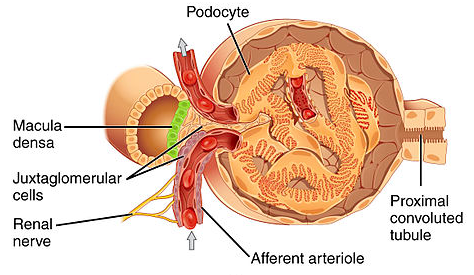
The regulation of GFR with association to the salt concentrations in the macula densa cells.
High salt concentrations (high reabsorption through the macula densa cells) leads to construction of the afferent blood vessel
- Low salt reabsorption = dilation of vessel = increased blood flow = increased filtration rate
- High salt reabsorption = constriction of vessel = decreased flow = decreased filtration rate
Filtered Load
How much substance filters into Bowmans space over a period of time
EXAMPLE: If 50mg/mL of glucose is found in the blood and the glomerulus filters 10mL/min, the the filtration load of glucose will be....
- This does not tell us how much will be excreted. It only tells us how much enters the nephron.
- If we measure how much of the substance is excreted, we can determine how much was reabsorbed.
0:00 / 0:00
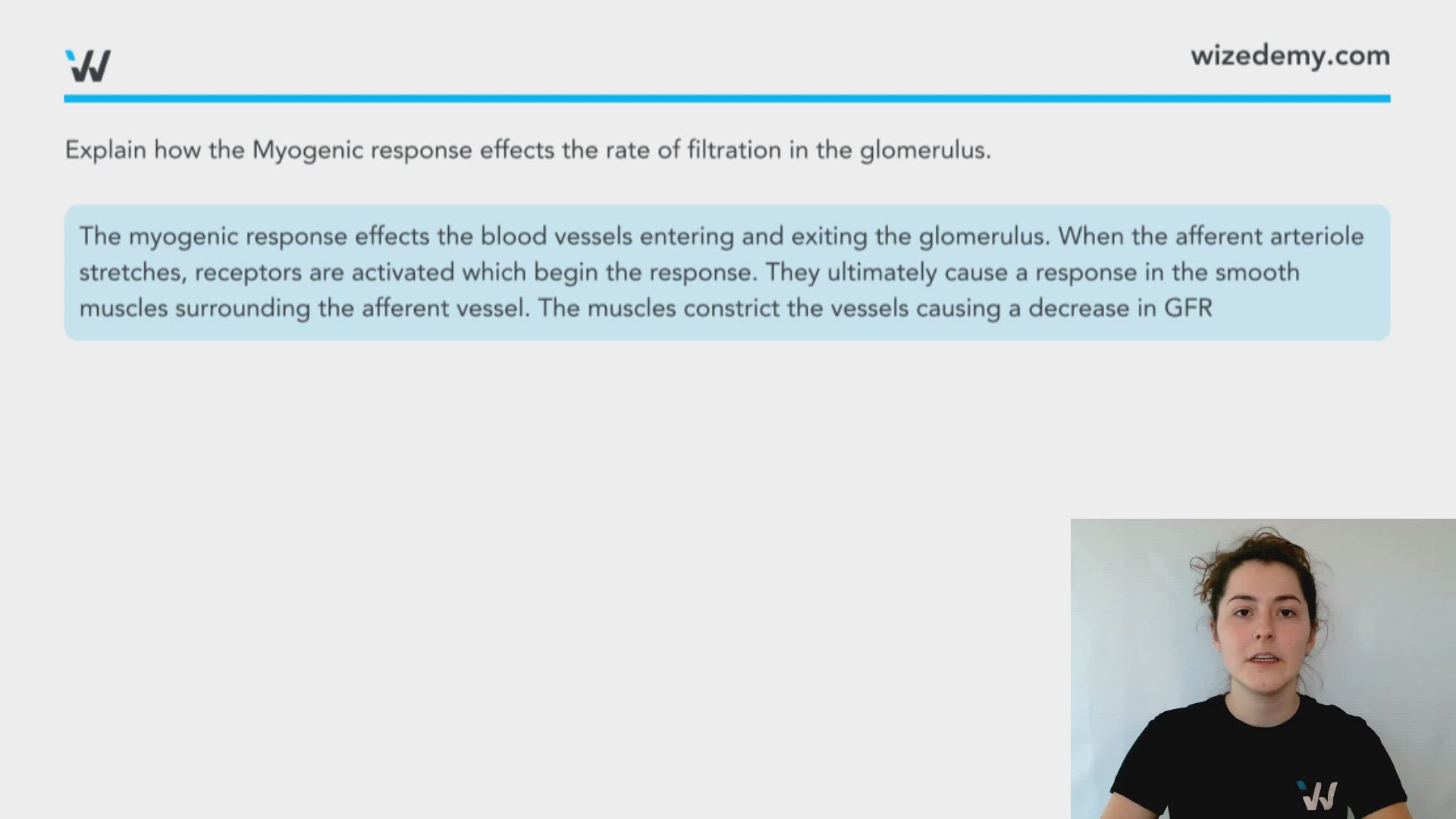
Explain how the Myogenic response effects the rate of filtration in the glomerulus.
The myogenic response effects the blood vessels entering and exiting the glomerulus. When the afferent arteriole stretches, receptors are activated which begin the response. They ultimately cause a response in the smooth muscles surrounding the afferent vessel. The muscles constrict the vessels causing a decrease in GFR
Important vocabulary for this section
- Secretion
- Excretion
- absorption
- reabsportion
- glomerular corpuscle
- plasma concentration
- renal concentation
- GFR
- Afferent arteriole
- Efferent arteriole
Please come up with definitions (written or in your head) and add to the list. The more vocabulary you know, the easier it is to understand the material!