Wize University Physiology Textbook > Renal Physiology
Reabsorption and Secretion
Popular Courses
MCAT
General Course
DAT
General Course
Intro to Physiology
University Study Guides
PHYSIOL 1021
Western University
PHYSIOL 2130
Western University
Intro to Physiology
University Study Guides
PSL300H1
University of Toronto
PHYSL 210
University of Alberta
PHGY 210
McGill University
PHGY 215
Queen's University
BIOLOGY 2601A/B
Western University
KNES 259
University of Calgary
PHGY 216
Queen's University
BIOL 273
University of Waterloo
BIOL 260
University of British Columbia
PHYSIOL 3120
Western University
KNES 260
University of Calgary
BIOL 116
Case Western Reserve University
PPT 301
University of North Dakota
ANAT 212
McGill University

0:00 / 0:00
Secretion and Reabsorption
Once in the nephron, the filtrate will be refined by adding and removing things from it. In order to do this, we need to be able to move things between the lumen of the nephron and the blood vessels outside of the nephron. In other words, molecules must be able to move through the tubule cells. We have two main forms of movement:
- Transcellular movement
- Secretion - moving into the lumen through 2 transporters (one into and one out of the cell)
- Reabsorption - moving out of the lumen through 2 transporters (one into and one out of the cell)
- Paracelular movement - between cells
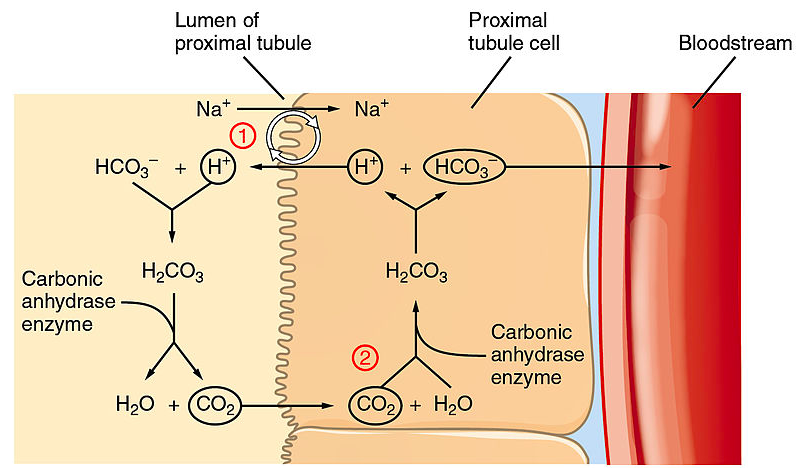
Transcellular movement is done using channels and transporters to move specific substances across the tubule cells and into/out of the lumen of the nephron. Some of 'gateways' include:
- Sodium Channels
- Aquaporin
- Glucose uniporters
- Sodium/glucose symporters
- Sodium/hydorgen antiporters
- Sodium/potassium ATPase pumps
We can change the amount of a substance being secreted or reabsorbed by either adding/removing/inhibiting or activating these channels from the tubule cells.
- We can promote/inhibit production of the channels by altering gene expression
- We can move the cannel into or out of the membrane to increase or decrease secretion/reabsorption
- We can activate/inhibit the channels using other substances.
EXAMPLE: What transporter/channel might be saturated in an individual with diabetes?
- very high glucose levels in blood = high filtration rate into the nephron
- Glucose uniporters and sodium/glucose symporters will be hard at work and will likely become saturated
- RESULT: not all glucose can be reabsorbed before excretion = urine contains glucose
0:00 / 0:00
What transporters or channels are present in the collecting duct of the nephron?
Na+ ion channels
K+ ion channels
ATPase
aquaporins

Mark Yourself Question
- Grab a piece of paper and try this problem yourself.
- When you're done, check the "I have answered this question" box below.
- View the solution and report whether you got it right or wrong.
Which part of the nephron would be most greatly effected under the following conditions? What would the effect be?
i) removal of all symporters
ii) increased water filtration
iii) increased production of Na+ channel inhibition factor