Popular Courses
MCAT
General Course
DAT
General Course
Intro to Physiology
University Study Guides
PHYSIOL 1021
Western University
PHYSIOL 2130
Western University
Intro to Physiology
University Study Guides
PSL300H1
University of Toronto
PHYSL 210
University of Alberta
PHGY 210
McGill University
PHGY 215
Queen's University
BIOLOGY 2601A/B
Western University
KNES 259
University of Calgary
PHGY 216
Queen's University
BIOL 273
University of Waterloo
BIOL 260
University of British Columbia
PHYSIOL 3120
Western University
KNES 260
University of Calgary
BIOL 116
Case Western Reserve University
PPT 301
University of North Dakota
ANAT 212
McGill University

0:00 / 0:00
Water/Ion Balance
- this lesson will cover water and ions and their concentrations in our blood/plasma
- too much water = swelling = hypertension
- not enough water = shriveling = hypotension
- high ion concentrations will draw water to that area by osmosis (more water reabsorbed into our bodies)
- low ion concentrations will have a higher water concentration to begin with, but will need to gain more ions to be within the "normal" range for our body (more ions reabsorbed by our body
Wize Concept
The organ system of our body that is most important in regulating water and ion levels is the KIDNEY!
Two Main Hormones
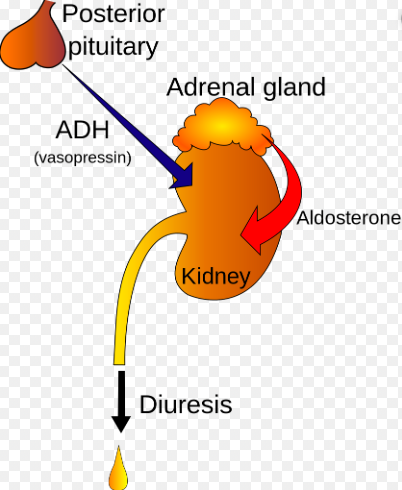
- Vasopressin (ADH) - increases water in the blood
- Aldosterone - increases ions in the blood
Vasopressin (ADH)
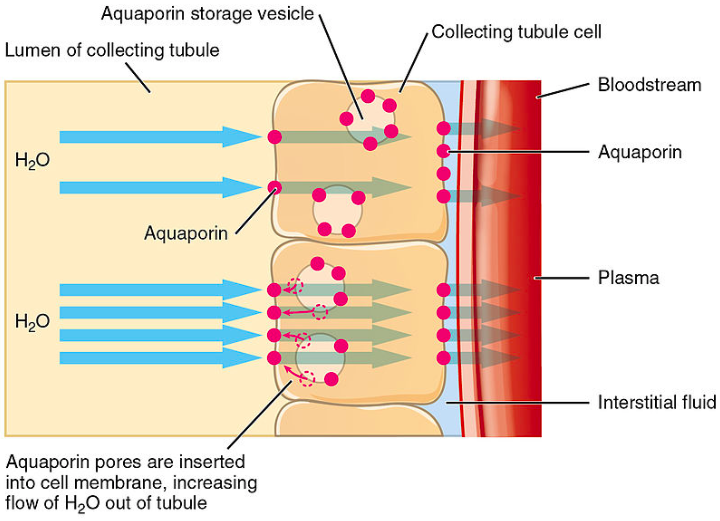
- important for water reabsorption
- secreted from posterior pituitary, made by hypothalamus
- stimulated by receptors found in the walls of arteries that can tell when the walls are stretched or not.
- ADH released when there is not enough water in the blood ––> no stretch detected in artery walls
- binds to receptors on collecting tubule cells and causes aquaporin to be put into the membrane
- dysfunction results in diabetes
commons.wikimedia.org
Aldosterone
- important for ion reabsorption (Na+ and K+)
- secreted from the adrenal gland
- regulated by negative feedback
- also partly regulated by renin - a hormone made at the beginning of the nephron
Steps of ion Reabsorption using Aldosterone
- aldosterone binds to a receptor on a cell in the ascending loop of Henle
- receptor sends a signal to make more Na+ and K+ channels
- channels are made and put into the cells so more Na+ and K+ can return to the blood
Big Picture Summary
The posterior pituitary and the adrenal gland will release their respective hormones to act on the kidney. Under the influence of these hormones, the kidney will allow reabsorption of water and ions back into the blood stream. When ADH and Aldosterone are active, urine volume DECREASES and blood volume INCREASES. When these hormones are not present, the opposite occurs.
- ex. when you drink alcohol, the alcohol actually inhibits the function of ADH -–> less water is reabsorbed back into the body = more water in urine ––> thats why you have to pee all the time!
ar.wikipedia.org
0:00 / 0:00
Rein-Angiotensin-Aldosterone System (RAAS)
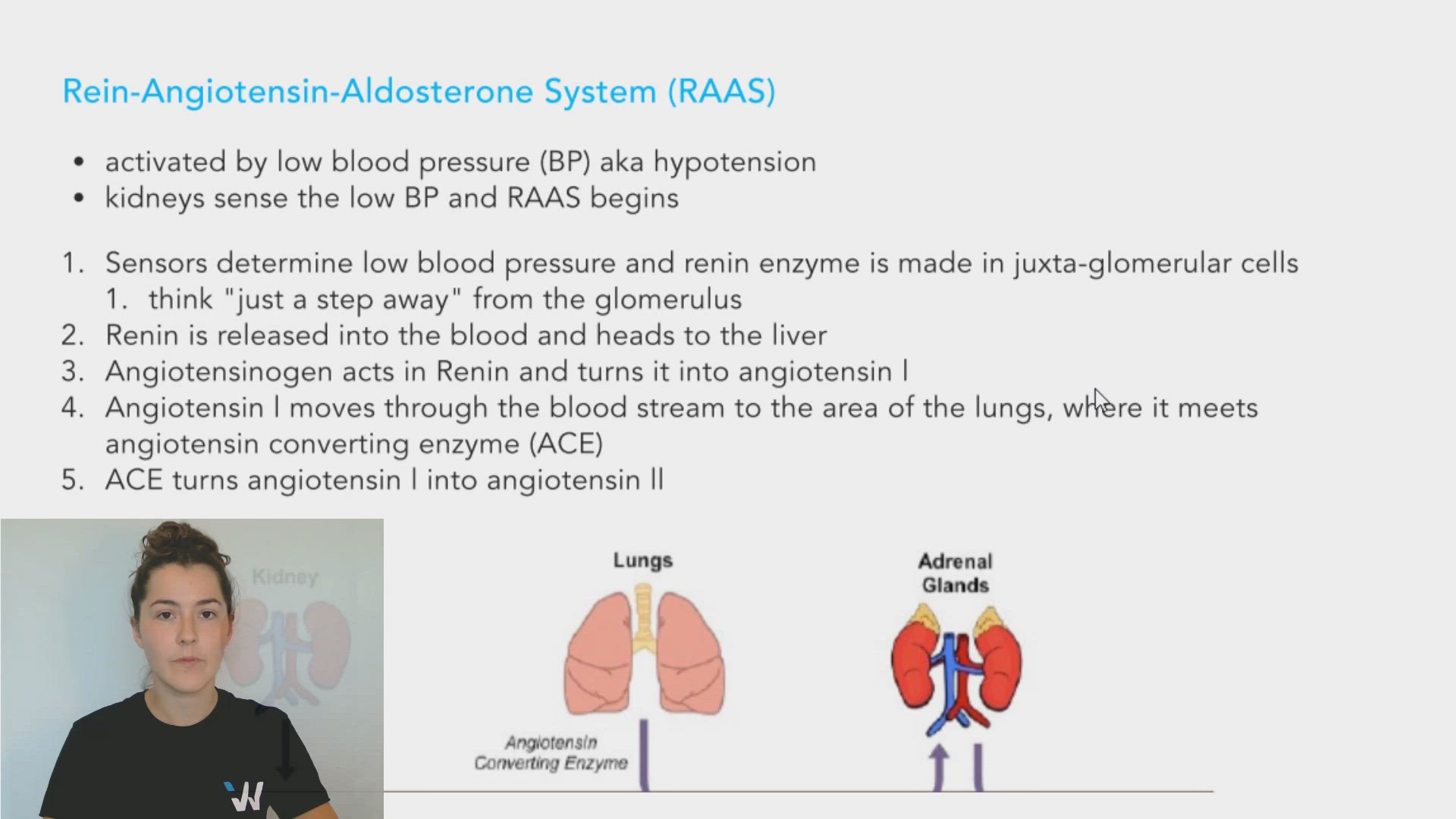
- activated by low blood pressure (BP) aka hypotension
- kidneys sense the low BP and RAAS begins
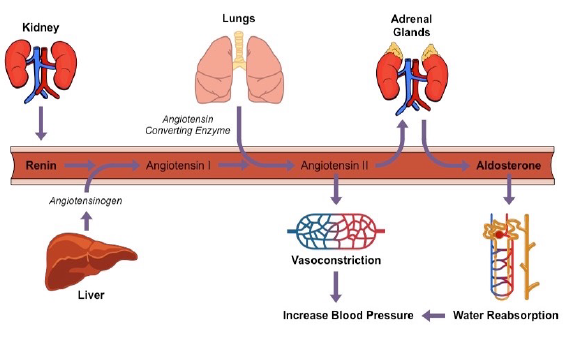
- Sensors determine low blood pressure and renin enzyme is made in juxta-glomerular cells
- think "just a step away" from the glomerulus
- Renin is released into the blood and heads to the liver
- Angiotensinogen acts in Renin and turns it into angiotensin l
- Angiotensin l moves through the blood stream to the area of the lungs, where it meets angiotensin converting enzyme (ACE)
- ACE turns angiotensin l into angiotensin ll
commons.wikimedia.org
ANGIOTENSIN ll HAS WIDE SPREAD EFFECTS ON THE BODY, INCLUDING:
- ion reabsorption in the kidneys (nephron)
- activation of the sympathetic nervous system
- making aldosterone
- vasoconstriction ––> causing increased blood pressure
- stimulates secretion of ADH ––> decreases urine output


Mark Yourself Question
- Grab a piece of paper and try this problem yourself.
- When you're done, check the "I have answered this question" box below.
- View the solution and report whether you got it right or wrong.
What would be an effect if Angiotensin Converting Enzyme (ACE) stopped being produced?
- Less sodium would be reabsorbed into the blood stream
- Angiotensin II levels would increase
- Blood pressure would increase
- more ADH would be produced
Extra Activity...
Make a summary chart for the hormones associated with the kidney. Be sure to include...
- Where is the hormone made?
- Where is the hormone secreted from?
- Stimulators?
- Inhibitors?
- Action?