Wize University Physiology Textbook > Reproductive Physiology
Male Reproduction
Popular Courses
MCAT
General Course
DAT
General Course
Intro to Physiology
University Study Guides
PHYSIOL 1021
Western University
PHYSIOL 2130
Western University
Intro to Physiology
University Study Guides
PSL300H1
University of Toronto
PHYSL 210
University of Alberta
PHGY 210
McGill University
PHGY 215
Queen's University
KNES 259
University of Calgary
PHGY 216
Queen's University
BIOL 273
University of Waterloo
BIOL 260
University of British Columbia
PHYSIOL 3120
Western University
KNES 260
University of Calgary
BIOL 116
Case Western Reserve University
PPT 301
University of North Dakota
ANAT 212
McGill University
HTHSCI 2FF3
McMaster University
0:00 / 0:00
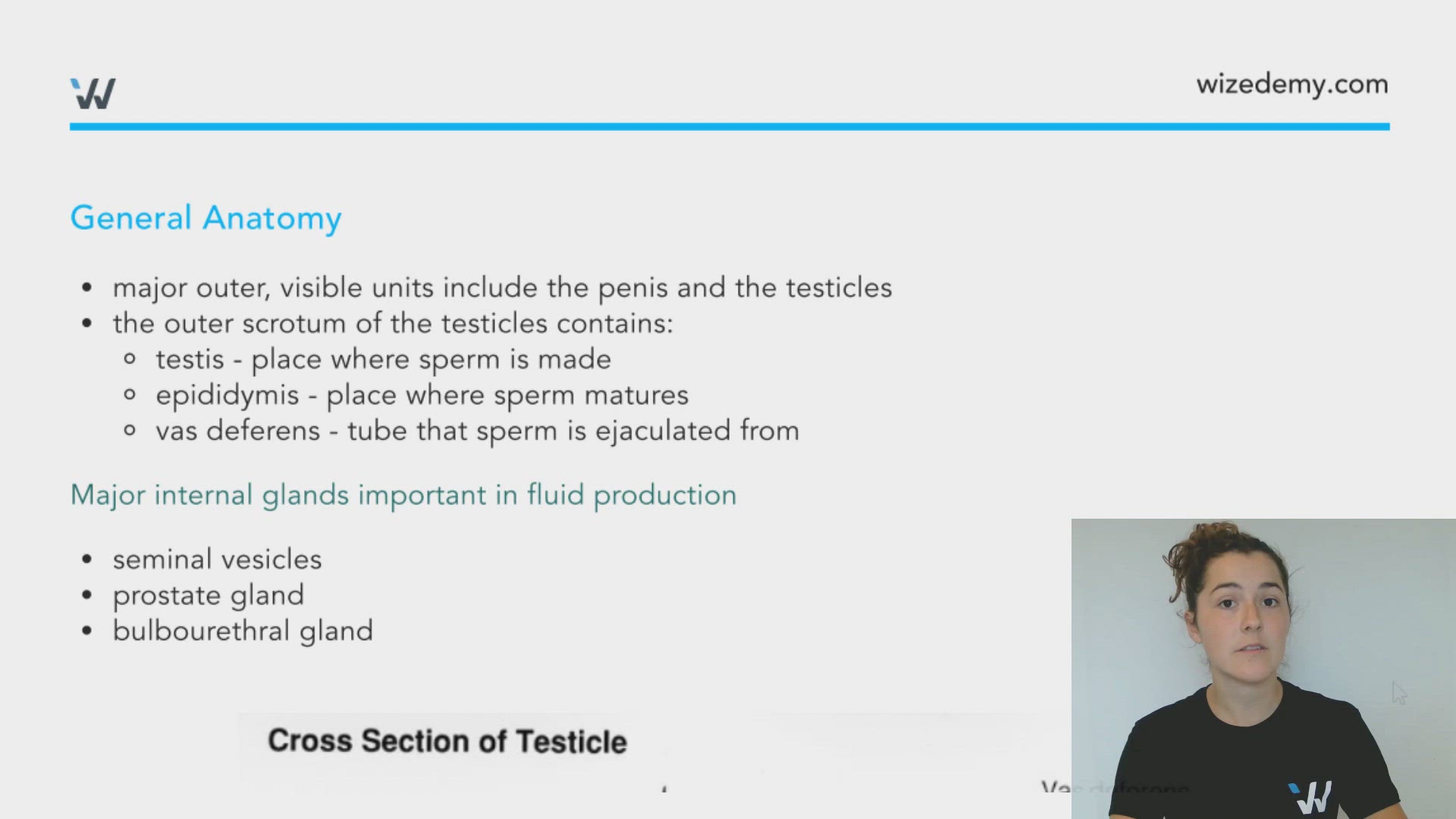
General Anatomy
- major outer, visible units include the penis and the testicles
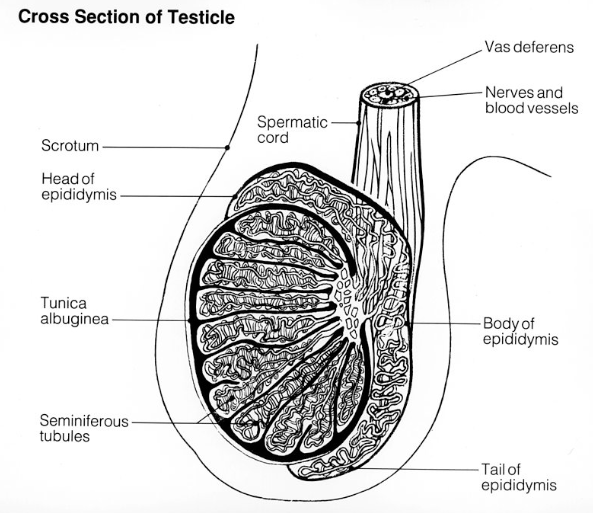
- the outer scrotum of the testicles contains:
- testis - place where sperm is made
- epididymis - place where sperm matures
- vas deferens - tube that sperm is ejaculated from
Major internal glands important in fluid production
- seminal vesicles
- prostate gland
- bulbourethral gland
commons.wikimedia.org
Spermatogenesis
- The production of sperm
- main production happens in the testes (specifically the seminiferous tubules)
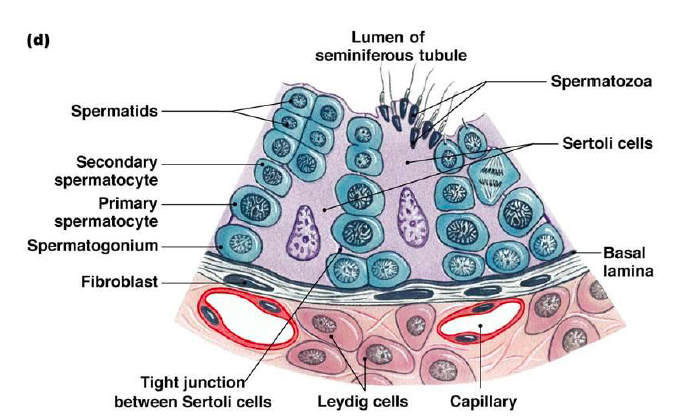
- Looking at a cross-section view of the seminiferous tubules, we can see different cell types involved in sperm production
Leydig cells
- make testosterone
- Stimulated by LH
Sertoli cells
- support the regulation of sperm production
- ANALOGY: the cheerleaders or the emotional support workers ... "you got this, spermatocytes!"
- I suppose this would make the Leydig cells the practical, "all business" cells - "hey body, let me give you something materialistic and useful. Here's some testosterone."
- back to the sertoli cells... they create the blood-testes barrier
- uses tight junctions between two sertoli cells to make this barrier
- its role is to seperate later stages of sperm production from contact with the blood
- Stimulated by FSH
Steps of Spermatogenesis
- Spermatogonia cells divide by mitosis (just like all other cells of the body). One cell from each division will go on to become a sperm, the other will remain as spermatogonia so it can continue the production of more spermatogonia.
- Primary spermatocyte goes through first meiosis and becomes a secondary spermatocyte
- Secondary spermatocyte goes through second meiosis and becomes a spermatid
- Spermatid becomes spermatozoa
Spermatozoa
- the typical circular cell structure we are used to seeing is now gone.
- the spermatozoa is agile and highly motile
- it has a shield on its head full of enzymes that will be released when the sperm reaches the egg.
- The entire structure is light weight and based more on speed and ability than it is on longevity
- ANALOGY: Sperm are like race cars, not a suburban... yes I just compared sperm to a race car.
0:00 / 0:00
Hormonal Regulation
Hypothalamus and Anterior Pituitary
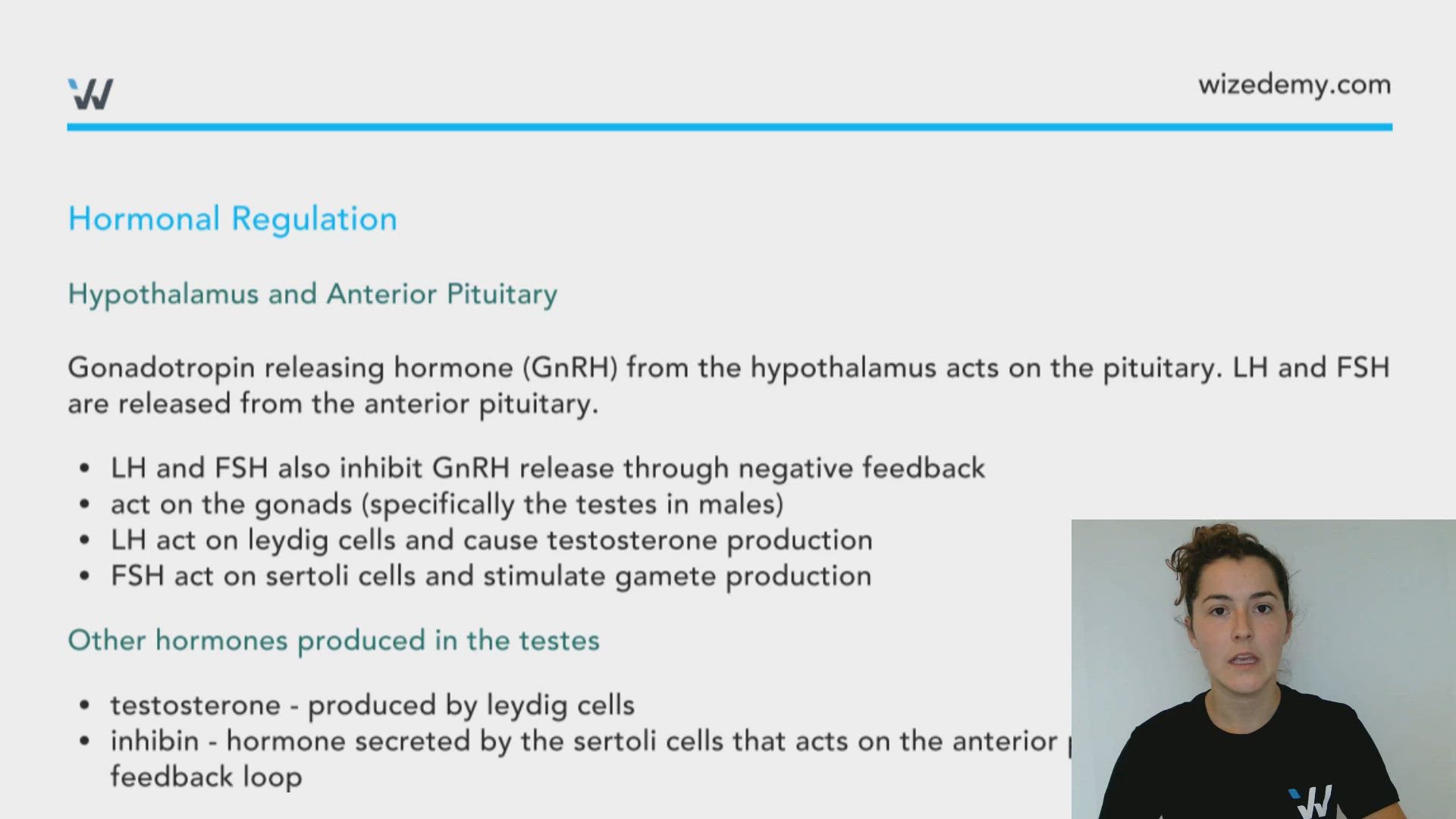
Gonadotropin releasing hormone (GnRH) from the hypothalamus acts on the pituitary. LH and FSH are released from the anterior pituitary.
- LH and FSH also inhibit GnRH release through negative feedback
- act on the gonads (specifically the testes in males)
- LH act on leydig cells and cause testosterone production
- FSH act on sertoli cells and stimulate gamete production
Other hormones produced in the testes
- testosterone - produced by leydig cells
- inhibin - hormone secreted by the sertoli cells that acts on the anterior pituitary in a negative feedback loop

commons.wikimedia.org
Mike is suffering from a chronic disease related to a hormone produced in the pituitary gland. One of his symptoms is that he is infertile. After doing blood work, it's noted that his testosterone levels are normal. What would be a good treatment plan for Mike?