Popular Courses
MCAT
General Course
DAT
General Course
Intro to Physiology
University Study Guides
PHYSIOL 1021
Western University
PHYSIOL 2130
Western University
Intro to Physiology
University Study Guides
PSL300H1
University of Toronto
PHYSL 210
University of Alberta
PHGY 210
McGill University
PHGY 215
Queen's University
KNES 259
University of Calgary
PHGY 216
Queen's University
BIOL 273
University of Waterloo
BIOL 260
University of British Columbia
PHYSIOL 3120
Western University
KNES 260
University of Calgary
BIOL 116
Case Western Reserve University
PPT 301
University of North Dakota
ANAT 212
McGill University
HTHSCI 2FF3
McMaster University
0:00 / 0:00
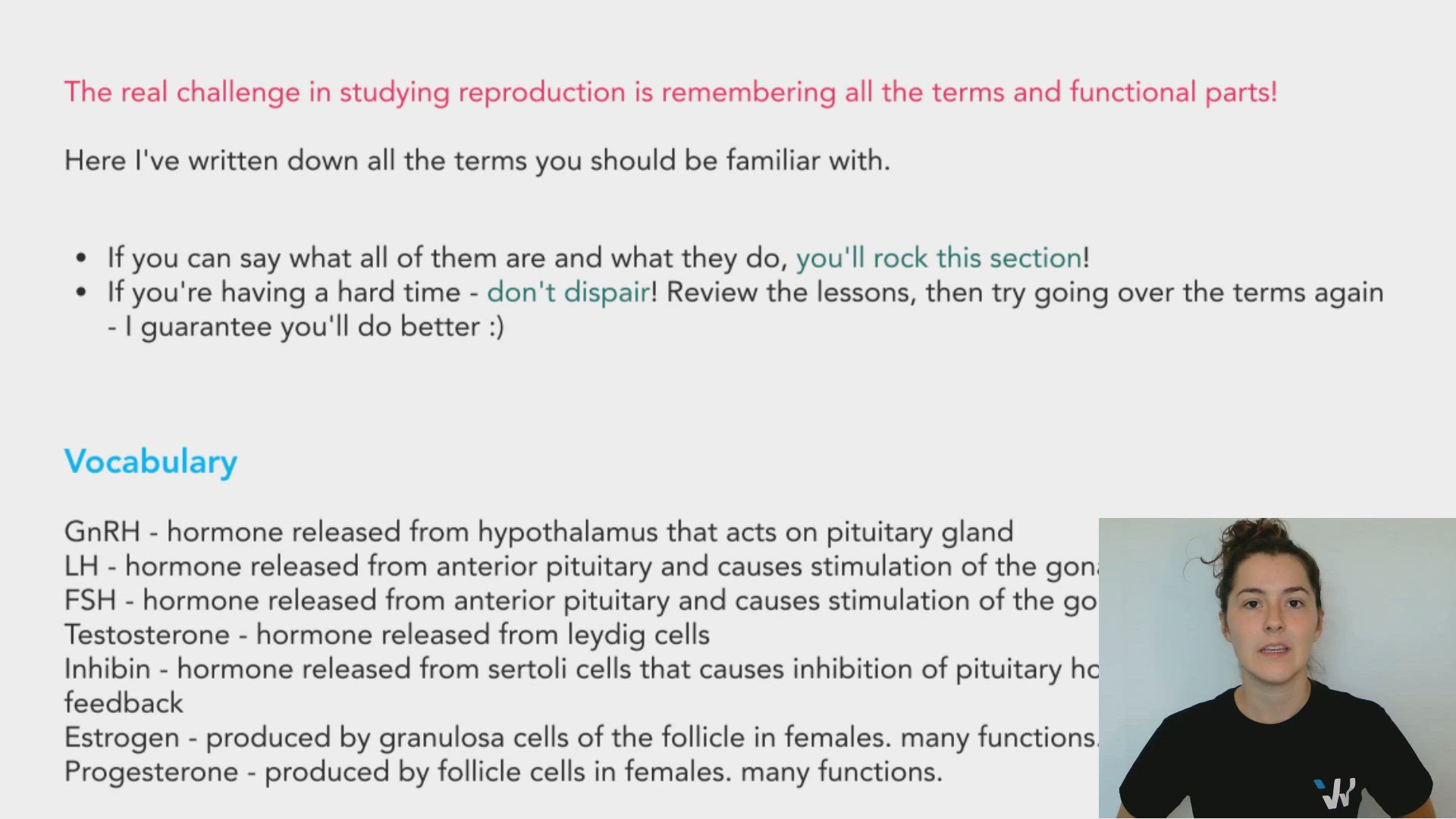
The real challenge in studying reproduction is remembering all the terms and functional parts!
Here I've written down all the terms you should be familiar with.
- If you can say what all of them are and what they do, you'll rock this section!
- If you're having a hard time - don't dispair! Review the lessons, then try going over the terms again - I guarantee you'll do better :)
Vocabulary
GnRH - hormone released from hypothalamus that acts on pituitary gland
LH - hormone released from anterior pituitary and causes stimulation of the gonads
FSH - hormone released from anterior pituitary and causes stimulation of the gonads
Testosterone - hormone released from leydig cells
Inhibin - hormone released from sertoli cells that causes inhibition of pituitary hormones by negative feedback
Estrogen - produced by granulosa cells of the follicle in females. many functions.
Progesterone - produced by follicle cells in females. many functions.
human placental lactogen - hormone secreted by the placenta causing low glucose uptake into cells by the mother.
DHT - hormone that causes external male genitalia to form
Testes - where sperm are made
Seminiferous Tubules - exact location in the testes where sperm are made
Epididymis - location sperm mature after being in the seminiferous tubules
Spermatogenesis - form of meiosis that makes sperm. 4 viable sperm per spermatogonia
Leydig Cells - responsible for making testosterone in males
Sertoli Cells - responsible for supporting and regulating spermatogenesis
Blood-testes barrier - made by sertoli cells to separate spermatogenesis from the blood stream
Spermatogonia - cells that divide by mitosis. Some will go on to undergo spermatogenesis and become sperm
Speratocyte - cell that is going through meiosis to become sperm
Spermatid - cell with 23 chromosomes. still a round, typical cell shape.
Spermatozoa - matured sperm
Meiosis - development of either sperm or egg cells that have 23 chromosomes instead of 46
Ovaries - location where ovum are made in females
Uterus - location where the future baby implants and develops
Oogenesis - form of meiosis that makes an ovum. 1 viable ovum per oogonia
Oogonia - cells that divide by mitosis. Some will go on to undergo oogenesis and become an ovum
Oocyte - cell that is going through meiosis to become an ovum
Ovum/egg - cell with 23 chromosomes that can be fertilized and become a fetus
Polar body - underdeveloped ovum made by oogenesis
Ovarian cycle - part of the menstrual cycle that produces an ovum and secretes hormones
Uterine cycle - part of the menstrual cycle that causes changes in the uterine lining
Menstrual cycle - changes in the female reproductive organs due to oogenesis
Follicular phase - the first 14 days of the menstrual cycle. the ovum is developed through oogenesis
Luteal phase - the last 14 days of the menstrual cycle. The corpus luteum secretes hormones that cause changes in the uterus
Menses phase - first 5 days of the uterine cycle. shedding of the uterine lining
Proliferation phase - after menses, the uterine lining grows thicker again
Follicle - surrounds the developing ovum in the ovary and helps support its growth
Granulosa cells - part of the follicle that produces hormones
Ovulation - when the ovum breaks free from the follicle
Corpus luteum - the follicle after the egg breaks free. mainly used to make progesterone
zygote - ovum + spermatozoa
trophoblast - outer cells of a blastocyst
inner cell mass - mass wishing the blastocyst
blastocyst - a ball of rapidly dividing cells at the beginning of pregnancy
syncitiotrophoblast - trophoblasts that fuse together to make multinucleated trophoblasts. They become the placenta.
placenta - layer surrounding growing fetus that provides nutrients and a connection to the mother.
endometrium - the part of the uterine lining closest to the inside of the uterus. This is where the blastocyst will implant
bipotential premordium - unisexual parts of a baby that are developed at 6 weeks
SOX9 - its presence produces male sex characteristics. Without SOX 9, no male reproductive organs.