Popular Courses
MCAT
General Course
Intro to Physiology
University Study Guides
PHYSIOL 1021
Western University
PHYSIOL 2130
Western University
Intro to Physiology
University Study Guides
PSL300H1
University of Toronto
PHYSL 210
University of Alberta
PHGY 210
McGill University
PHGY 215
Queen's University
KNES 259
University of Calgary
PHGY 216
Queen's University
BIOL 273
University of Waterloo
BIOL 260
University of British Columbia
PHYSIOL 3120
Western University
KNES 260
University of Calgary
BIOL 116
Case Western Reserve University
PPT 301
University of North Dakota
ANAT 212
McGill University
HTHSCI 2FF3
McMaster University
KNES 323
University of Calgary

0:00 / 0:00
Introduction to Body Water
The most abundant constituent of the body is water. The total amount of fluid or water is called total body water, which accounts for 45 to 75% of body weight. This value is maintained constant in healthy individuals and it can be said that our water volume is in a dynamic steady state.

In general, total body water correlates inversely with body fat: total body water is a lower percentage of body weight when fat high, and higher when fat is low.

*Fun fact* Body fat % measurement at gym: how easily the electrical signal travels through the body depends on water content of tissue. Dehydrated = apparent higher body fat %.
- Other sources of variation:
- Age: body water % decreases as individuals grow older.
- Gender: females have less body water because they have higher body fat % (exception is infants)
- Weight
- Ethnicity
- Important Formulas:
Water Balance
In health, we are generally in water balance, but, there are several situations which may cause us to be in negative water balance:
- Lost in the desert -> reduced intake of water
- Running a marathon -> excessive sweating
- Went hiking Cusco, Peru -> too much loss in expiration
- Ate bad shellfish -> excessive loss from gut
There's also such a thing as water intoxication from drinking excessive water (radio show contestant) or renal failure.
We gain water through ingested foods, liquids and oxidation of nutrients.
We lose water through obligatory and facultative losses.
- Obligatory losses: occur independent of intake and are necessary for maintaining health.
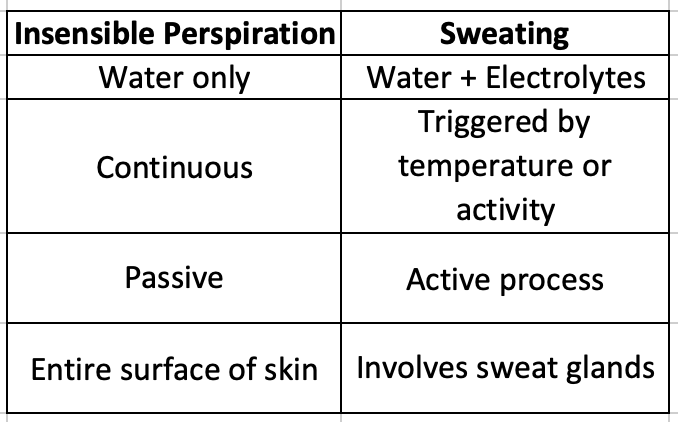
- Insensible losses include evaporation from skin and lining of respiratory tract.
- Water in urine and stool.
- Facultative losses: vary with intake of water.
- Kidney is a major homeostatic organ: drink lots of water, urinate lots of water.
* Important *: insensible losses are NOT the same as sweating!
0:00 / 0:00
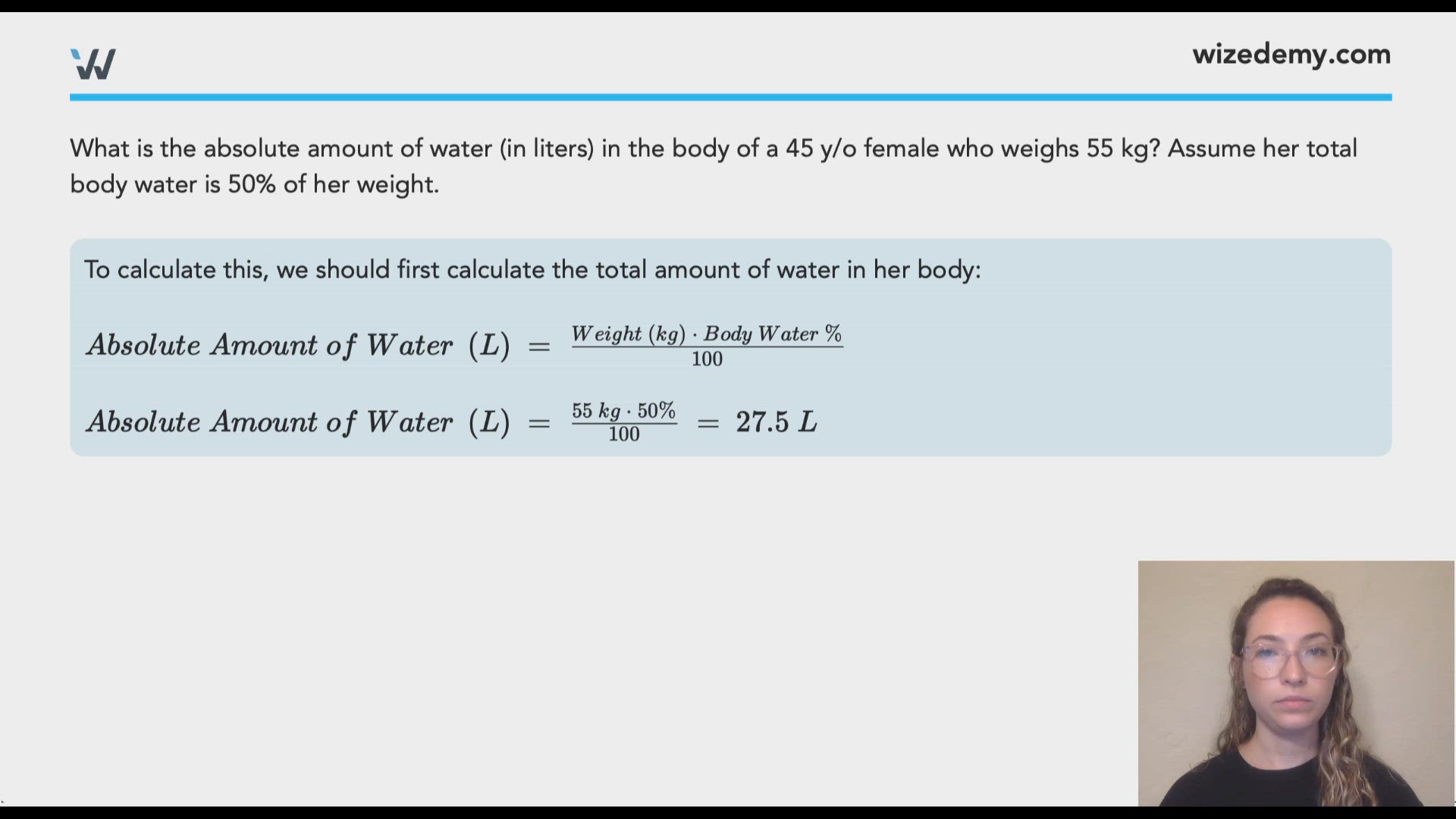
What is the absolute amount of water (in liters) in the body of a 45 y/o female who weighs 55 kg? Assume her total body water is 50% of her weight.
To calculate this, we should first calculate the total amount of water in her body:
0:00 / 0:00
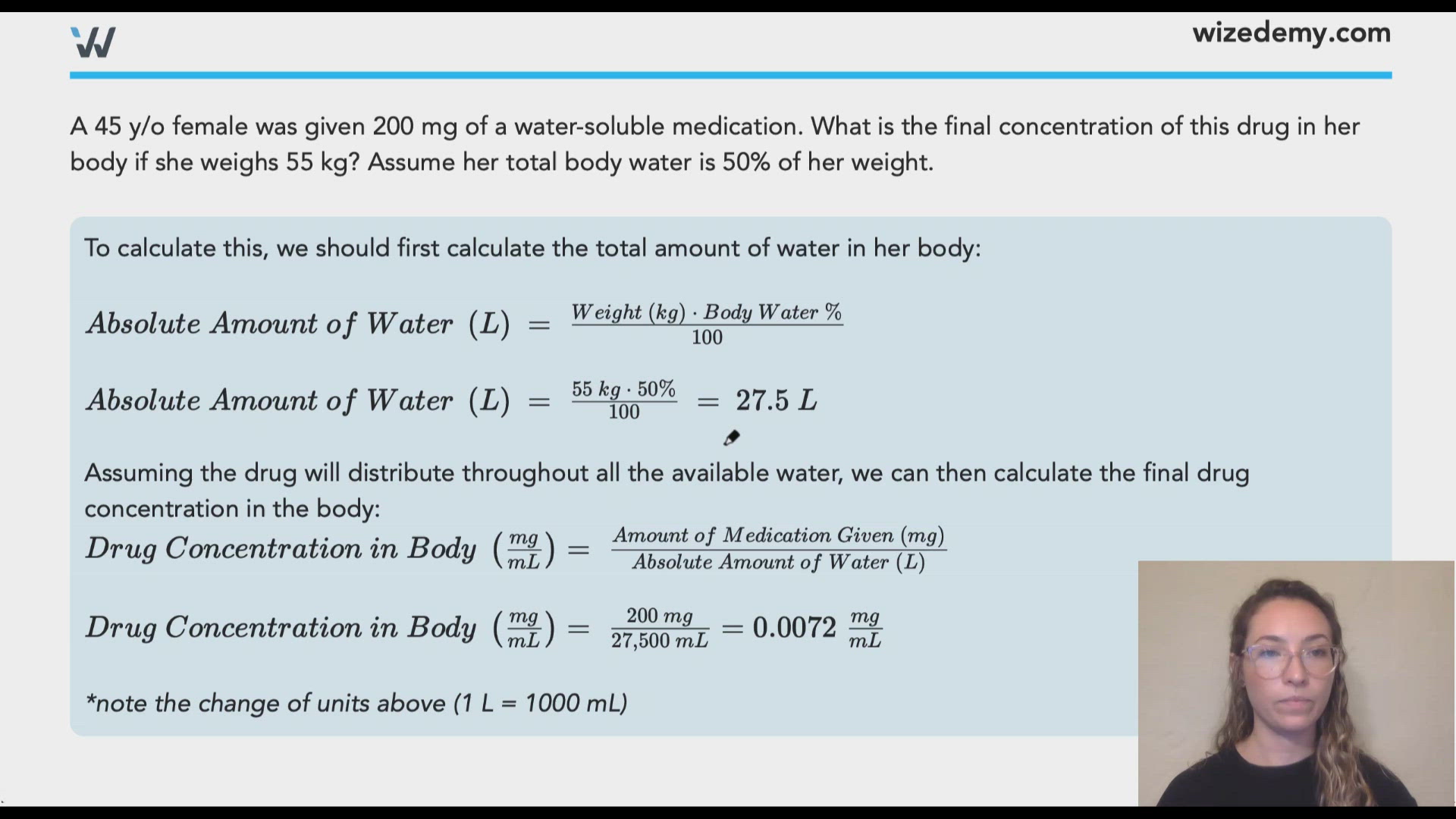
A 45 y/o female was given 200 mg of a water-soluble medication. What is the final concentration of this drug in her body if she weighs 55 kg? Assume her total body water is 50% of her weight.
To calculate this, we should first calculate the total amount of water in her body:
Assuming the drug will distribute throughout all the available water, we can then calculate the final drug concentration in the body:
*note the change of units above (1 L = 1000 mL)
Consider what you know about total body water and how it can vary amongst individuals. Different patients received 100 mg of a medication. Assuming the medication is water-soluble, which of the following will have the lowest final concentration of the medication in their body?
Regarding total body water and water balance, which of the following is FALSE? Select all that apply.