Popular Courses
MCAT
General Course
Intro to Physiology
University Study Guides
PHYSIOL 1021
Western University
PHYSIOL 2130
Western University
Intro to Physiology
University Study Guides
PSL300H1
University of Toronto
PHYSL 210
University of Alberta
PHGY 210
McGill University
PHGY 215
Queen's University
KNES 259
University of Calgary
PHGY 216
Queen's University
BIOL 273
University of Waterloo
BIOL 260
University of British Columbia
PHYSIOL 3120
Western University
KNES 260
University of Calgary
BIOL 116
Case Western Reserve University
PPT 301
University of North Dakota
ANAT 212
McGill University
HTHSCI 2FF3
McMaster University
KNES 323
University of Calgary
0:00 / 0:00
Body Water Compartments
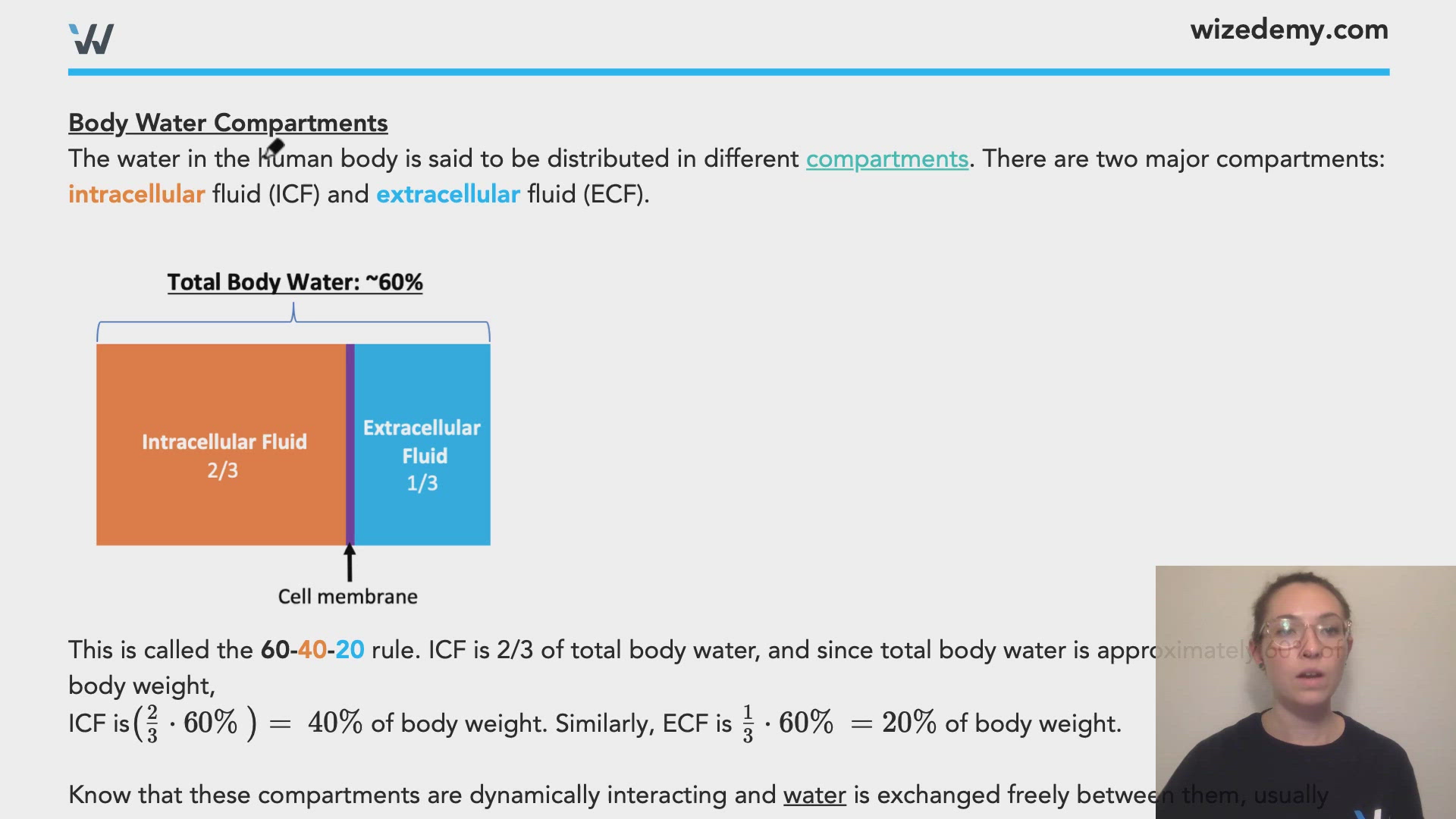
The water in the human body is said to be distributed in different compartments. There are two major compartments: intracellular fluid (ICF) and extracellular fluid (ECF).

This is called the 60-40-20 rule. ICF is 2/3 of total body water, and since total body water is approximately 60% of body weight,
ICF is of body weight. Similarly, ECF is of body weight.
Know that these compartments are dynamically interacting and water is exchanged freely between them, usually through some "barrier". In this case, ICF and ECF are separated by cellular membranes.
The ECF compartment can be further subdivided into interstitial fluid (ISF) (3/4 of ECF) and plasma (1/4 of ECF). That is, ISF is of body weight, and plasma is the remaining 5%.

Plasma is the aqueous component of blood: the fluid in which the blood cells are suspended. Typically, plasma constitutes 55% of blood volume, whereas the remaining 45% is composed on red blood cells (majority), white blood cells and platelets. When whole blood is centrifuged, plasma can be seen clearly as the yellowish fluid on top. Serum is plasma minus clotting factors.
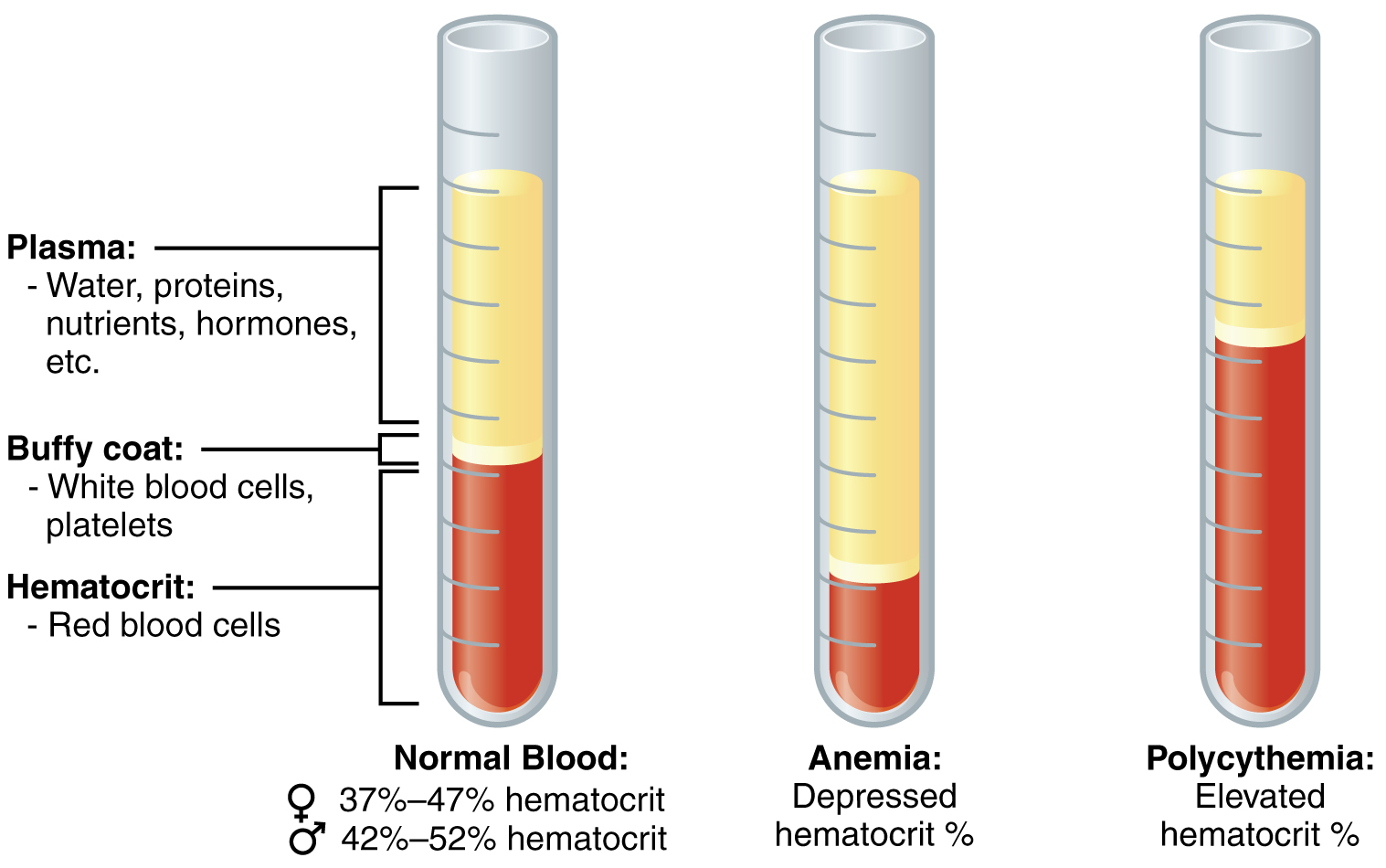
The percent of blood volume occupied by red blood cells is called hematocrit. Normal ranges can be seen above and vary between men and women, with males having higher hematocrit values on average.
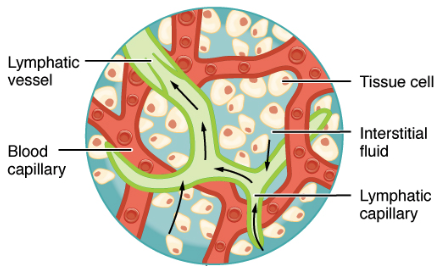
Interstitial fluid is considered an ultrafiltrate of plasma: that is, plasma minus plasma proteins and blood cells. This is because ISF is separated from plasma by the capillary walls: this is the barrier that separates ISF and plasma. Capillary walls essentially filter the plasma retaining proteins and blood cells in circulation.
There are yet another two minor subcompartments of ECF: transcellular fluid and lymph.

Transcellular fluid is a collection of small fluid volumes secreted by cells into certain body cavities for a specific function. Examples: pleural and pericardial fluid (lungs and heart), peritoneal (abdominal cavity), synovial (joints), intraocular (eyes), etc.
Lymph is the ISF that gets into the lymphatic system. After the plasma is filtered by the capillaries into ISF, this fluid has to go somewhere to be returned to the circulation: this is lymph. The lymphatic system is a network of blind tubules that coalesce into larger vessels and finally return lymph into the circulation.
Indicator Dilution Method
Method to determine compartment volumes based on a known amount of a test substance introduced and its measure concentration from blood. The volume is determined by using , where V is the compartment volume, Q is the known quantity of indicator and c is its concentration in plasma. Different indicators should be used for different volumes of interest:
- Total body water: Antipyrine, or
- ECF: Inulin, sucrose or mannitol
- Plasma: Evan's Blue or -Albumin
Remember: Total Body Water = ICF + ECF = ICF + (ISF + Plasma)
0:00 / 0:00
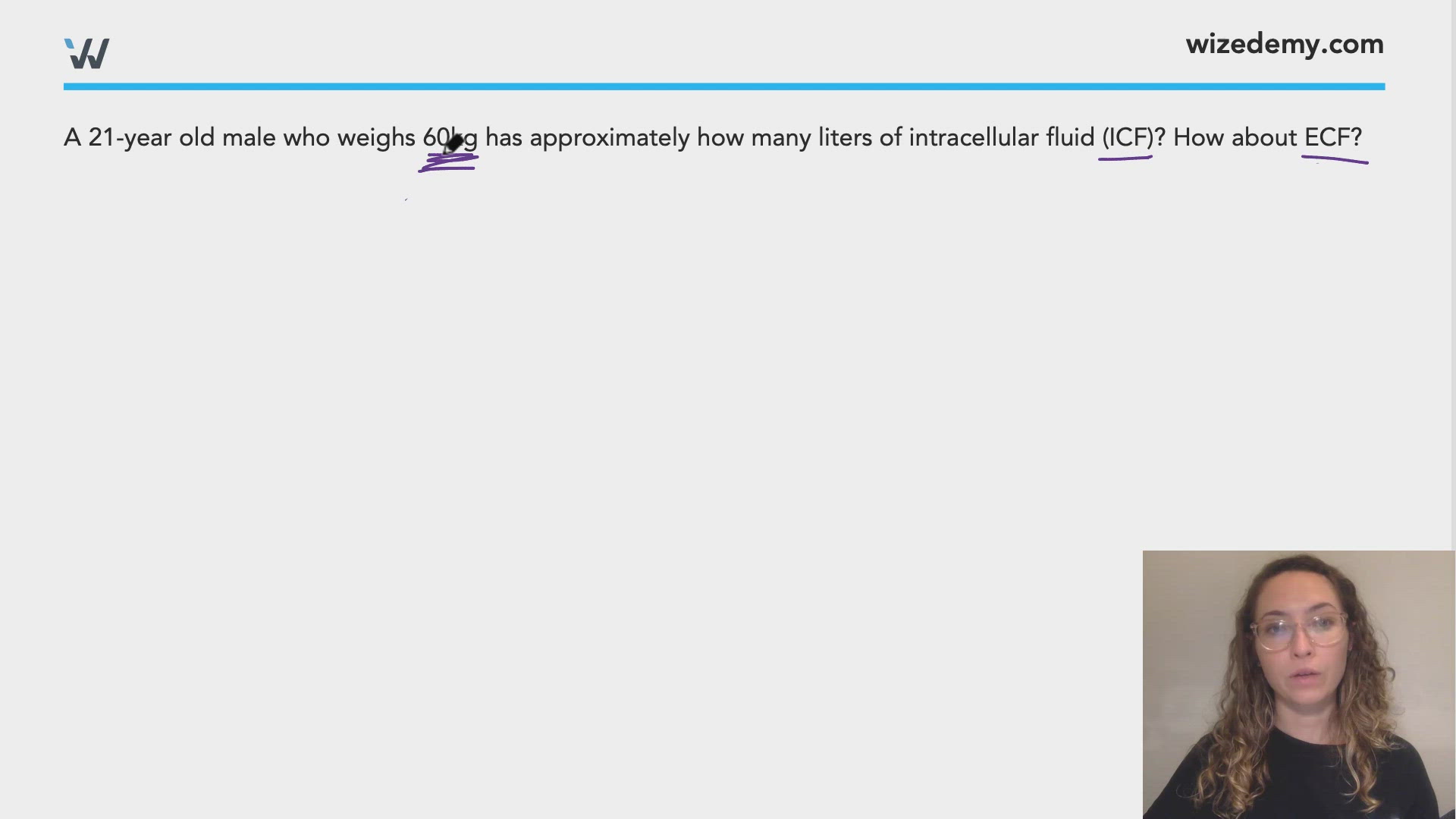
A 21-year old male who weighs 60kg has approximately how many liters of intracellular fluid (ICF)? How about ECF?
A 21-year old male is considered the physiological standard individual. We can use the 60-40-20 rule to estimate the volumes of the ECF and ICF compartments. Here, 60% of body weight is total body water, 40% of body weight is ICF and 20% is ECF.
ICF =
ECF =
0:00 / 0:00
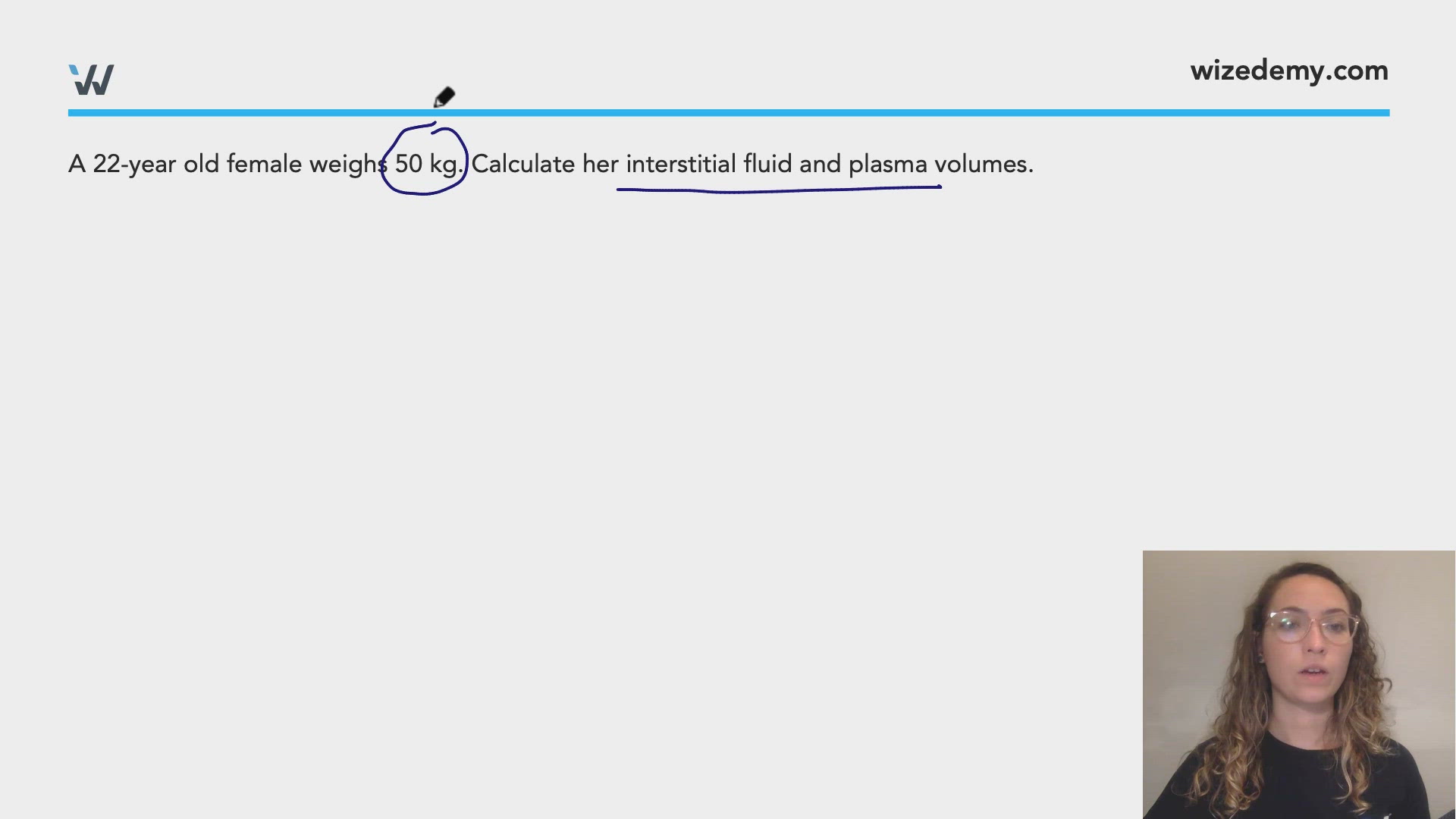
A 22-year old female weighs 50 kg. Calculate her interstitial fluid and plasma volumes.
Interstitial fluid (ISF) and plasma correspond to 3/4 and 1/4 of ECF, respectively. Since ECF is 20% of body water, it follows:
ECF =
ISF =
Plasma =
Alternatively, we can directly calculate this values by knowing that ISF is 15% and plasma is 5% of body weight.
ISF =
Plasma =
The extracellular fluid (ECF) volume:
Which statement(s) about lymph and transcellular fluid are FALSE?