Wize University Physiology Textbook > Body Fluids
Characteristics
Popular Courses
MCAT
General Course
Intro to Physiology
University Study Guides
PHYSIOL 1021
Western University
PHYSIOL 2130
Western University
Intro to Physiology
University Study Guides
PSL300H1
University of Toronto
PHYSL 210
University of Alberta
PHGY 210
McGill University
PHGY 215
Queen's University
KNES 259
University of Calgary
PHGY 216
Queen's University
BIOL 273
University of Waterloo
BIOL 260
University of British Columbia
PHYSIOL 3120
Western University
KNES 260
University of Calgary
BIOL 116
Case Western Reserve University
PPT 301
University of North Dakota
ANAT 212
McGill University
HTHSCI 2FF3
McMaster University
KNES 323
University of Calgary
0:00 / 0:00
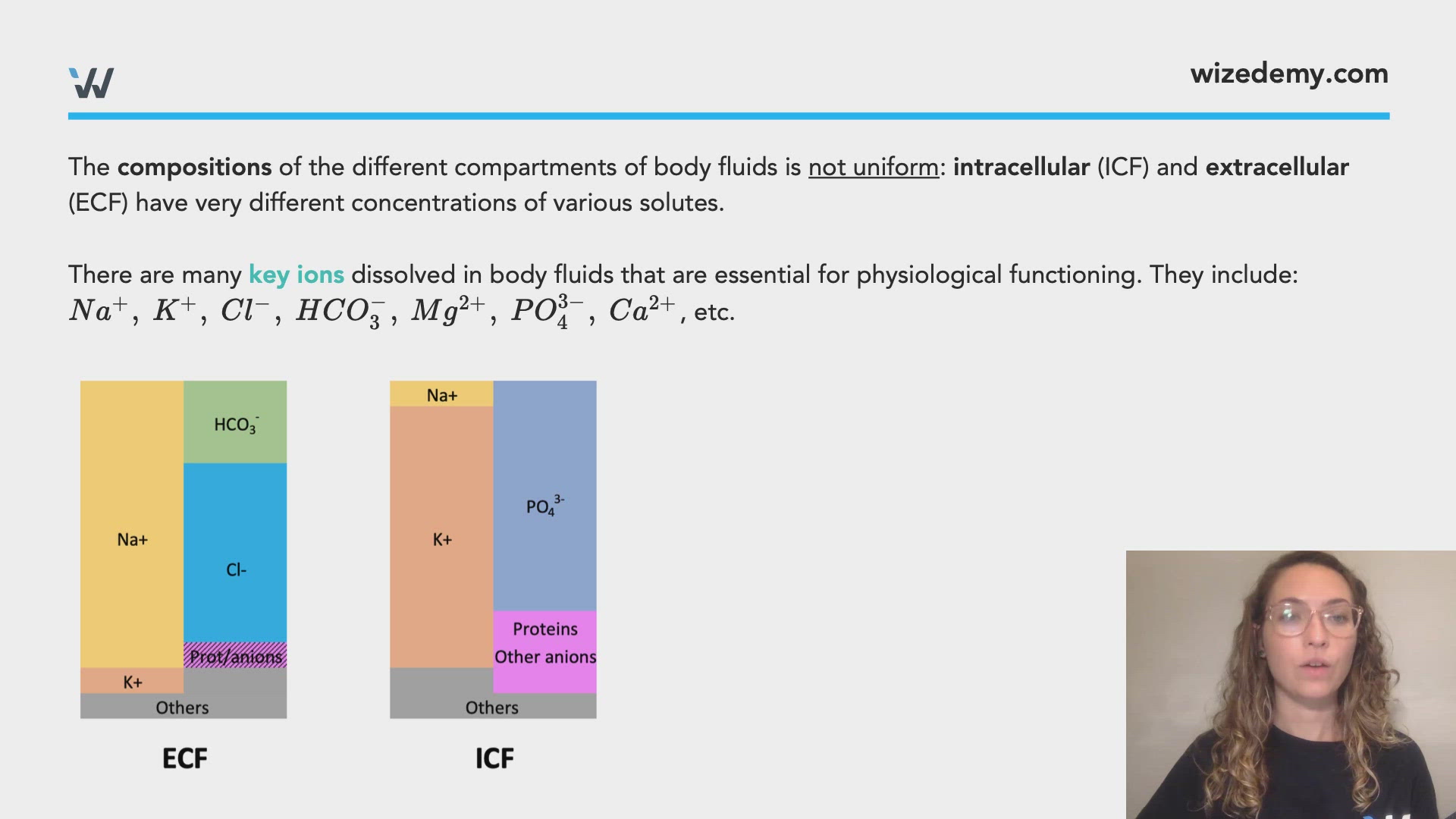
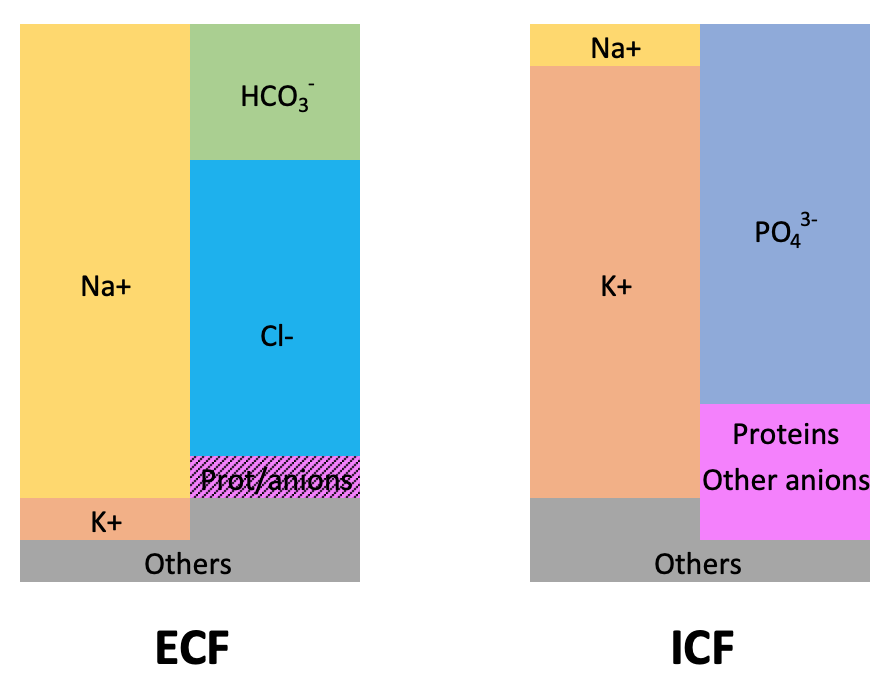
The compositions of the different compartments of body fluids is not uniform: intracellular (ICF) and extracellular (ECF) have very different concentrations of various solutes.
There are many key ions dissolved in body fluids that are essential for physiological functioning. They include: , etc.

Review of Units of Concentration
- Amounts of solute: moles, equivalents (Eqs), or osmoles
- Concentrations of solute: moles/L (M), Eq/L, or osmol/L (Osm)
- One mole is molecules of the substance.
- One equivalent is used to describe the amount of ionized solute. It is equal to # moles x valence of ionized solute.
- An osmole is the number of particles into which a solute dissociates in solution. If a solute does not dissociate into solution (e.g. glucose), then osmolarity = molarity.
Watch Out!
In some texts, the notation osm/L is used instead of just Osm to indicate osmolarity. You might see me using that in some exercise videos. However, to avoid any confusion, I will stick with Osm to indicate osmolarity (osmoles/L) in the future.
Important Formulas
0:00 / 0:00
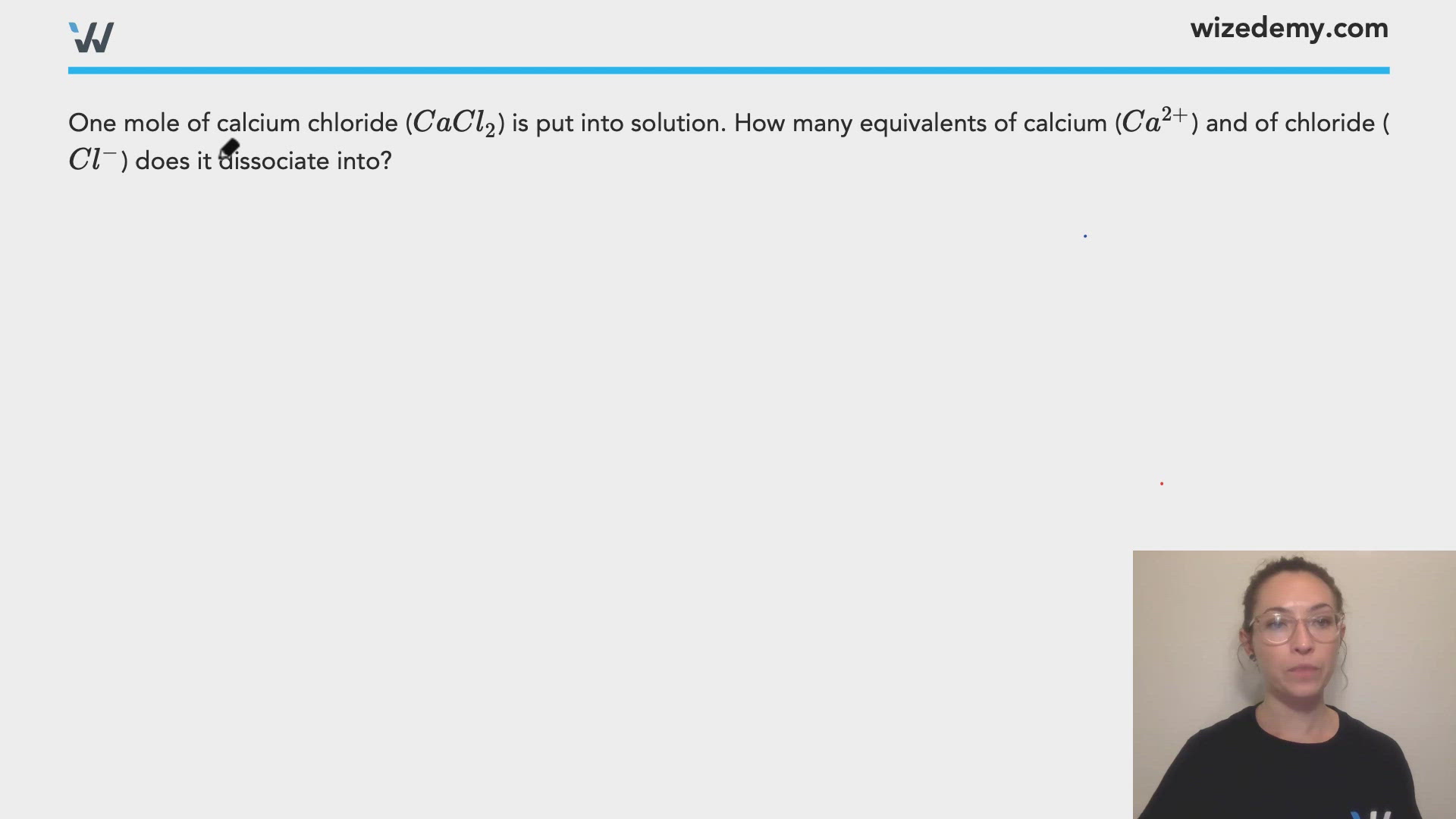
One mole of calcium chloride () is put into solution. How many equivalents of calcium () and of chloride () does it dissociate into?
By definition, an equivalent is the number of moles of a solute multiplied by its valence. Therefore:

One mole of calcium chloride therefore dissociates into one mole of calcium and two moles of chloride. The valence of calcium is 2 and that of chloride is 1. This gives:
For calcium = 1 mole x 2 (valence) = 2 equivalents
For chloride = 2 moles x 1 (valence) = 2 equivalents
yields 2 equivalents of calcium and 2 equivalents of chloride.
0:00 / 0:00
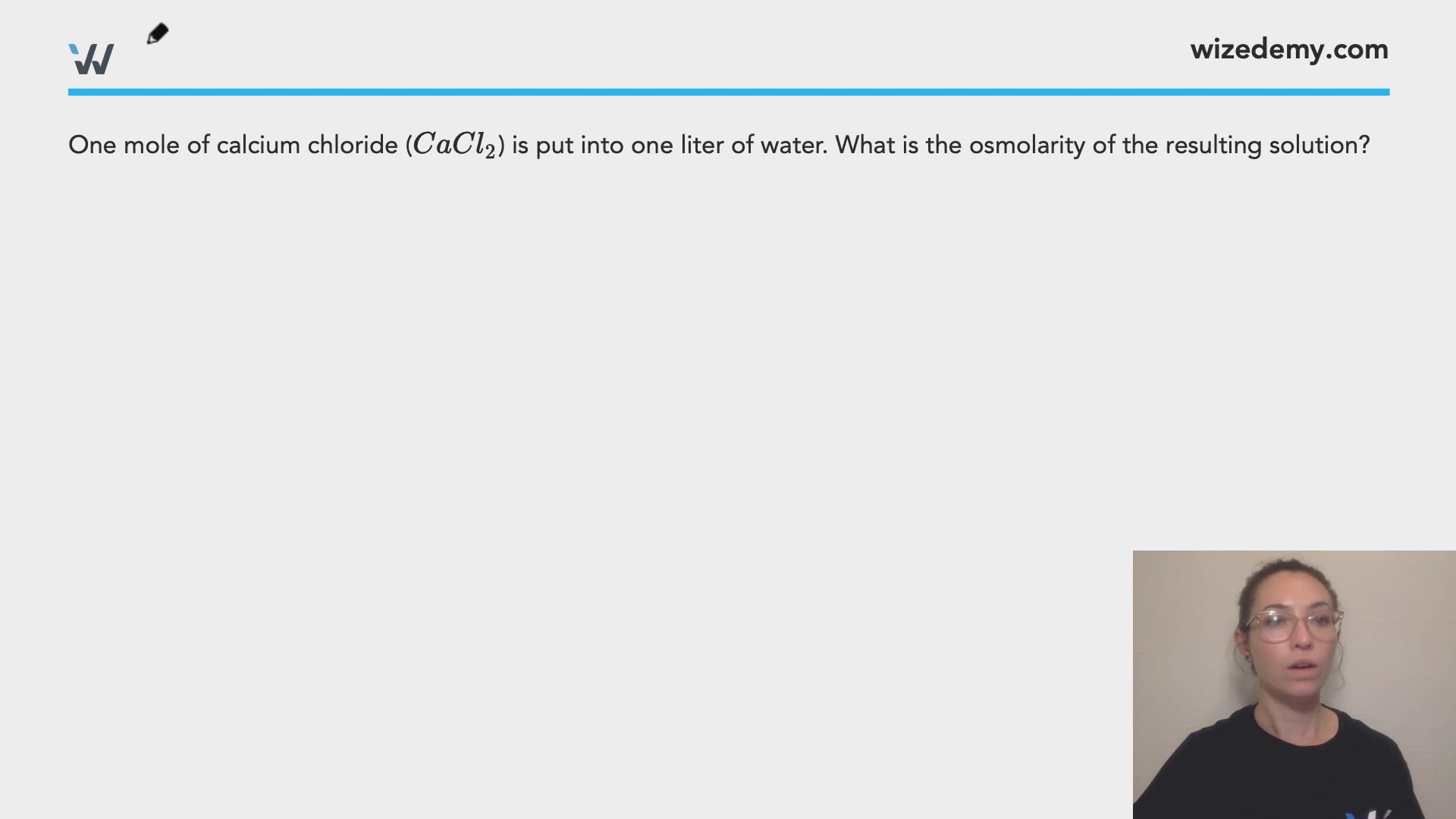
One mole of calcium chloride () is put into one liter of water. What is the osmolarity of the resulting solution?
In solution, 1 mole of calcium chloride in 1 liter of water makes a solution of 1 mol/L or 1 M (molarity). It dissociates into 1 mole of and 2 moles of as follows:

By definition, osmolarity is the concentration of particles in solution (Osm/L). An osmole is the number of particles a solute dissociates into when in solution. When a solute dissociates into more than one particle in solution, its osmolarity equals its molarity times the number of particles.
Therefore, for : 1 mol/L = 3 osmoles/L = 3 Osm (1 + 2 ).
A solution is prepared such that 48.6 g of (MW = 24.3 g/mol) is put in 1 L of water. The concentration of this solution can be expressed as:
Relative to intracellular fluid (ICF), ECF has:
Indicator Dilution Method:
- Total body water: Antipyrine,
- ECF: Inulin, sucrose or mannitol
- Plasma: Evan's Blue or -Albumin
Total Body Water = ICF + ECF = ICF + (ISF + Plasma)
Important Percentages:
- Total body water: 60% of body weight (BW)
- ICF: 40% of BW (2/3 of TBW)
- ECF: 20% of BW (1/3 of TBW)
- ISF: 15% of BW (3/4 of ECF)
- Plasma: 5% of BW (1/4 of ECF)
- Transcellular fluid and Lymph: 1-2% of ECF