Wize University Psychology Textbook > Research Methods in Psychology
Correlational Designs
Popular Courses
MCAT
General Course
Psychology
University Study Guides
PSYC 100
Queen's University
PSYCH 1000
Western University
PSYCH 1X03
McMaster University
PSYCH 104
University of Alberta
PSYCHOL 1002A/B
Western University
Psychology
University Study Guides
PSYC*1000
University of Guelph
PSYC 100
McGill University
PSY100H1
University of Toronto
PSYC 101
University of British Columbia
HH/PSYC 1010 6.00
York University
PSYC 200
University of Calgary
PSYC 102
University of British Columbia
PSYC 100B
Queen's University
PSYC 100A
University of Victoria
PSYC 200
Concordia University
PSYC 1004
Virginia Tech
PSYCH 100
Pennsylvania State University
0:00 / 0:00
Correlational Designs

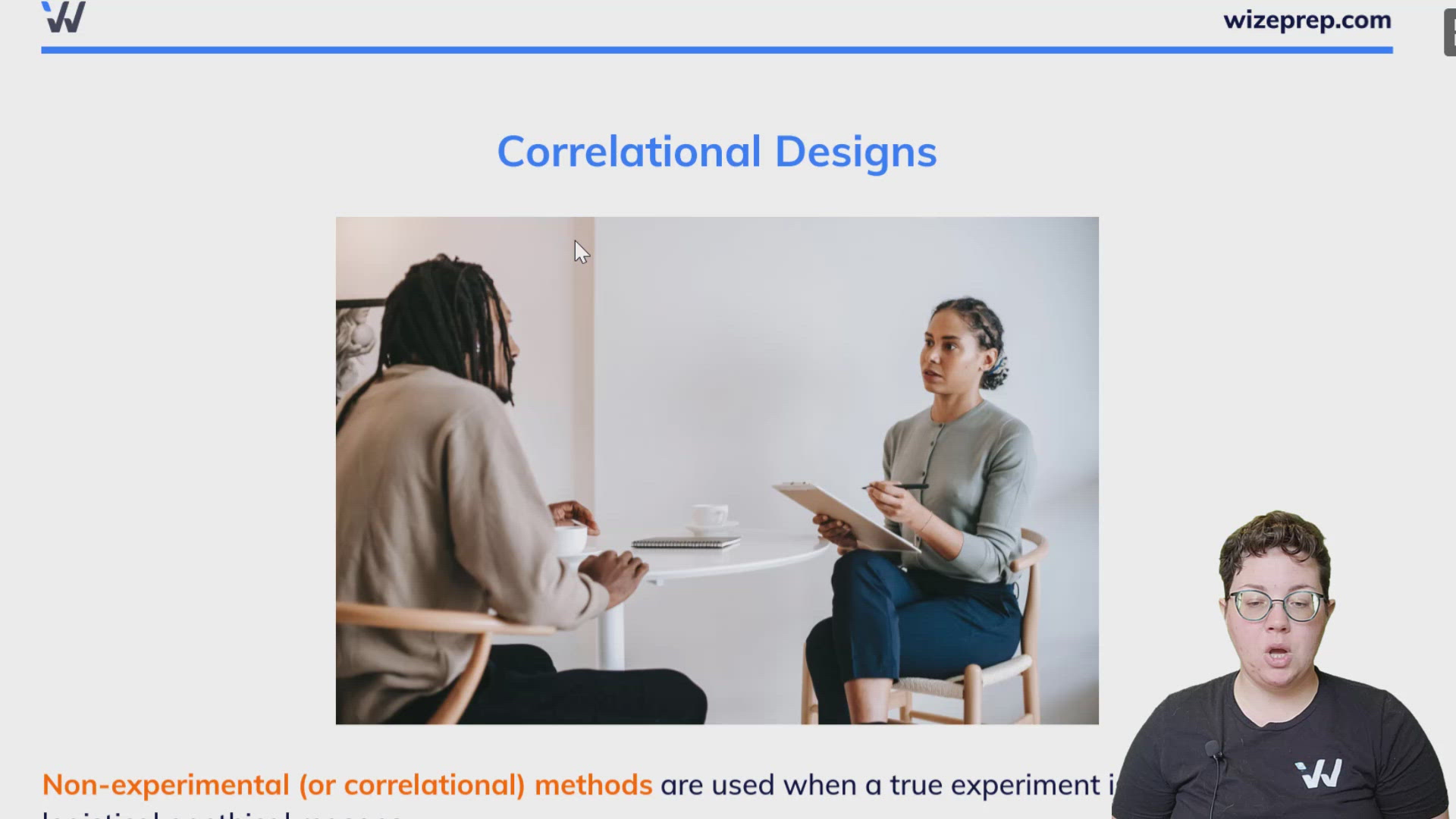
Non-experimental (or correlational) methods are used when a true experiment is not possible for logistical or ethical reasons.
Because non-experimental methods lack the control of experiments, we cannot establish cause and effect when we use them, but we can discover patterns.
Watch Out!
If a question describes a non-experimental method like a survey or case study, be on the lookout for possible answers that involve cause and effect conclusions!
Case Study - an in-depth study of one (or a small number) of individuals. Usually used when someone has a rare condition or set of experiences.
Survey or Questionnaire - collecting answers to a series of (usually closed-ended) questions from a group of people. Can be done by having the individual participants fill out a survey form, or by asking the questions and marking down responses
Focus group - a group interview where participants are able to and encouraged to interact with each other
Observational design - watching a person or group of people to see how they behave in a situation, with no intervention by the researcher
Quasi-experimental designs - look like experiments, but have at least one variable that looks like an independent variable but was measured, not manipulated. This is usually the case when you are interested in a variable that cannot be manipulated for either ethical or practical reasons. We cannot make cause and effect conclusions because we don't have the kind of control needed to do so.
Example: You cannot ethically assign some participants to experience childhood abuse. You cannot randomly assign people to be a particular age, sex, gender, race, have a particular household income, etc.
Practice: Correlational Designs
The major difference between correlational and experimental designs is that:
Practice: Non-Experimental Methods
Anna conducts a series of one-on-one interviews with nurses and finds that the nurses who report the greatest job satisfaction work with attending physicians who are perceived by the nurses as trusting their knowledge and experience. What can be concluded from this study?