Wize University Psychology Textbook > Genetics & Evolution
Genetic Influences on Behaviour
Popular Courses
MCAT
General Course
Psychology
University Study Guides
PSYC 100
Queen's University
PSYCH 1000
Western University
PSYCHOL 1002A/B
Western University
Psychology
University Study Guides
PSYC*1000
University of Guelph
PSYCH 1XX3
McMaster University
PSYC 100
McGill University
PSY100H1
University of Toronto
PSYC 101
University of British Columbia
HH/PSYC 1010 6.00
York University
PSYC 200
University of Calgary
PSYC 100B
Queen's University
PSYC 100A
University of Victoria
PSYC 200
Concordia University
PSYCH 100
Pennsylvania State University
PSC 001
University of California - Davis
PSY 2012
University of Florida
PSY 101
Michigan State University
0:00 / 0:00
Genetic Influences on Behaviour

Intelligence
In childhood, genetic influences account for approximately 40% of difference in IQ. This influence increases to up to 70% in adulthood.
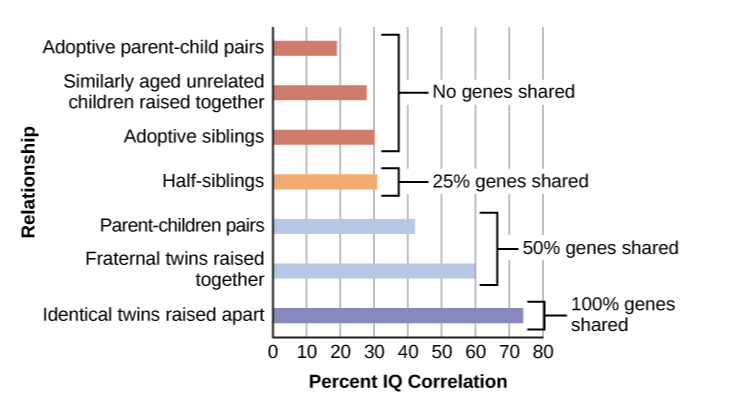
Twin-adoption and family studies have demonstrated that identical twins reared apart (i.e., same genetics but different environments) are more similar in their levels of intelligence than fraternal twins reared together (i.e., 50% shared genes, same environment)
Adopted children’s IQ is more similar to their biological parents than their adopted parents.
Biological Reaction Range
Biological reaction range - the range of possibilities for a certain trait that a certain genetic code allows.
We inherit a range of potential for a certain trait from our parents, and then environment determines where on that range we fall
Example: IQ is not fixed at birth. You may be born with a biological reaction range of 95-110, and then depending on environmental influences (diet, activities, education, etc.) end up with an IQ somewhere in that range.
We cannot currently measure reaction ranges.
Genetics and Personality
Personality has a lower heritability range than intelligence, but there is a relationship between genetics and personality
Example: Big 5 personality traits have heritability coefficients from .42 to .57, meaning 42%-57% of the variability in these personality traits can be attributed to genetics.
Monozygotic/identical twins are more alike in personality than dizygotic/fraternal twins.
In twin studies, monozygotic/identical twins are more alike than dizygotic/fraternal twins, and it doesn't really matter if they were raised together or apart.
Practice: Genetic Influences on Behaviour
Susan and Molly are identical twins. Susan's IQ is 110, and Molly's is 95. This illustrates the influence of: