Wize University Psychology Textbook > Sensation & Perception
Thresholds, Just-Noticeable-Difference, & Weber's Law
Popular Courses
MCAT
General Course
Psychology
University Study Guides
PSYC 100
Queen's University
PSYCH 1000
Western University
PSYCH 104
University of Alberta
PSYCHOL 1002A/B
Western University
Psychology
University Study Guides
PSYC*1000
University of Guelph
PSYCH 1XX3
McMaster University
PSYC 100
McGill University
PSY100H1
University of Toronto
PSYC 101
University of British Columbia
HH/PSYC 1010 6.00
York University
PSYC 200
University of Calgary
PSYC 100B
Queen's University
PSYC 100A
University of Victoria
PSYC 200
Concordia University
PSYC 1004
Virginia Tech
PSYCH 100
Pennsylvania State University
PSC 001
University of California - Davis
0:00 / 0:00
Thresholds, Just-Noticeable Difference, & Weber's Law

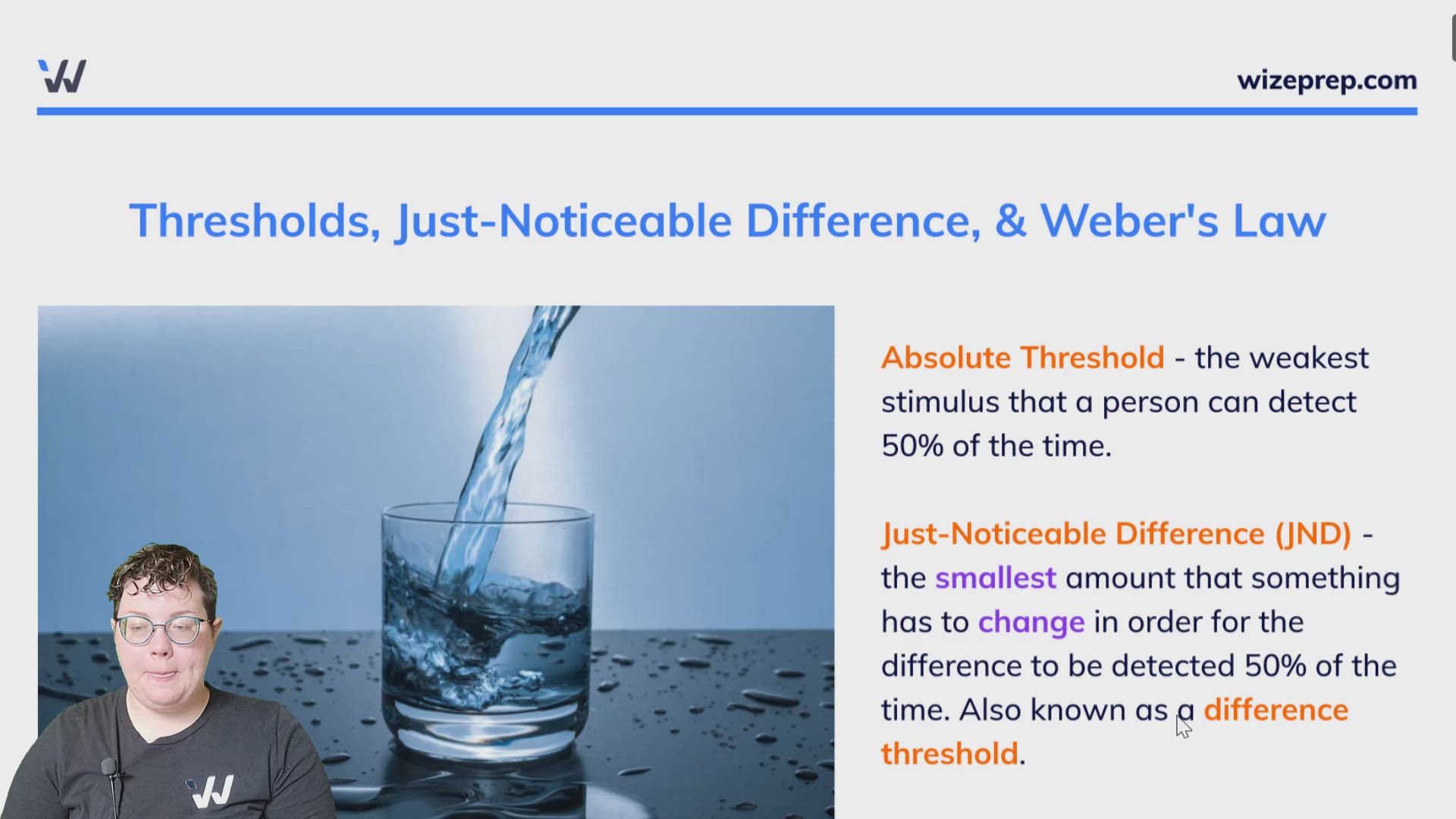
Absolute Threshold - the weakest stimulus that a person can detect 50% of the time.
Just-Noticeable Difference (JND) - the smallest amount that something has to change in order for the difference to be detected 50% of the time. Also known as a difference threshold.
Weber's Law - the size of the JND is a constant proportion to the original stimulus magnitude.
Example: If you can just detect the difference between a 10lb and 11lb weight, you will just be able to detect the difference between a 100lb and 110lb weight. The original stimulus is 10x heavier, so the difference needed is 10x as much.
Practice: Thresholds, Just-Noticeable Difference, and Weber's Law
Which difference would be easiest to perceive?