Popular Courses
MCAT
General Course
Psychology
University Study Guides
PSYC 100
Queen's University
PSYCH 1000
Western University
PSYCH 104
University of Alberta
PSYCHOL 1002A/B
Western University
Psychology
University Study Guides
PSYC*1000
University of Guelph
PSYCH 1XX3
McMaster University
PSYC 100
McGill University
PSY100H1
University of Toronto
PSYC 101
University of British Columbia
HH/PSYC 1010 6.00
York University
PSYC 200
University of Calgary
PSYC 100B
Queen's University
PSYC 100A
University of Victoria
PSYC 200
Concordia University
PSYC 1004
Virginia Tech
PSYCH 100
Pennsylvania State University
PSC 001
University of California - Davis

0:00 / 0:00
Eye Anatomy
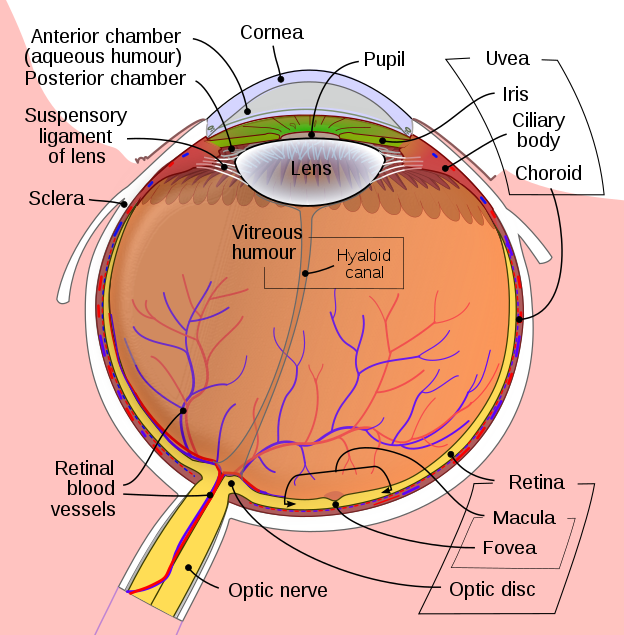
Cornea - protects the eye, focuses light
Pupil & Iris- dilates and constricts to control how much light enters the eye
Lens - focuses light entering the eye on the retina
Retina - tissue on the back of the eye that is made up of photoreceptors that transduce light into a neural signal
Fovea - focal point where vision is clearest
Macula - area right around the focal point
Optic Nerve - bundle of axon fibers from photoreceptors and other cells on the retina. Exits through back of the eye, creating a blind spot
Photoreceptors
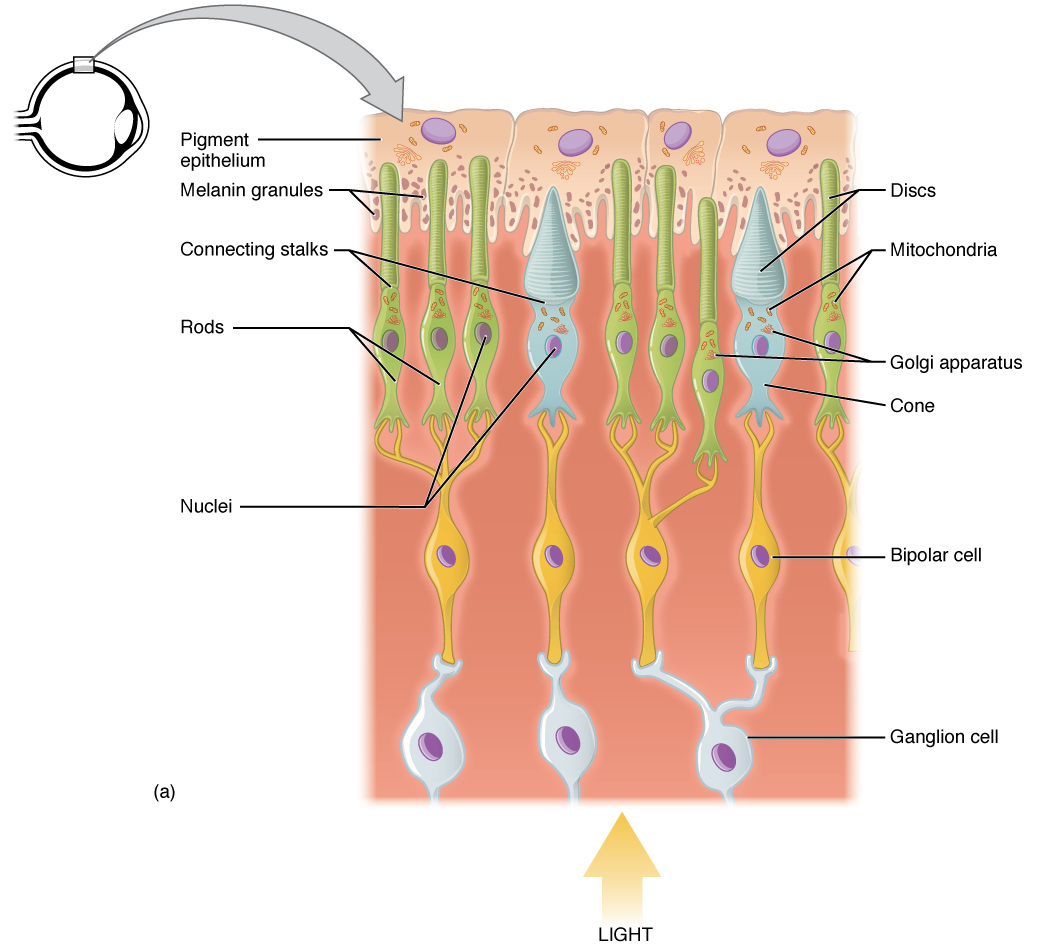
Photoreceptors - cells that respond to light and transduce it into a neural signal
Rods - photoreceptors primarily sensitive to light and dark with low spatial resolution
Cones - photoreceptors primarily sensitive to colour with high spatial resolution
Bipolar cells - link between photoreceptors and ganglion cells
Ganglion cells - collect inputs from photoreceptors. Sensitive to blue light
Cones are concentrated near the fovea, whereas rods are more dense further away from the fovea - this is why our peripheral vision is not as sensitive to colour and fine detail.
Practice: Eye Anatomy
The blind spot in the eye is: