Wize University Psychology Textbook > Consciousness
The Neural Basis of Consciousness
Popular Courses
Psychology
University Study Guides
PSYC 100
Queen's University
PSYCH 1000
Western University
PSYCH 104
University of Alberta
PSYCHOL 1002A/B
Western University
Psychology
University Study Guides
PSYC*1000
University of Guelph
PSYC 100
McGill University
PSYC 101
University of British Columbia
HH/PSYC 1010 6.00
York University
PSYC 200
University of Calgary
PSYC 100B
Queen's University
PSYC 100A
University of Victoria
PSYC 200
Concordia University
PSYC 1004
Virginia Tech
PSYCH 100
Pennsylvania State University
PSC 001
University of California - Davis
PSY 2012
University of Florida
PSY 101
Michigan State University
PSYCH10
University of California - Los Angeles
0:00 / 0:00
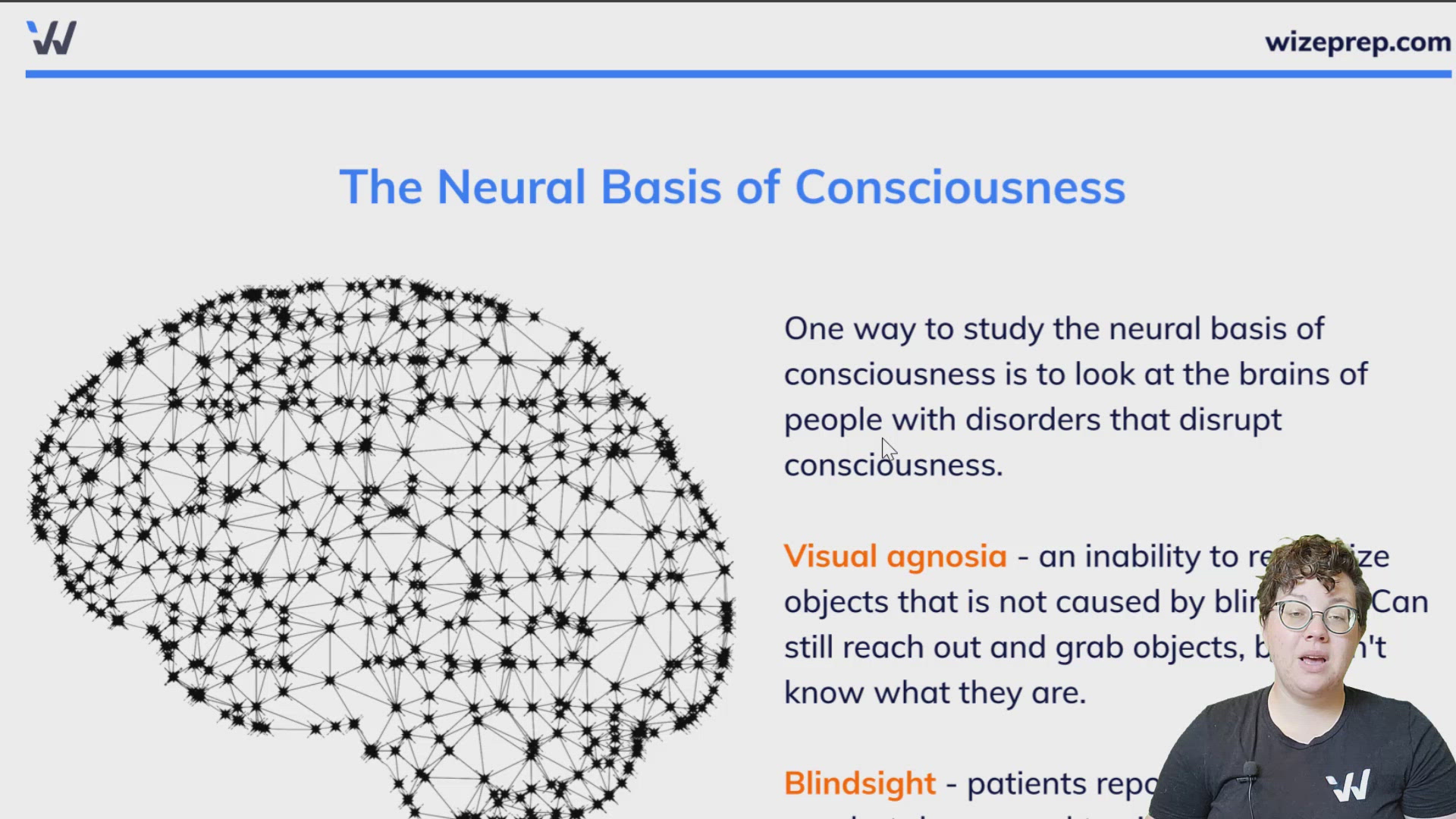
The Neural Basis of Consciousness

One way to study the neural basis of consciousness is to look at the brains of people with disorders that disrupt consciousness.
Visual agnosia - an inability to recognize objects that is not caused by blindness. Can still reach out and grab objects, but don't know what they are.
Blindsight - patients report that they cannot see, but do respond to visual objects without awareness of them.
Both visual agnosia and blindsight illustrate that we can process visual information without awareness.
The Modular View of Consciousness
Modular view - the brain is made up of many different areas that each have tasks they are responsible for.
Consciousness is a global workspace that results from these areas working together.
A person with visual agnosia would: