Wize University Psychology Textbook > Learning
Classical Conditioning
Popular Courses
MCAT
General Course
Psychology
University Study Guides
PSYC 100
Queen's University
PSYCH 1000
Western University
PSYCH 1X03
McMaster University
PSYCH 104
University of Alberta
PSYCHOL 1002A/B
Western University
PSYC*1000
University of Guelph
Psychology
University Study Guides
PSYC 100
McGill University
PSY100H1
University of Toronto
PSYC 101
University of British Columbia
HH/PSYC 1010 6.00
York University
PSYC 200
University of Calgary
PSYC 100B
Queen's University
PSYC 100A
University of Victoria
PSYC 200
Concordia University
PSYC 1004
Virginia Tech
PSYCH 100
Pennsylvania State University
PSC 001
University of California - Davis

0:00 / 0:00
Classical Conditioning
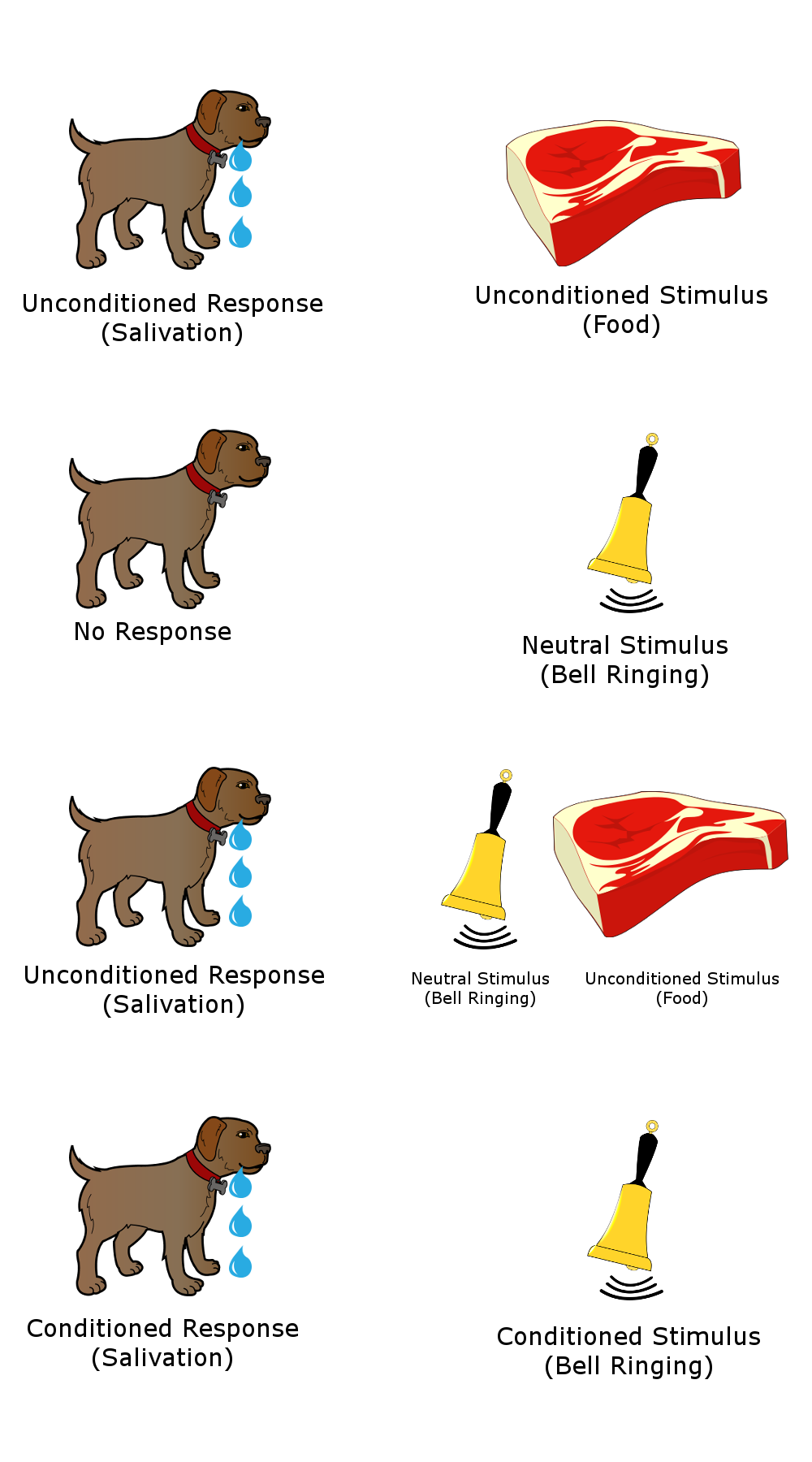
Classical conditioning is learned during a process called acquisition
Before conditioning
- Unconditioned stimulus (US or UCS) elicits unconditioned response (UR or UCR)
- Neutral stimulus (NS) elicits no response
During conditioning
- US and NS are repeatedly paired
- UR is elicited by US
After conditioning
- NS has become the conditioned stimulus (CS)
- CS elicits the conditioned response (CR) which is the same behaviour as the UR, but in response to the CS instead of the US
- Typically CR is a weaker response than UR
Classical conditioning is also known as Pavlovian conditioning
Classical conditioning is a form of associative learning - you are learning the association between two stimuli
Wize Tip
If a question refers to "associative learning" make sure you think about both classical and operant conditioning
0:00 / 0:00
Extinction, Spontaneous Recovery, Generalization, & Discrimination

Extinction - gradual loss of conditioned response when conditioned stimulus is repeatedly present in the absence of the unconditioned stimulus
Spontaneous recovery - reappearance of the conditioned response after extinction. Weaker than original CR
Can go through several cycles of extinction and spontaneous recovery
Stimulus generalization - respond with the conditioned response to stimuli that are similar to the conditioned stimulus
Example: if you get eat something and get sick after, you are likely to avoid similar foods in the future
Stimulus discrimination - the ability/tendency to respond differently to stimuli which are similar to each other
Example: You respond differently to the ringing of a school bell to indicate a change of class period and to indicate a fire alarm, because of the length of the ring
Practice: Classical Conditioning
Nicole is absorbed in studying for the her final and is surprised when she looks at the clock and sees that it is lunch time. Normally, Nicole starts feeling hungry at around 11:45, but it is now 12:30 and she isn’t feeling hungry yet.
On her way to the dining hall, Nicole starts feeling very hungry. In Nicole's case, the conditioned stimulus is:
Practice: Extinction, Spontaneous Recovery, Generalization, & Discrimination
Ava's dog Buddy loves to go for walks on a leash. Buddy used to wag his tail as soon as they got outside, but now he wags his tail when Ava picks up the leash.
One day, Ava is cleaning out her garage and pulls some old rope out of a box. Buddy gets excited and wags his tail just like he does when he goes out for a walk.
Buddy has ________ the stimulus of the leash to the rope