Wize University Psychology Textbook > Learning
Operant Conditioning
Popular Courses
MCAT
General Course
Psychology
University Study Guides
PSYC 100
Queen's University
PSYCH 1000
Western University
PSYCH 1X03
McMaster University
PSYCH 104
University of Alberta
PSYCHOL 1002A/B
Western University
PSYC*1000
University of Guelph
Psychology
University Study Guides
PSYC 100
McGill University
PSY100H1
University of Toronto
PSYC 101
University of British Columbia
HH/PSYC 1010 6.00
York University
PSYC 200
University of Calgary
PSYC 100B
Queen's University
PSYC 100A
University of Victoria
PSYC 200
Concordia University
PSYC 1004
Virginia Tech
PSYCH 100
Pennsylvania State University
PSC 001
University of California - Davis

0:00 / 0:00
Principles of Operant Conditioning

Law of Effect - behaviours that produce satisfying consequences will increase in frequency and behaviours that produce dissatisfying consequences will decrease in frequency
Reinforcement - a consequence that increases the probability of a behaviour reoccurring
Punishment - a consequence that decreases the probability of a behaviour reoccurring
Watch Out!
It doesn't matter what the consequence giver intends - it only matters what the effect on the behaviour is.
If it increases, it's reinforcement. If it decreases, it's punishment

0:00 / 0:00
Types of Reinforcement
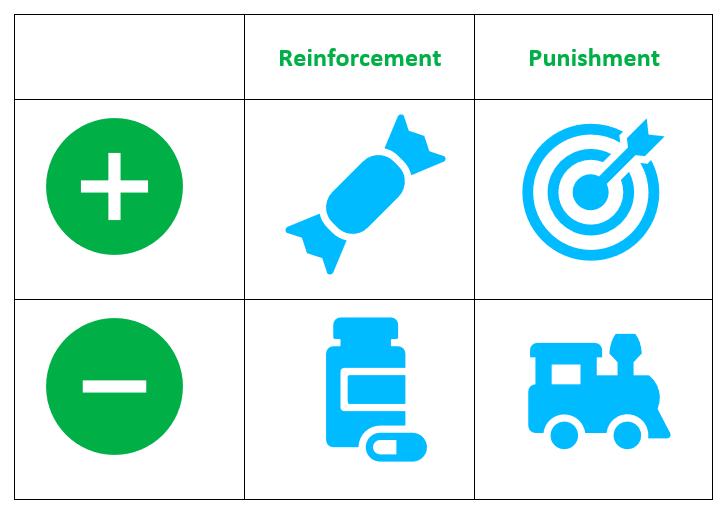
Positive reinforcement - adding something, resulting in an increase in the probability of a behaviour
Positive punishment - adding something, resulting in an decrease in the probability of a behaviour
Negative reinforcement - taking something away, resulting in an increase in the behaviour
Negative punishment - taking something away, resulting in a decrease in the behaviour
Wize Tip
It helps to think of "positive" as a plus sign and "negative" as a minus sign - it is about adding vs taking away, not good vs. bad

Primary reinforcers - things that are reinforcing based on their ability to fulfill a biological need
Example: food, water, sleep, shelter, sex
Secondary reinforcers - things that are reinforcing because we have learned that they have a benefit
Example: money, grades, watching tv
0:00 / 0:00
Reinforcement Schedules

Continuous reinforcement
- Reward is given following every behaviour
- Fast acquisition (learning)
- Fast extinction
Intermittent or partial reinforcement
- Reward is given following only some behaviours
- Slower acquisition than continuous reinforcement
- Slower extinction than continuous reinforcement
Partial Reinforcement Schedules
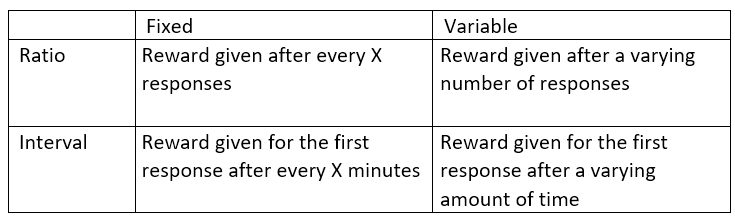
Fixed schedules have lower resistance to extinction than variable schedules
Ratio schedules produce higher rates of responding than interval schedules

0:00 / 0:00
Punishment, Escape, & Avoidance Learning

Punishment is generally less effective than reinforcement, and can produce negative consequences
Escape conditioning - person/animal learns to escape the punishing situation
Example: A child learns to run and hide when their parent is yelling
Avoidance conditioning - person/animal learns to avoid the punishment by responding to a precursor behaviour/signal which is acquired through classical conditioning
Example: A child learns that when their parent is stomping around the house and slamming doors, an outburst of anger is likely to follow, so as soon as the parent starts stomping around the child goes outside to avoid the parent
0:00 / 0:00
Shaping & Chaining

Some behaviours are too complex to learn during simple operant conditioning
Shaping - rewarding successive approximations of the goal behaviour
Example: You reward a 4 year old for anything that vaguely resembles letter shapes
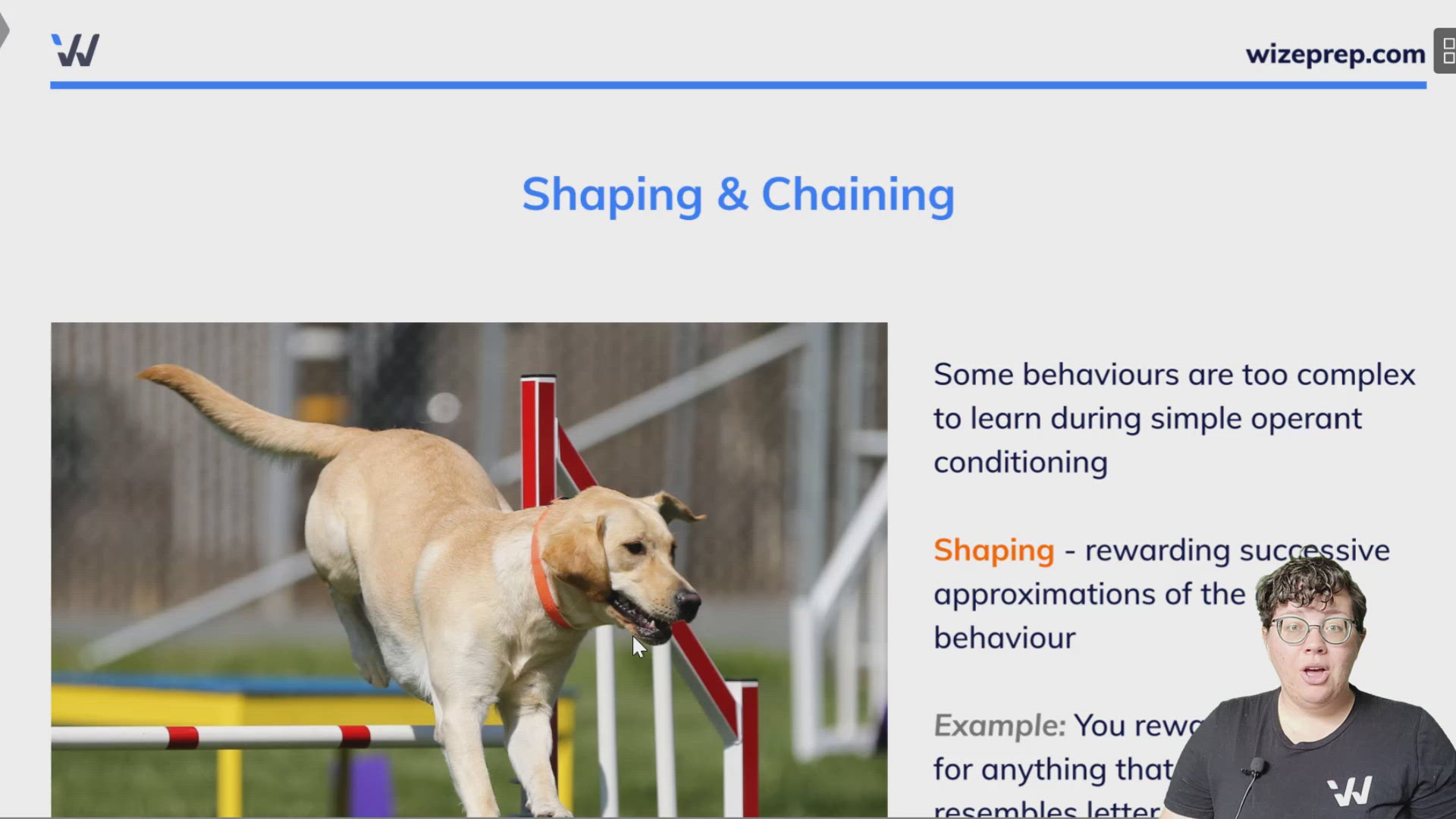
Chaining - teaching a sequence of behaviours by rewarding the first behaviour, then the first and second, etc.
Example: Teaching a dog an agility course. Once the first trick is mastered, the dog has to do the first and second trick in order to get a reward
Practice: Types of Reinforcement
Which of the following is an example of negative reinforcement?
Practice: Reinforcement Schedules
Melody works very hard at her job in order to earn attention and approval from her supervisor. She is responsible for a weekly budget report and puts in tremendous effort to be sure she has it on the supervisor's desk every Friday by 4:30pm. About once a month her supervisor is pleased and rewards Melody by letting her go home early. Many weeks this does not happen and her supervisor barely seems to notice the punctual delivery of the report.
Which of the following would you expect in terms of Melody's behaviour?
Practice: Punishment, Escape, and Avoidance Learning
Trent's boss loves to yell at employees who are slacking. Trent has learned to discriminate between the footsteps of his boss and those of other coworkers, so that when his boss is approaching he can stop playing on his phone and pretend to work. This is an example of:

Mark Yourself Question
- Grab a piece of paper and try this problem yourself.
- When you're done, check the "I have answered this question" box below.
- View the solution and report whether you got it right or wrong.
Practice Question: Shaping & Chaining
Describe how a trainer could use shaping to get a client in shape to run a marathon.
Mark Yourself Question
- Grab a piece of paper and try this problem yourself.
- When you're done, check the "I have answered this question" box below.
- View the solution and report whether you got it right or wrong.
Practice: Principles of Operant Conditioning
Whenever Colleen bothers her sister, their mom tries to punish her by sending her to her room. Colleen actually really likes being alone in her room.
Explain what will likely happen to Colleen's behaviour, based on the above scenario.