Wize University Psychology Textbook > Language & Thought
How We Use Language
Popular Courses
Psychology
University Study Guides
PSYC 100
Queen's University
Psychology
University Study Guides
PSYCHOL 1003A/B
Western University
PSYC 101
University of British Columbia
HH/PSYC 1010 6.00
York University
PSYC 200
University of Calgary
PSYC 102
University of British Columbia
PSYC 100B
Queen's University
PSYC 100A
University of Victoria
PSYC 200
Concordia University
PSYCH 100
Pennsylvania State University
PSC 001
University of California - Davis
PSY 2012
University of Florida
PSY 101
Michigan State University
PSYCH10
University of California - Los Angeles
PSY 101
San Diego State University
PSC 001Y
University of California - Davis
PSY 101
University of Arizona
PSYC 1001
University of Cincinnati
0:00 / 0:00
How We Use Language

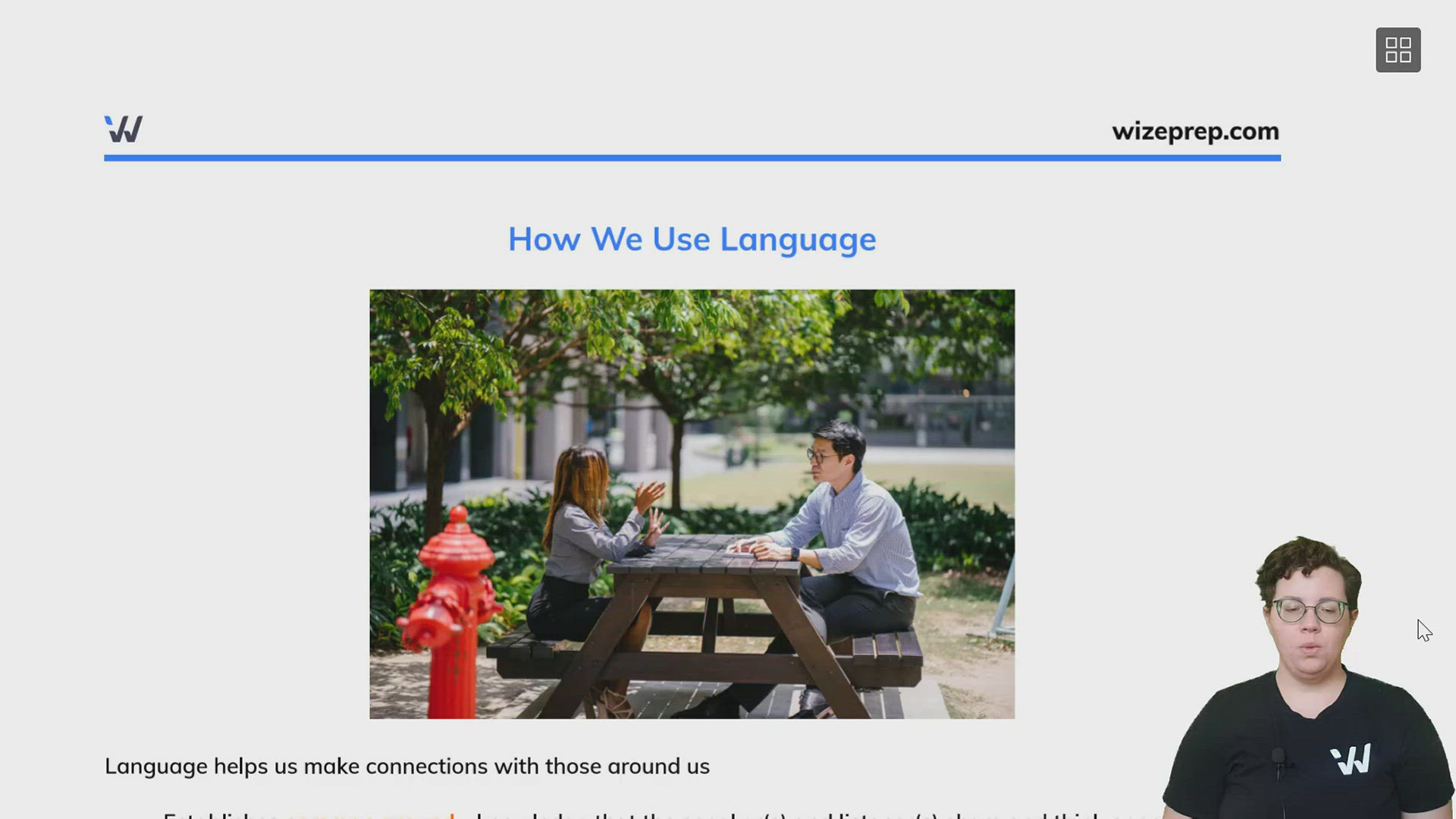
Language helps us make connections with those around us
- Establishes common ground - knowledge that the speaker(s) and listener(s) share and think or assume they share.
- Example - when you are talking to your classmate you assume he knows your professor's name
- Audience design - we tailor our speech to those around us, based on common ground
- Example - when you talk to your classmate you say "Dr. Song", but when you talk to your parent you say "my psychology professor, Dr. Song"

Conversation between people is coordinated at multiple levels
- Lexicon - we tend to use similar words/terms as the people around us
- Syntax - we tend to use similar word order and sentence structure as the people around us
- Rates of speech - we match our speed to that of other people in the conversation
Language helps us develop situation models - mental representations of the topic of a conversation
- Priming - thinking about one topic (e.g., cheeseburger) makes you think about another (fries)

Gossip (talking about yourselves and people you know) regulates emotional world
- Establishes and enlarges ingroup (group you belong to) and differentiates from outgroup (all other groups/people)
- Linguistic intergroup bias - For ingroup members we use adjectives (he is nice) to describe positive actions and verbs (he stole the candy) to describe negative actions. For outgroup members, we use verbs (he shared his snack) to describe positive actions and adjectives (he is mean) to describe negative actions.
- Adjectives imply permanence/stability. Verbs imply something is temporary or exceptional.
Sam is speaking to his new friend Pam about his plans for the weekend. He says "Lee and I are going to order pizza and watch a movie". Pam looks confused. This is because of a lack of: