Wize University Psychology Textbook > Language & Thought
Judgment & Decision Making
Popular Courses
MCAT
General Course
Psychology
University Study Guides
PSYC 100
Queen's University
PSYCH 1X03
McMaster University
Psychology
University Study Guides
PSYC*1000
University of Guelph
PSY100H1
University of Toronto
PSYCHOL 1003A/B
Western University
PSYC 101
University of British Columbia
HH/PSYC 1010 6.00
York University
PSYC 200
University of Calgary
PSYC 102
University of British Columbia
PSYC 100B
Queen's University
PSYC 100A
University of Victoria
PSYC 200
Concordia University
PSYCH 100
Pennsylvania State University
PSC 001
University of California - Davis
PSY 2012
University of Florida
PSY 101
Michigan State University
PSYCH10
University of California - Los Angeles
0:00 / 0:00
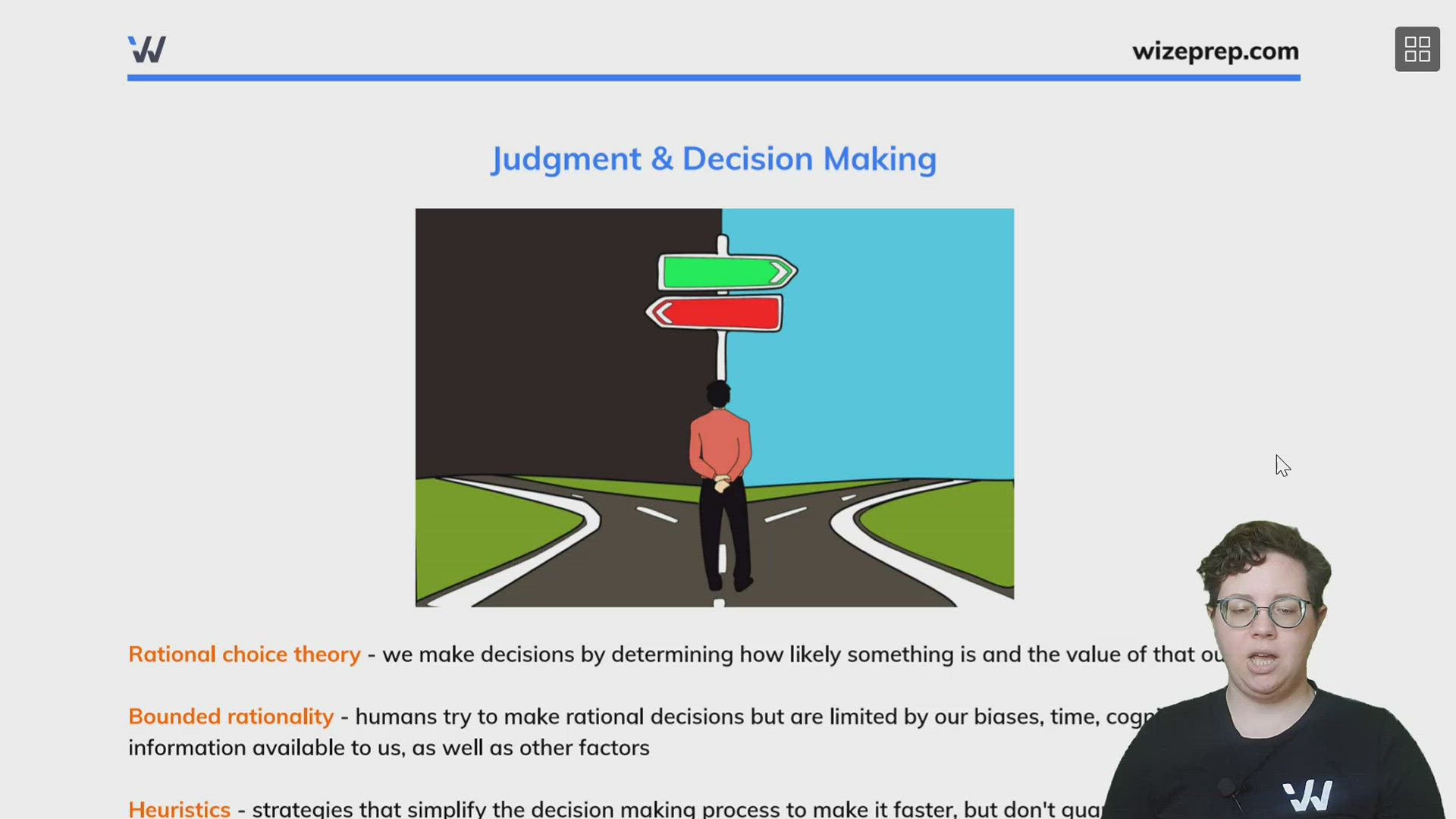
Judgment & Decision Making

Rational choice theory - we make decisions by determining how likely something is and the value of that outcome
Bounded rationality - humans try to make rational decisions but are limited by our biases, time, cognitive cost, and information available to us, as well as other factors
Heuristics - strategies that simplify the decision making process to make it faster, but don't guarantee we'll reach the solution
Algorithms - slower, well-defined sequences or rules that guarantee a solution
Types of Biases
Availability bias - items that come to mind easier are judged as more frequent
- Example - we judge planes as more dangerous than cars, even though far more people die in car accidents in a given year, because plane crashes are more memorable
Representativeness heuristic - we judge the probability of an event based on how much it represents a prototype, ignoring other relevant information
- Example - we judge a classmate who is sitting in the front row wearing glasses as more likely to be an A student than a C student, ignoring that there are many, many more C students than A students
Anchoring - if asked to make a judgment about a number or proportion, it is affected by the number used to construct the question, even if that number is arbitrary
- Example - One group is asked if the number of vegetarians in the population is less than or more than 10%. The other group is asked about whether it's less or more than 30%. Then they are asked to estimate the percentage of vegetarians in the population. The first group will give lower estimates than the second group.
Framing - framing a question in terms of gains vs. losses shapes the answers given, even if the outcomes are the same.
- Example - Two groups are each asked to choose between two scenarios regarding a sinking ship with 600 passengers
- Group 1
- Rescue A - 200 people survive
- Rescue B - a one-third probability that 600 people survive and a two-thirds probability that nobody will survive
- Group 2
- Rescue C - 400 people will die
- Rescue D - a one-third probability that nobody will die and a two-thirds probability that 600 die
- In Group 1, most people will choose A, and in Group 2, most people will choose D
- If you actually calculate the results of each outcome, A&C are identical, and B&D are identical!
- Prospect Theory
- When a problem is framed in terms of gains we are risk-averse
- When a problem is framed in terms of losses we are risk-seeking
Optimism Bias - belief that, compared to others, we are more likely to experience positive events and less likely to experience negative events
System 1 & System 2 Decision Making
System 1 Decision Making - quick, intuitive, automatic, effortless, emotional
System 2 Decision Making - slow, conscious, effortful, logical
Most of the time, system 1 decision making is perfectly fine. System 2 thinking would require too much energy
We should use system 2 thinking when decisions are important or highly consequential
Practice: Judgment & Decision Making
A specific formula for solving a problem is called _______