Wize University Psychology Textbook > Language & Thought
Problem-Solving Theories
Popular Courses
MCAT
General Course
Psychology
University Study Guides
PSYC 100
Queen's University
Psychology
University Study Guides
PSYC*1000
University of Guelph
PSY100H1
University of Toronto
PSYCHOL 1003A/B
Western University
PSYC 101
University of British Columbia
HH/PSYC 1010 6.00
York University
PSYC 200
University of Calgary
PSYC 102
University of British Columbia
PSYC 100B
Queen's University
PSYC 100A
University of Victoria
PSYC 200
Concordia University
PSYCH 100
Pennsylvania State University
PSC 001
University of California - Davis
PSY 2012
University of Florida
PSY 101
Michigan State University
PSYCH10
University of California - Los Angeles
PSC 001Y
University of California - Davis

0:00 / 0:00
Problem-Solving Theories

Means-End Analysis - process of searching for the steps needed to reduce the differences between our current situation and desired goal
- Analyze the goal
- Analyze the current state
- List differences between the two states
- Reduce the list of differences
- Direct means (solves without intermediate steps)
- Generating subgoals
- Finding similar problems with known solutions
Analogical problem-solving - we solve a problem by finding a similar problem with a known solution and applying that solution to our current problem
Insight - a sudden understanding that appears to come out of nowhere
- Problems solved by insight are associated with a burst of electrical activity in the right temporal lobe about 1/3 of a second before we come up with the solution
Functional fixedness - tendency to perceive the functions of objects as fixed or unchanging, which constricts thinking
- Candle problem - given a candle, box of matches, and thumbtacks, mount the candle on the wall and light it
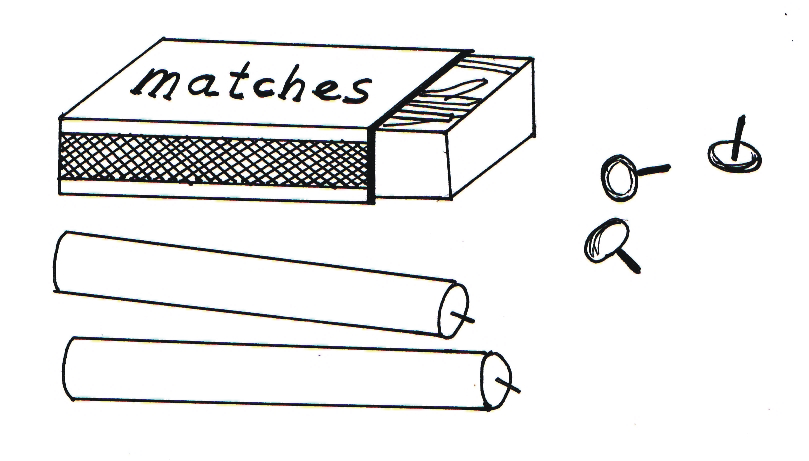
Anwinkle at English Wikibooks, CC BY-SA 3.0 via Wikimedia Commons
Practice: Problem-Solving Theories
Michaela is sitting in a wobbly chair - one leg is just a tiny bit shorter than the others. She can't find a piece of paper or cardboard to stick under it (at least not one that she can spare!). Her younger sister comes along and sticks a thumbtack into the shorter leg, making the chair even. Michaela couldn't solve this problem because of: