Popular Courses
Psychology
University Study Guides
Psychology
University Study Guides
PSYCH 1XX3
McMaster University
PSYCHOL 1003A/B
Western University
PSYC 201
University of Calgary
PSYC 200
Concordia University
PSYC 1004
Virginia Tech
PSYCH 100
Pennsylvania State University
PSC 001
University of California - Davis
PSY 2012
University of Florida
PSY 101
Michigan State University
PSYCH10
University of California - Los Angeles
PSY 101
San Diego State University
PSC 001Y
University of California - Davis
PSY 101
University of Arizona
PSYC 1001
University of Cincinnati
PSY 200
North Carolina State University
PSY 101
Arizona State University - Tempe
PSY-P 101
Indiana University - Bloomington
PSYC 1315
University of Texas at Arlington
0:00 / 0:00
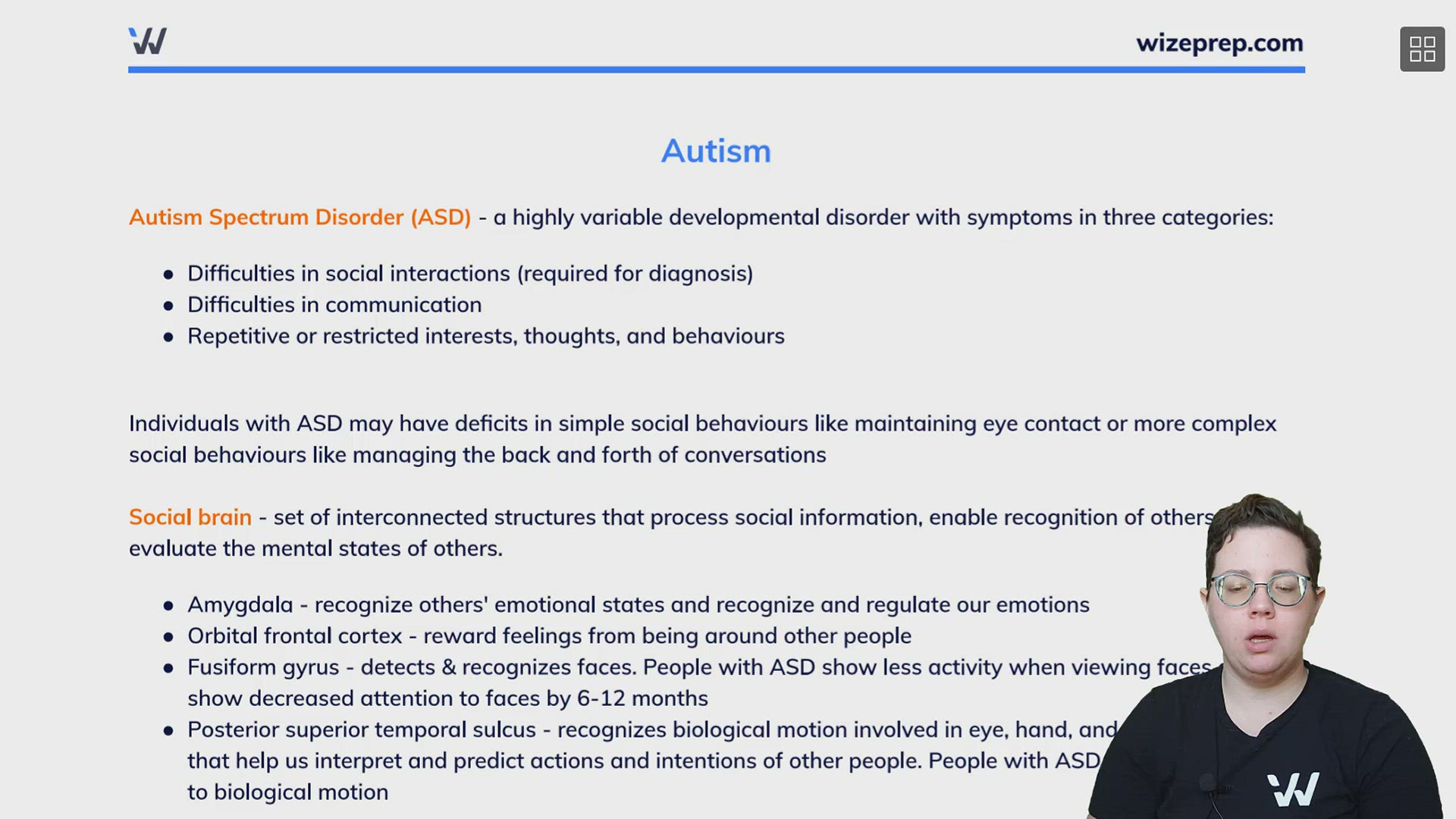
Autism
Autism Spectrum Disorder (ASD) - a highly variable developmental disorder with symptoms in three categories:
- Difficulties in social interactions (required for diagnosis)
- Difficulties in communication
- Repetitive or restricted interests, thoughts, and behaviours
Individuals with ASD may have deficits in simple social behaviours like maintaining eye contact or more complex social behaviours like managing the back and forth of conversations
Social brain - set of interconnected structures that process social information, enable recognition of others, and evaluate the mental states of others.
- Amygdala - recognize others' emotional states and recognize and regulate our emotions
- Orbital frontal cortex - reward feelings from being around other people
- Fusiform gyrus - detects & recognizes faces. People with ASD show less activity when viewing faces and show decreased attention to faces by 6-12 months
- Posterior superior temporal sulcus - recognizes biological motion involved in eye, hand, and body movements that help us interpret and predict actions and intentions of other people. People with ASD are less sensitive to biological motion
Researchers study infant development and genetics to try and identify early markers for ASD, before behavioural symptoms emerge
Practice: Autism
Match the structures of the social brain with their functions
A.
recognizing others' emotional states, recognizing and regulating our emotions
B.
reward feelings from being around other people
C.
detecting & recognizing faces
D.
recognizing biological motion
Amygdala
Orbital frontal cortex
Fusiform gyrus
Posterior superior temporal sulcus