Popular Courses
MCAT
General Course
Psychology
University Study Guides
PSYC 100
Queen's University
Psychology
University Study Guides
PSYC*1000
University of Guelph
PSYCH 1XX3
McMaster University
PSY100H1
University of Toronto
PSYCHOL 1003A/B
Western University
HH/PSYC 1010 6.00
York University
PSYC 102
University of British Columbia
PSYC 201
University of Calgary
PSYC 200
Concordia University
PSYC 1004
Virginia Tech
PSYCH 100
Pennsylvania State University
PSC 001
University of California - Davis
PSY 2012
University of Florida
PSY 101
Michigan State University
PSYCH10
University of California - Los Angeles
PSY 101
San Diego State University
PSC 001Y
University of California - Davis
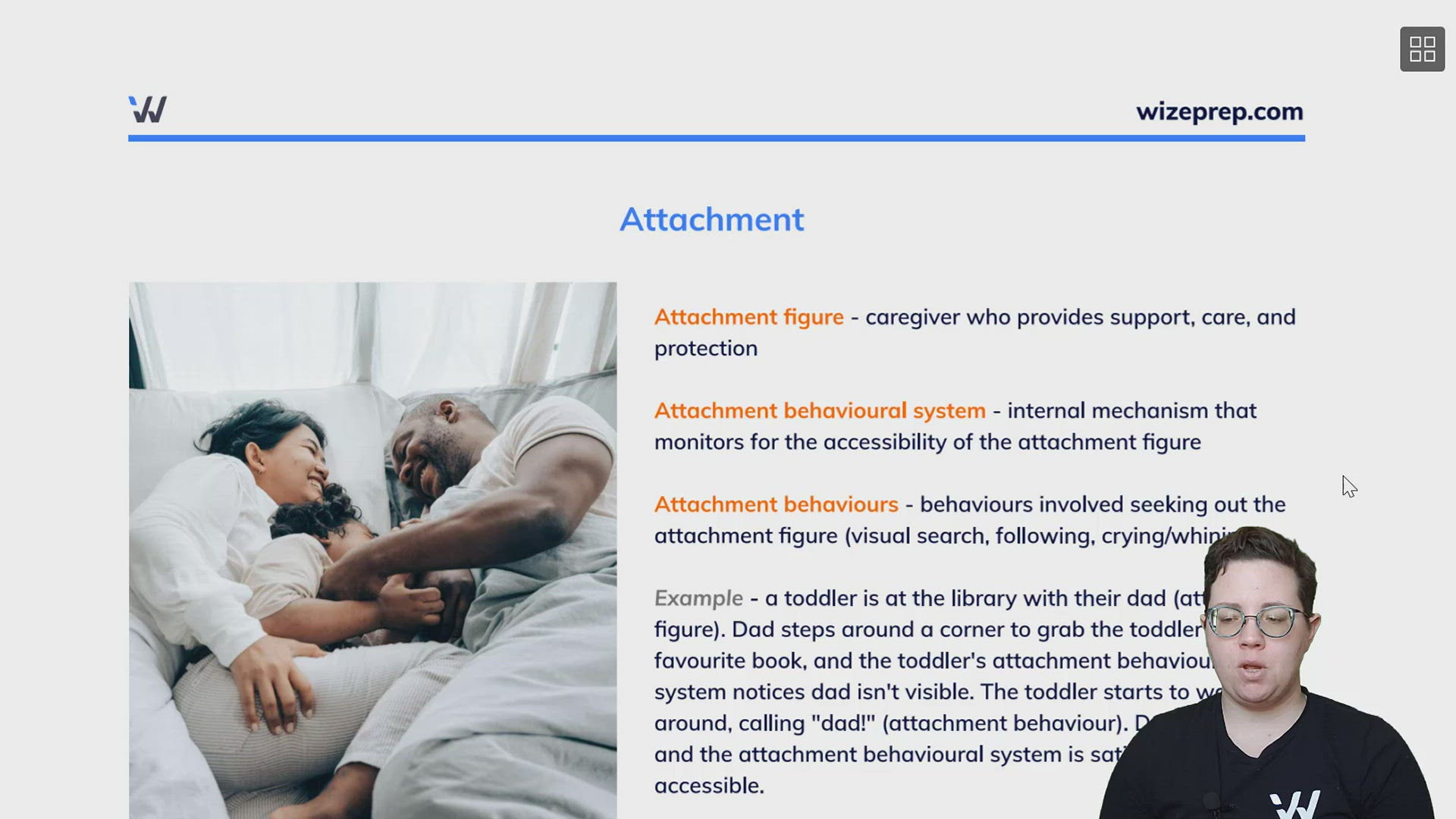
0:00 / 0:00
Attachment

Attachment figure - caregiver who provides support, care, and protection
Attachment behavioural system - internal mechanism that monitors for the accessibility of the attachment figure
Attachment behaviours - behaviours involved seeking out the attachment figure (visual search, following, crying/whining)
Example - a toddler is at the library with their dad (attachment figure). Dad steps around a corner to grab the toddler's favourite book, and the toddler's attachment behavioural system notices dad isn't visible. The toddler starts to walk around, calling "dad!" (attachment behaviour). Dad reappears, and the attachment behavioural system is satisfied that he is accessible.
Strange Situation - an experimental design constructed to test infant-parent separations and attachment
- 12-18 month old infants are brought into the lab with a parent
- Child plays for awhile with parent and stranger present
- Parent leaves the room, researchers observe child's behaviour
- Parent returns to the room, researchers observe child's behaviour
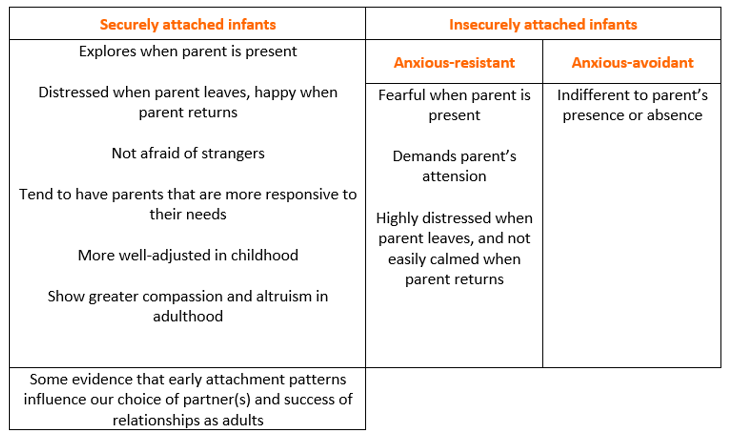
Attachment deprivation (due to isolation, group settings like orphanages, serious neglect) associated with lower IQ, more behavioural problems, and difficulty forming peer relationships. If a child is removed from the situation and placed with caregivers, these issues can resolve - the younger the better.
Practice: Attachment
The quality of attachment between an infant and their caregiver is dependent upon;
It is Roan's first day at daycare. When his mother drops him off, he is hysterical and clings to her. When she arrives at the end of the day, Roan runs up to her and hugs her leg but quickly becomes hysterical again, kicking her and thrashing his body when she tries to pick him up to comfort him. What attachment style does this example suggest?