Wize University Psychology Textbook > Personality
Social-Cognitive Approach
Popular Courses
Psychology
University Study Guides
Psychology
University Study Guides
PSYCH 1XX3
McMaster University
PSY100H1
University of Toronto
PSYCHOL 1003A/B
Western University
PSYC 201
University of Calgary
PSYC 200
Concordia University
PSYCH 100
Pennsylvania State University
PSC 001
University of California - Davis
PSY 2012
University of Florida
PSY 101
Michigan State University
PSYCH10
University of California - Los Angeles
PSC 001Y
University of California - Davis
PSY 101
San Diego State University
PSY 101
University of Arizona
PSYC 1001
University of Cincinnati
PSY 200
North Carolina State University
PSY 101
Arizona State University - Tempe
PSY-P 101
Indiana University - Bloomington
PY 101
The University of Alabama
0:00 / 0:00
Social-Cognitive Approach

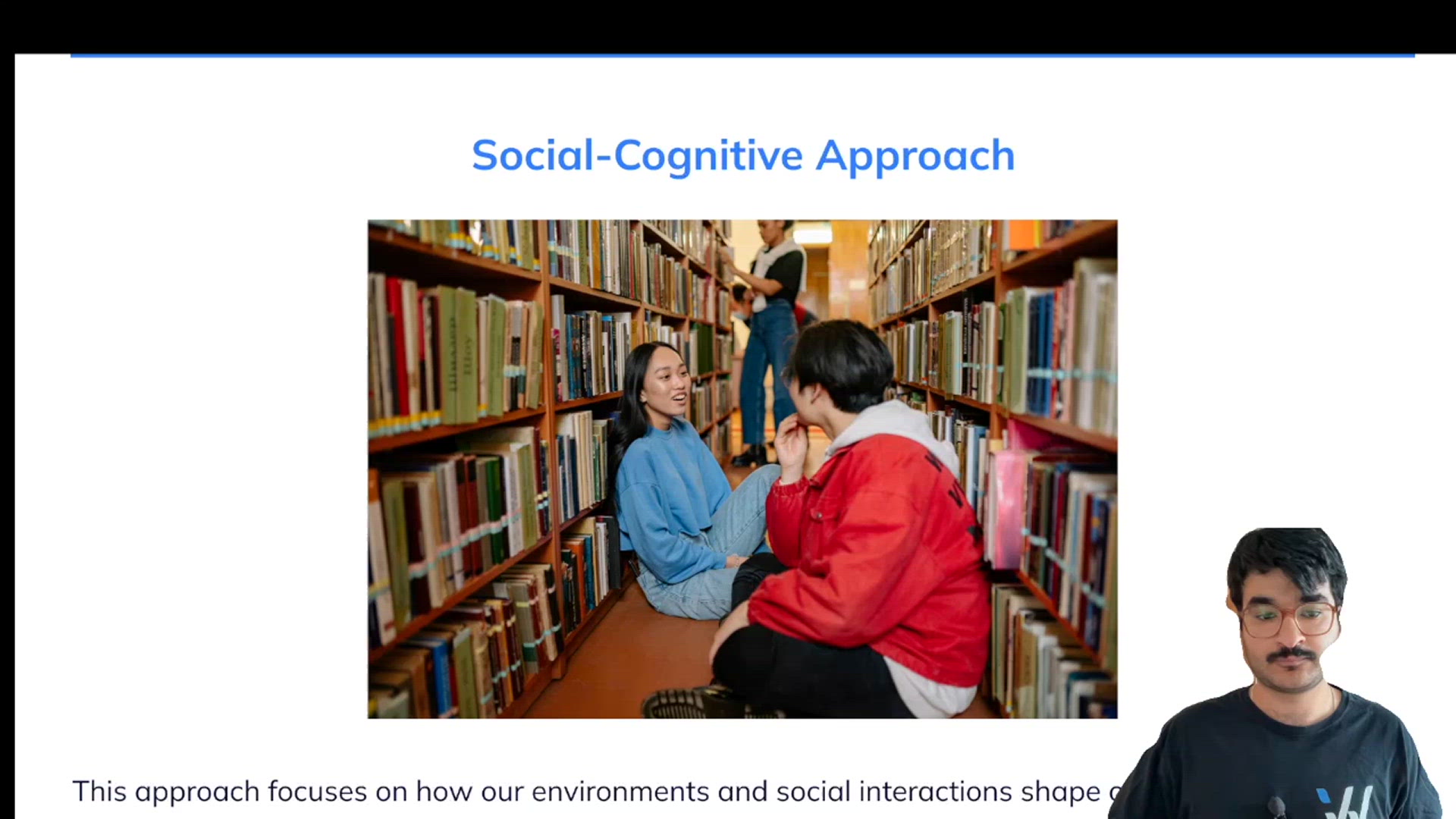
This approach focuses on how our environments and social interactions shape our personality
Reciprocal Determinism (Albert Bandura) - our personality is influenced by multidirectional interactions between our:
- Personal factors (emotions, thoughts, self-regulation)
- Behaviour (the way we act or react in different situations)
- Environment (reinforcement, social networks, cultural influences)
Example - George's parents (environment) raised him to value education as one of the most important pursuits in life. As a result, he ends up joining a lot of extracurricular clubs (behaviour), which introduces him to a lot of likeminded people (environment). He really respects people who feel the same way about education (personal factors), and finds that he doesn't feel interested in hanging out with classmates that skip class often (behaviour & environment).
Self-Efficacy - belief in our own ability to achieve goals or complete tasks
- Higher self-efficacy (greater confidence in our ability to achieve our goals) is associated with greater performance and accomplishment
Locus of Control (Julian Rotter) - how much control we think we have over our lives & whether we attribute events and outcomes to our own actions or external factors
- Internal locus of control - outcomes are mainly determined by our own actions
- External locus of control - outcomes are mainly determined by external forces
Example - Doing poorly on a test:
- Someone with an internal locus of control might say: "I didn't study enough, next time I'll need to review more flash cards"
- Someone with an external locus of control might say: "The teacher didn't even prepare us for the material, and I could barely focus during the test because of the noise in the hallway"