Popular Courses
Psychology
University Study Guides
PSYC 100
Queen's University
Psychology
University Study Guides
PSYC*1000
University of Guelph
PSYCH 1XX3
McMaster University
PSYC 100
McGill University
PSY100H1
University of Toronto
PSYCHOL 1003A/B
Western University
HH/PSYC 1010 6.00
York University
PSYC 100B
Queen's University
PSYC 201
University of Calgary
PSYC 200
Concordia University
PSYCH 100
Pennsylvania State University
PSC 001
University of California - Davis
PSY 2012
University of Florida
PSY 101
Michigan State University
PSYCH10
University of California - Los Angeles
PSY 101
San Diego State University
PSC 001Y
University of California - Davis
PSY 101
University of Arizona
0:00 / 0:00
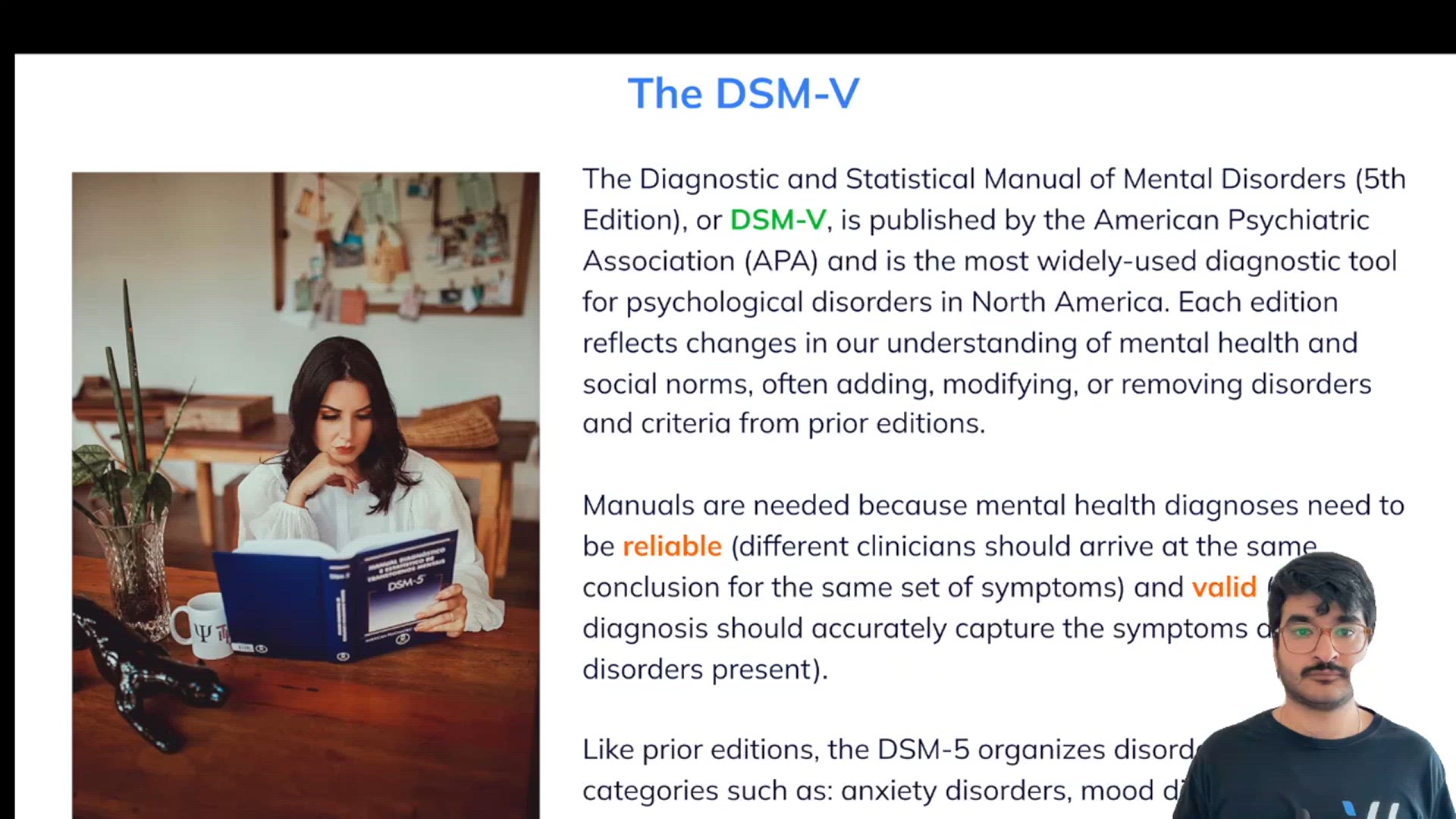
The DSM-V

The Diagnostic and Statistical Manual of Mental Disorders (5th Edition), or DSM-V, is published by the American Psychiatric Association (APA) and is the most widely-used diagnostic tool for psychological disorders in North America. Each edition reflects changes in our understanding of mental health and social norms, often adding, modifying, or removing disorders and criteria from prior editions.
Manuals are needed because mental health diagnoses need to be reliable (different clinicians should arrive at the same conclusion for the same set of symptoms) and valid (the diagnosis should accurately capture the symptoms and disorders present).
Like prior editions, the DSM-5 organizes disorders into categories such as: anxiety disorders, mood disorders, personality disorders, and substance-related disorders.
However, it added a dimension approach for symptoms to capture different levels of severity (i.e. mild, moderate, severe). Clinicians must also account for how long symptoms have persisted and the impact on the individual's daily functioning.
Some criticize the DSM for overdiagnosing and pathologizing normal behaviour and for centering Western social norms and understandings of mental health — though the DSM-V integrates cultural factors more than previous editions.