Wize University Statistics Textbook > Continuous Probability Distributions
Exponential Distribution
Popular Courses
Statistics
General Course
Intro to Statistics
University Study Guides
STAT 213
University of Calgary
STA 100
University of California - Davis
Grade 12 Data Management
Ontario High School
Intro to Statistics
University Study Guides
STATS 2035
Western University
STAT 161
University of Alberta
ENDG 319
University of Calgary
ECON 221
Concordia University
STAT 251
University of British Columbia
Grade 12 Statistics
Canada High School
MATH 203
McGill University
STAT*2060
University of Guelph
STA 2391
University of Ottawa
STAT-2910
University of Windsor
Stats 8
Oregon State
STAT 1000
University of Manitoba
ENGR 371
Concordia University
STAT 252
University of Victoria

0:00 / 0:00
Exponential Experiment
The exponential distribution describes the amount of time it takes until some event occurs. It is often used to model "failure" times or waiting times.
Examples
1) The length of time (in hours) between students dropping in at office hours.
2) The waiting time (in minutes) until a customer service operator answers your call.
3) The distance (in km) travelled by an old vehicle before it breaks down.
An exponential experiment has the following properties:
- Memoryless property this means the future probabilities are not influenced by how much time has elapsed in the past.
- The distribution of the remaining life does not depend on how long the time as elapsed.
- Example Although you've been on hold for a long time, it does not make it more likely that a customer service operator will answer your call in the next minute, or the minute after that.
- The exponential distribution is related to the Poisson distribution.
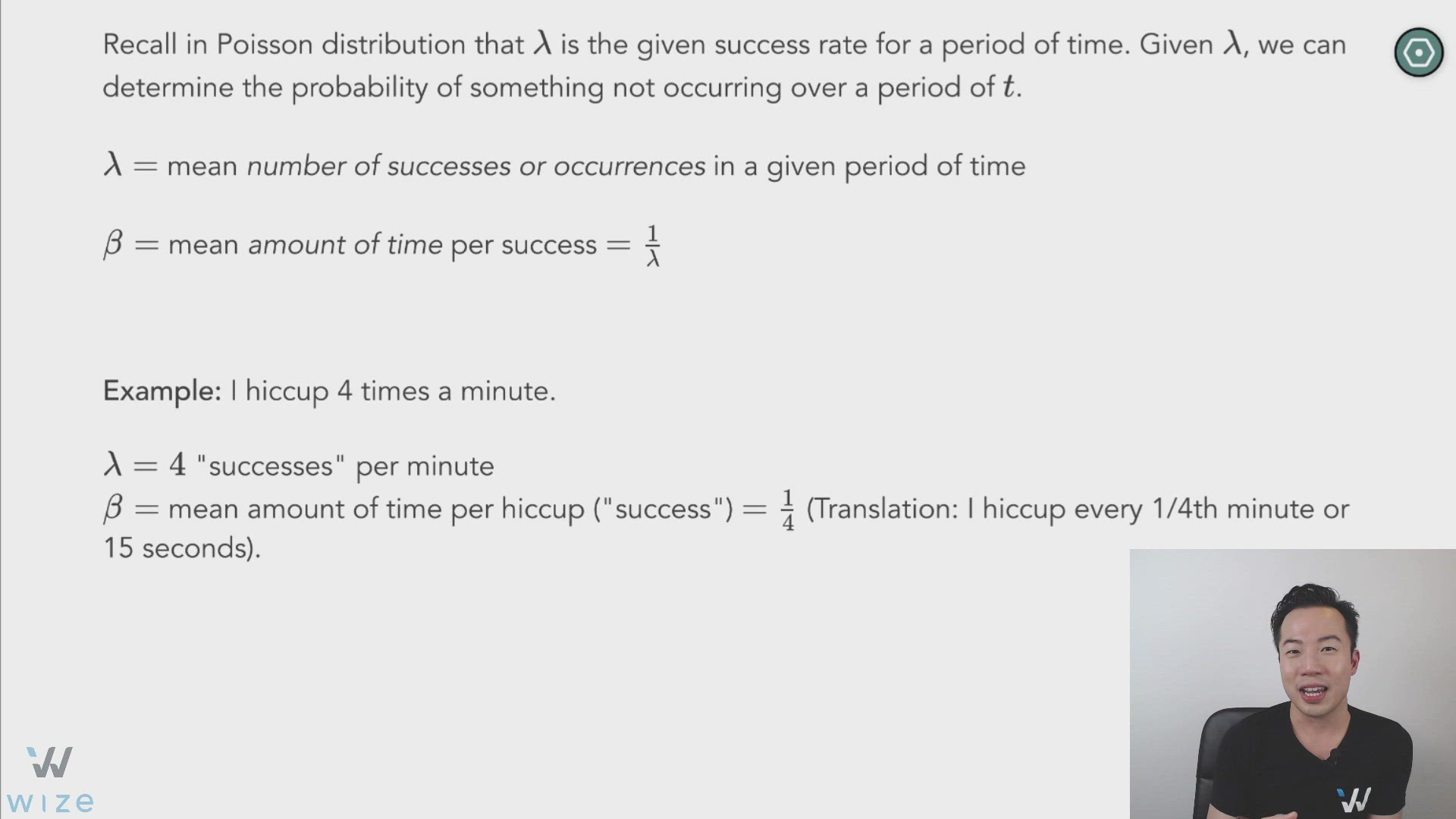
- Recall in Poisson distribution that is the given success rate for a period of time. Given , we can determine the probability of something not occurring over a period of .
mean number of successes or occurrences in a given period of time
mean amount of time per success
Example
I hiccup 4 times a minute.
- "successes" per minute
- mean amount of time per hiccup ("success") (Translation: I hiccup every 1/4th minute or 15 seconds).
Watch Out!
"Success" just denotes the outcome that you are interested in.
"Failure" just denotes the opposite outcome (i.e. complement).
For example, these could be "male or female", "win or lose", "greater than 1 or not greater than 1", etc.
0:00 / 0:00
Exponential Distribution
Recall
mean number of successes or occurrences in a given period of time
mean amount of time per success
Let how much time has elapsed without something occurring.
Cumulative Distribution Function (CDF)

Example #1
The number of burps follows an exponential probability distribution with an average of 3 burps a minute.
(a) What is the probability that the time between 2 burps is less than 2 minutes?
"successes" per minute
mean amount of time per burp ("success") (Translation: I burp every 1/3rd minute or 20 seconds).
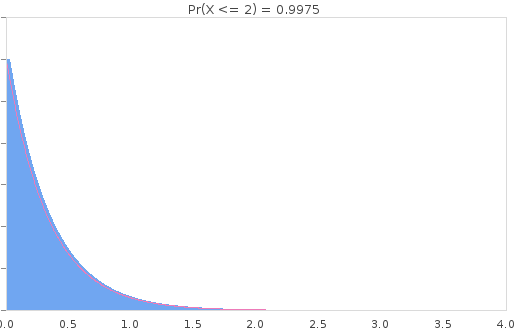
The high probability makes sense. Since I burp 3 times a minute (or I burp every 20 seconds), it is not very probable to have no burps a 2-minute gap between 2 burps. In other words, it is very probable that the time between 2 burps is less than 2 minutes.
(b) What is the probability that I do not burp in the next two minutes?
This is the same way as asking: "What is the probability that it will take me longer than 2 minutes to burp?"
Example #2
The time between a #23 bus arriving follows an exponential probability distribution with an average of 3 minutes. What is the probability that the time between 2 buses arriving is less than 2 minutes?
mean amount of time for bus to arrive (Translation: A bus arrives an average of 3 minutes).
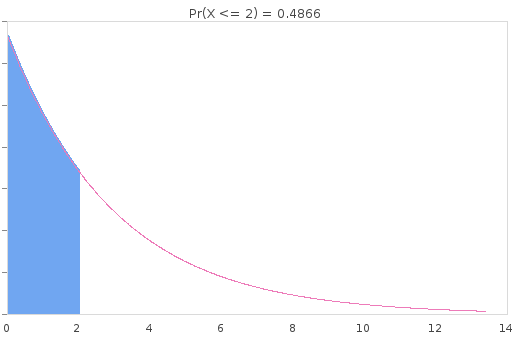
Do you see the differences between the two examples?
1. The first example tells you how many times a burp happens a minute.
2. The second example tells you the amount of time (in minutes) a bus arrives.
Watch Out!
Make sure you use and correctly!
The number of days that Bender the Robot can last with a fully charged battery can be modelled by an exponential distribution. He is expected to last days before needing to recharge.
a) What is the probability that he will last longer than 120 days?
b) What is the probability that he will last fewer than 150 days?
c) Bender already lasted 120 days so far since his large full charge. "Eh.. I got another month," he said. Given that he lasted 120 days, what is the probability that he will last 30 more days (i.e. 150 days in total)?