Popular Courses
STAT 151
University of Alberta
Statistics
General Course
Intro to Statistics
University Study Guides
COMM 191
University of British Columbia
STA 100
University of California - Davis
STAT 200
University of British Columbia
Intro to Statistics
University Study Guides
STATS 2035
Western University
STAT 161
University of Alberta
QMS 210
Toronto Metropolitan University
STAT 263
Queen's University
STAT*2040
University of Guelph
ENDG 319
University of Calgary
ECON 221
Concordia University
STAT 251
University of British Columbia
STATS 2B03
McMaster University
STAT 217
University of Calgary
COMM 162
Queen's University
STAT 1060
Dalhousie University
ECON 227
McGill University
0:00 / 0:00
Matched Pairs for Two Dependent Means

When the two means are dependent of each other, we are dealing with matched pairs or paired samples. These are instances when we compare two means that were very similar prior to an experiment.
How are two means dependent?
- One sample is drawn from the same population.
- Each observation contains a pair of measurements.
- We assess the differences from the matched or paired samples.
- Since each observation is measured twice, we calculate the difference between the before value and the after value.
- where is the sample mean of the differences which is the point estimate for the parameter the population mean of the differences.
- The differences calculated become a single sample, and we can essentially follow the one-sample hypothesis T-test.
- We also have , which is the sample standard deviation of the differences.
Examples
- The difference in responses of each subject is measured before and after receiving a treatment.
- The difference in the midterm grade and final exam grade of each student is being compared.
- The difference in appraisal value of each used car between two vehicle appraisal companies.
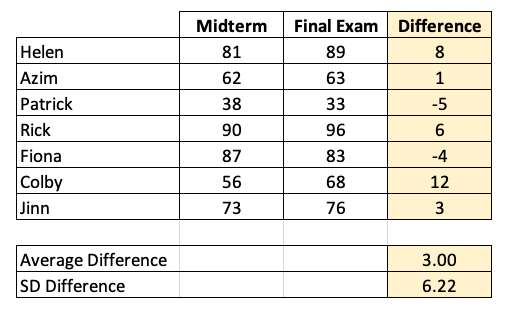
Key words: pairs, link, match, before/after, treatment/control, treatment/placebo, etc.
Does Central Limit Theorem apply with matched pairs?
Yes! One of the following conditions must hold:
- The matched pairs have differences that is drawn from a population with a normal distribution; or
- The sample size of matched pairs is sufficiently large
Examples
Determine if the following are examples of matched pairs:
1. In a 6-credit statistics course that runs from September to April, Professor Kim teaches the first half of the course (Sept-Dec) and Professor Krueger teaches the second half (Jan-Apr). At the end of each half of the course, students are asked to evaluate the professors in terms of teaching effectiveness (0 to 5). The department head compares the evaluation scores. →
YES
One sample: the students in the statistics course.
Paired measurement: each student provided two measurements (one evaluation for Dr. Kim and another evaluation for Dr. Krueger)
2. Max Powers is a famous and successful realtor. Based on a random sample of 47 homes that he sold, the average difference in home value is 82% higher after they are renovated. →
YES
One sample: the 47 homes
Pair measurements: the values of the homes before and after their were renovated
3. Leona is a personal shopper for celebrities and high-profile clients. Based on a random sample of 38 shoes from Macy's, the average price is $245. Based on a sample sample of 43 shoes from Nordstrom, the average price is $219. She concludes that the difference is not that significant. →
No
Two independent samples drawn from different populations: 38 shoes from Macy's and 43 shoes from Nordstrom.
This is essentially inference of two independent means, not matched pairs.