Popular Courses
COMM 214
Concordia University
STAT 151
University of Alberta
AP Statistics Exam Prep Course
AP Exam Prep
Statistics
General Course
Intro to Statistics
University Study Guides
COMM 215
Concordia University
Algebra I
US High School
STAT 213
University of Calgary
COMM 191
University of British Columbia
DATASCI 1000A/B
Western University
STA 100
University of California - Davis
Grade 12 Data Management
Ontario High School
High School Statistics
US High School
STATS 2244A/B
Western University
STATS 2244A/B
Western University
Intro to Statistics
University Study Guides
STATS 2035
Western University
STAT 161
University of Alberta
QMS 210
Toronto Metropolitan University
STAT 263
Queen's University

0:00 / 0:00
Percentiles
A percentile gives you a sense where a given number is ranked, relative to other numbers, within a dataset.
Example
If your midterm grade is in the top 10% percentile in your class, that means your midterm grade is in the top 10% when being compared to all other students' midterm grades in your class.
Steps for Determining Percentiles
- Arrange your data set (sample) from lowest to highest numbers.
- Compute where
- is the desired %
- is sample size, and
- is the location of the percentile
- Look at .
- If is not a whole number, then you round up to the number to get your desired percentile.
- If is a whole number, the desired percentile is the average of th and th numbers.
Wize Tip
The idea of a percentile is to “beat numbers in the sample (data set)”.
Quartiles
- To solve for the first quartile, Q1,
- To solve for the median, Q2,
- To solve for the third quartile, Q3,
0:00 / 0:00
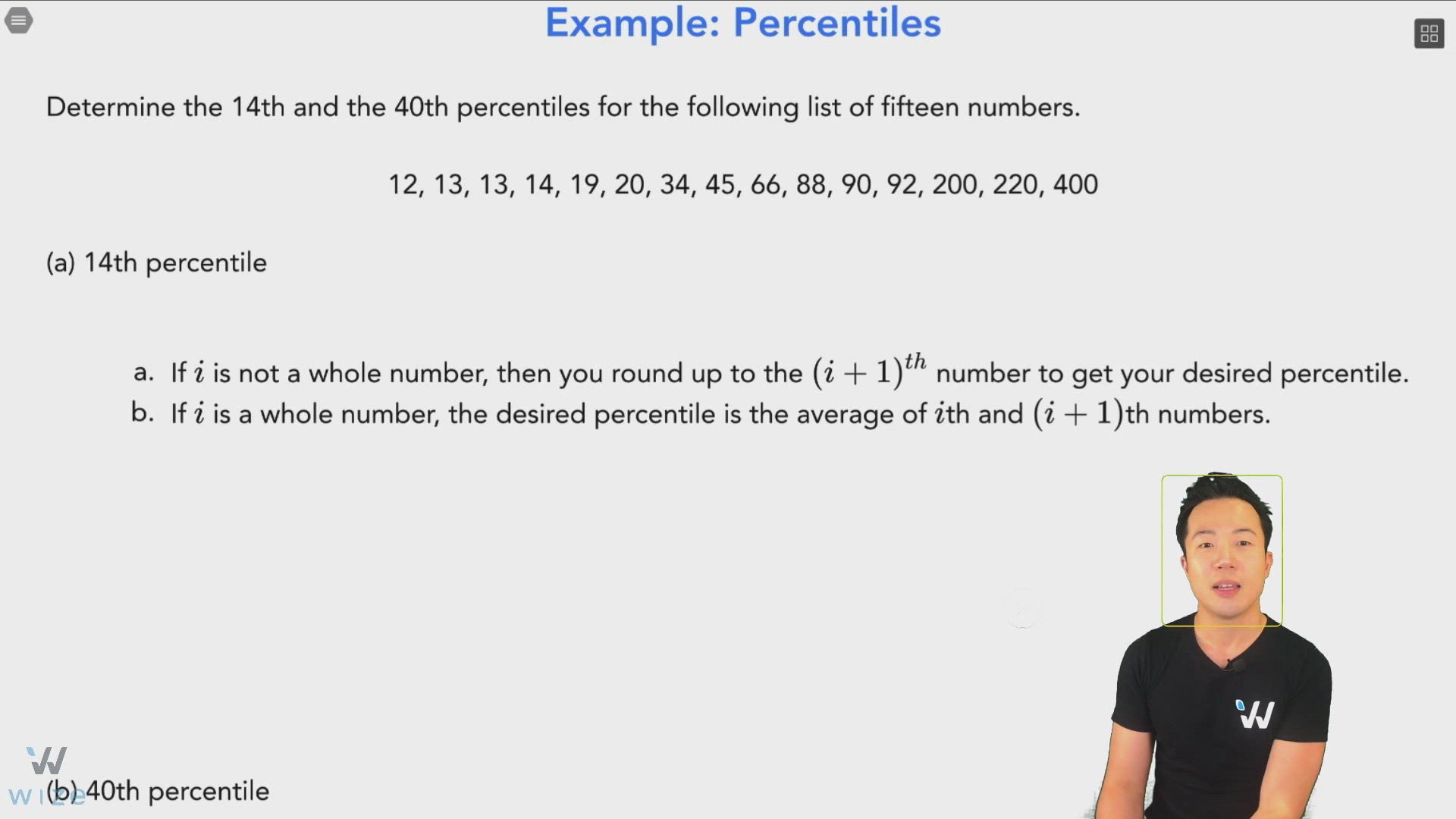
Example: Percentiles
Determine the 14th and the 40th percentiles for the following list of fifteen numbers.
12, 13, 13, 14, 19, 20, 34, 45, 66, 88, 90, 92, 200, 220, 400
(a) 14th percentile
- If is not a whole number, then you round up to the number to get your desired percentile.
- If is a whole number, the desired percentile is the average of th and th numbers.
is the 14th percentile
Remember: If is not a whole number, then you round up to the number to get your desired percentile.
(b) 40th percentile
Remember: If is a whole number, the desired percentile is the average of th and th numbers.
Practice: Percentiles
The amount earned (+) or lost ( -) by an investor per month over an eight-month period, in dollars, is given by −$200,−$10, $25, $80, $100, $180, $200, $490
(a) What is the 25th percentile?
(b) If the last number is changed from $490 to $6000, the 25th percentile remain unchanged. True or false?