Wize University Statistics Textbook > Counting Techniques
Counting Techniques
Popular Courses
COMM 214
Concordia University
STAT 151
University of Alberta
Statistics
General Course
Intro to Statistics
University Study Guides
Geometry
US High School
STAT 213
University of Calgary
STA 100
University of California - Davis
Grade 12 Data Management
Ontario High School
High School Statistics
US High School
Intro to Statistics
University Study Guides
STATS 2035
Western University
STAT 161
University of Alberta
STAT 263
Queen's University
ENDG 319
University of Calgary
STAT 251
University of British Columbia
STATS 2B03
McMaster University
Grade 12 Statistics
Canada High School
MATH 123
McGill University
MATH 203
McGill University
STAT*2060
University of Guelph
0:00 / 0:00
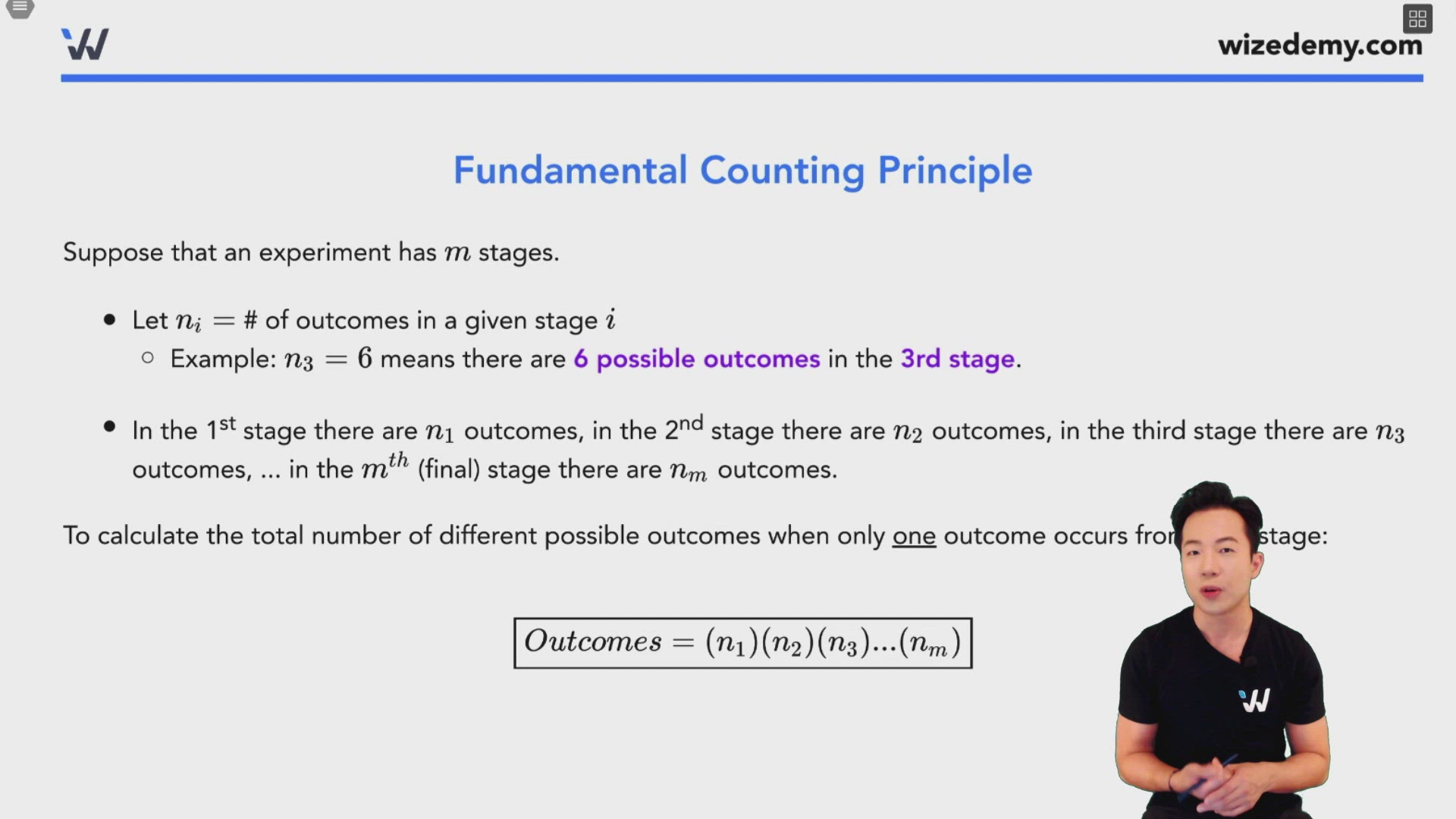
Fundamental Counting Principle
Suppose that an experiment has stages.
- Let # of outcomes in a given stage
- Example: means there are 6 possible outcomes in the 3rd stage.
- In the 1st stage there are outcomes, in the 2nd stage there are outcomes, in the third stage there are outcomes, ... in the (final) stage there are outcomes.
To calculate the total number of different possible outcomes when only one outcome occurs from each stage:
Example #1
Yyvonne is taking her dog to the dog spa. The spa package includes:
- Choose one of: (A) bubble bath or (B) pure rain experience; and
- Choose one of: (1) pawdicure, (2) massage, (3) Reiki
Determine how many possible treatment combos she can select from.
Example #2
For lunch, Jacob can pick:
- Pepsi, Coca-Cola, or Sprite as a drink;
- a chicken or beef burger;
- he has to have fries; and
- one of 4 possible desserts.
Determine how many possible meal combos he can select from.
It is simple to count when you only choose one item from each stage.
0:00 / 0:00
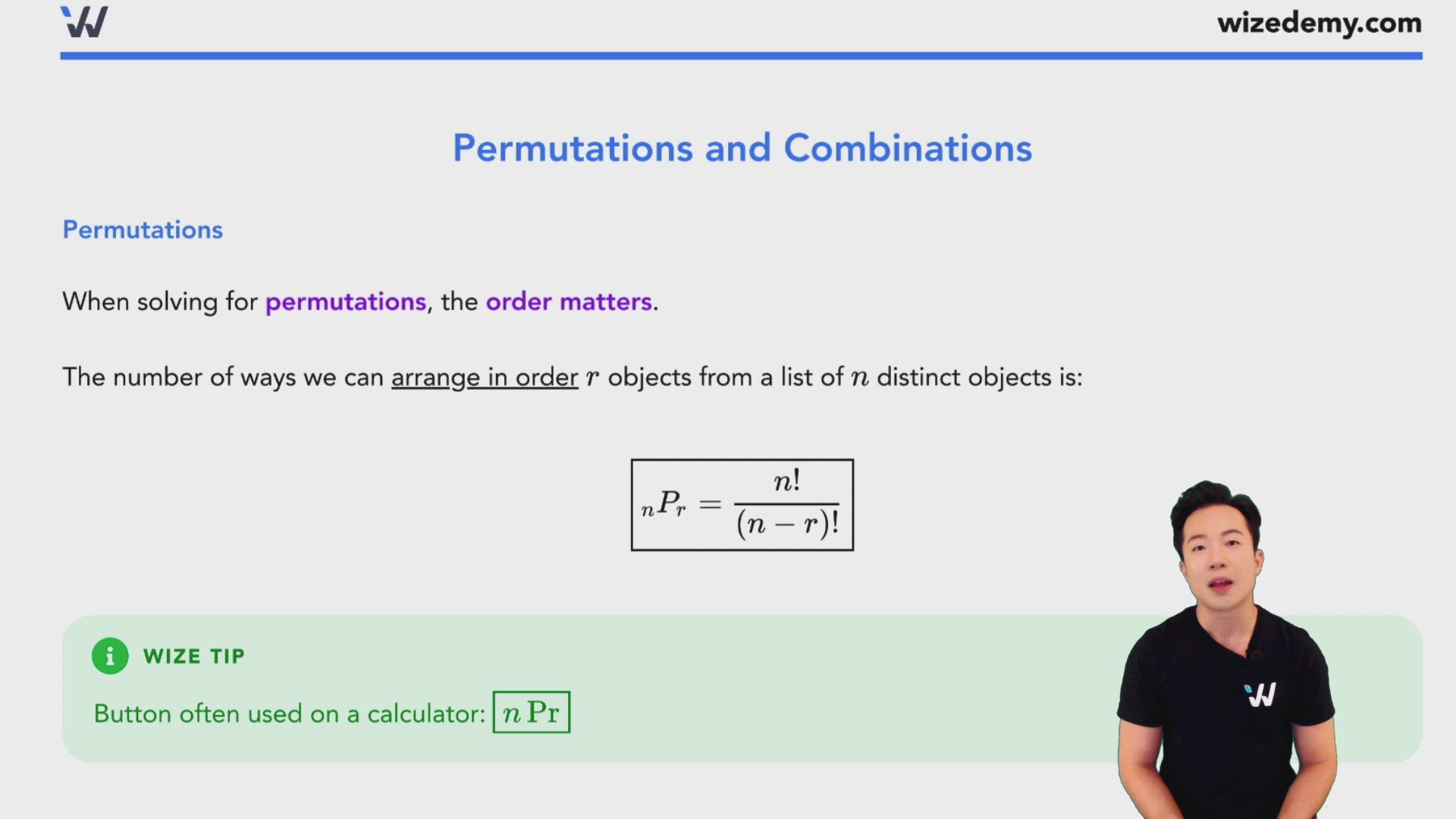
Permutations and Combinations
Permutations
When solving for permutations, the order matters.
The number of ways we can arrange in order objects from a list of distinct objects is:
Wize Tip
Button often used on a calculator:
Example #1
In how many ways can 10 employees fill 3 different shifts (i.e. morning, afternoon, evening)?
Order matters (permutation)
employees
shifts (in a specific order)
Combinations
When solving for combinations, the order does not matter.
The total number of ways to choose objects from a set containing distinct objects is calculated using :
- Unlike permutations, combinations do not care about the order of the items.
- There are fewer combinations than permutations.
if
Wize Concept
If then
Wize Tip
On a calculator this is the button
Example #1
From a group of 10 participants, how many ways can 3 people be selected to participate in a survey?
Order does not matter (combination)
participants to choose from
participants to be chosen
Santa has 4 reindeers, Prancer, Dancer, Raver, and Bender, and he wants to have 3 fly his sleigh on Christmas Eve. He always has his reindeer fly in a single-file line: front, middle, back. How many different ways can he arrange his reindeer?
There are 13 courses available for you to take next semester. How many ways can you enrol in 4 courses?
0:00 / 0:00
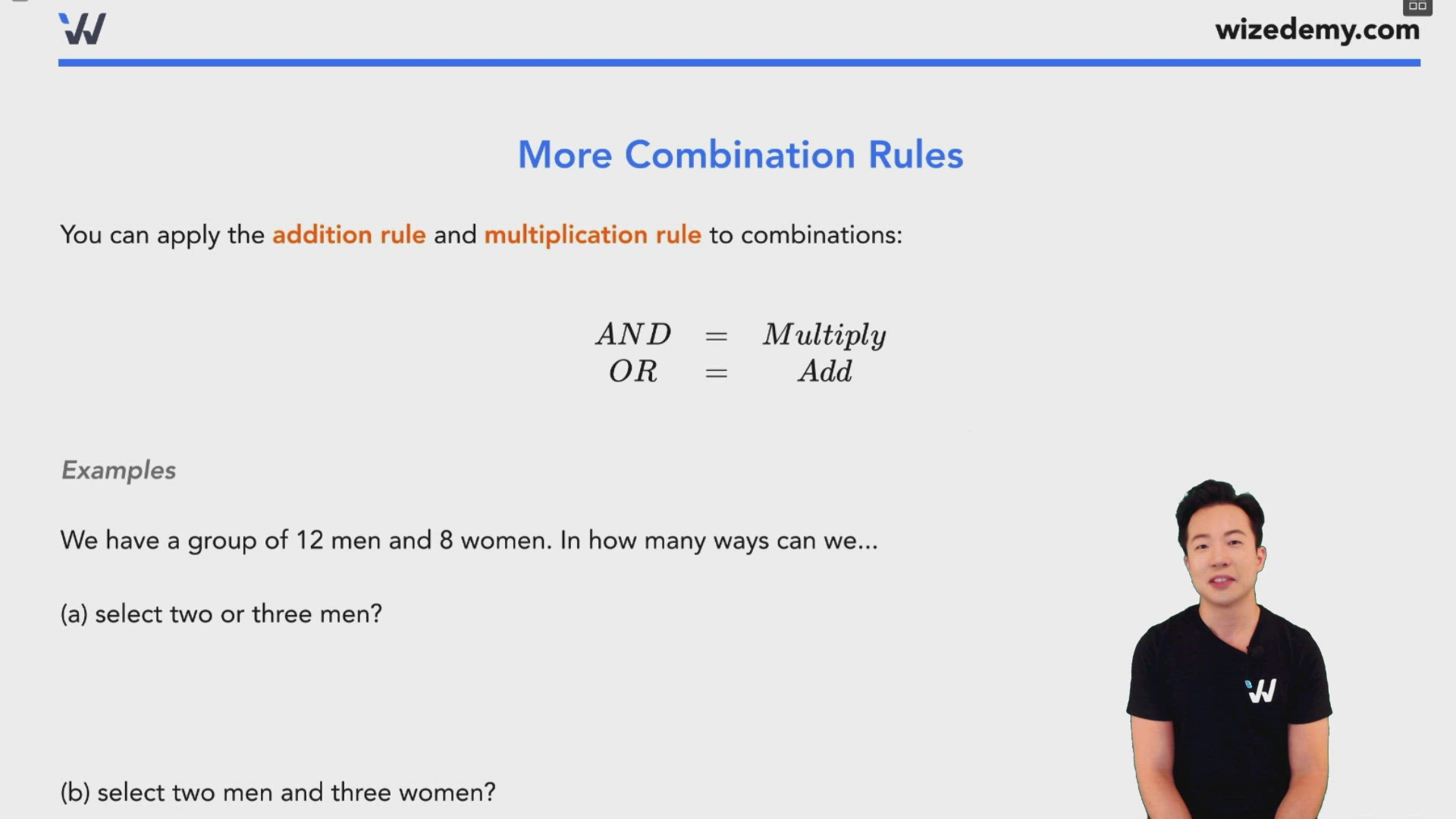
More Combination Rules
You can apply the addition rule and multiplication rule to combinations:
Examples
We have a group of 12 men and 8 women. In how many ways can we...
(a) select two or three men from a group of men?
(b) select two men from a group of men and three women from a group of women?
(c) select four men from a group of men or one woman from a group of women?
0:00 / 0:00
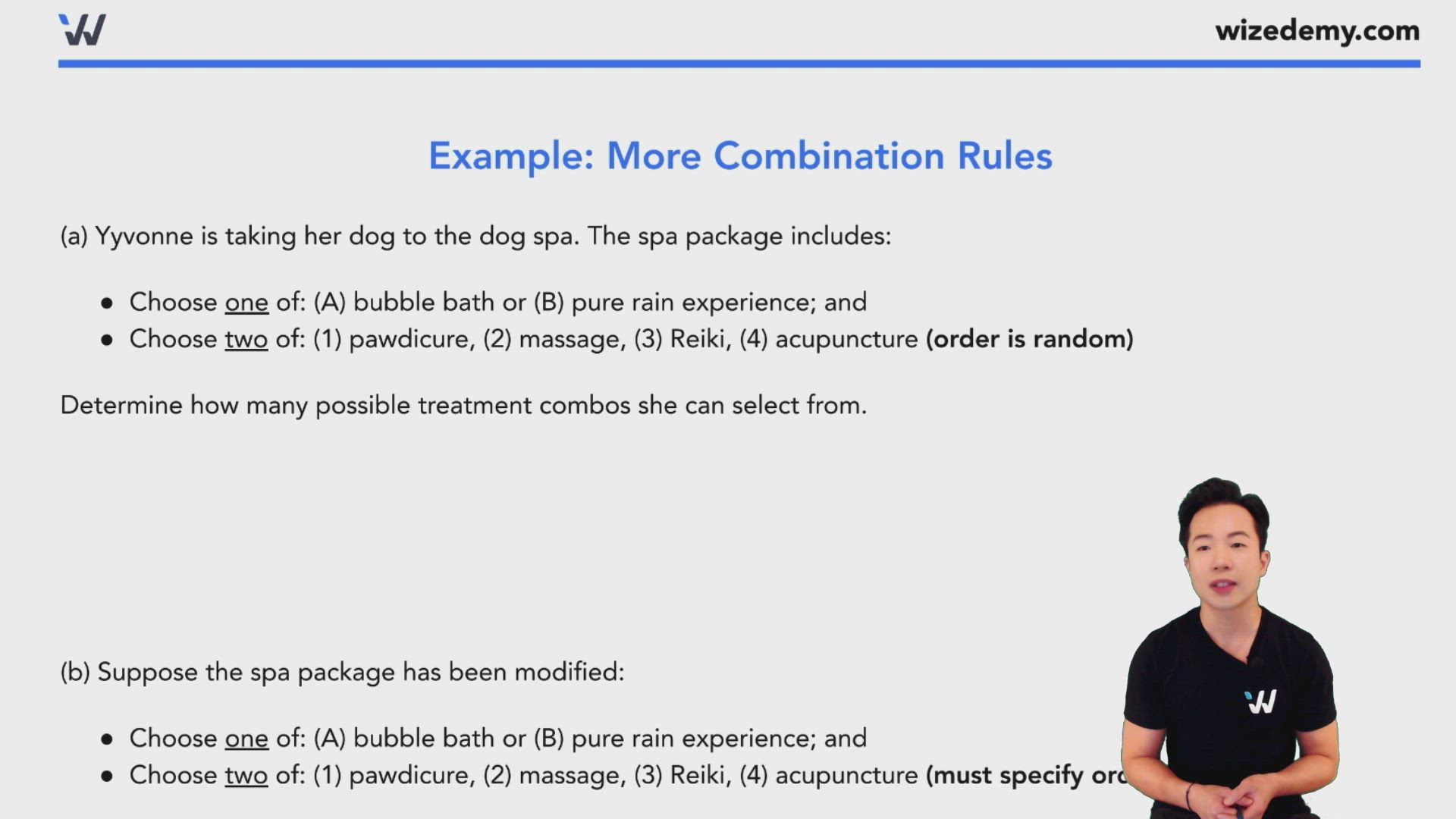
Example: More Combination Rules
(a) Yyvonne is taking her dog to the dog spa. The spa package includes:
- Choose one of: (A) bubble bath or (B) pure rain experience; and
- Choose two of: (1) pawdicure, (2) massage, (3) Reiki, (4) acupuncture (order is random)
Determine how many possible treatment combos she can select from.
Using a tree diagram could help!
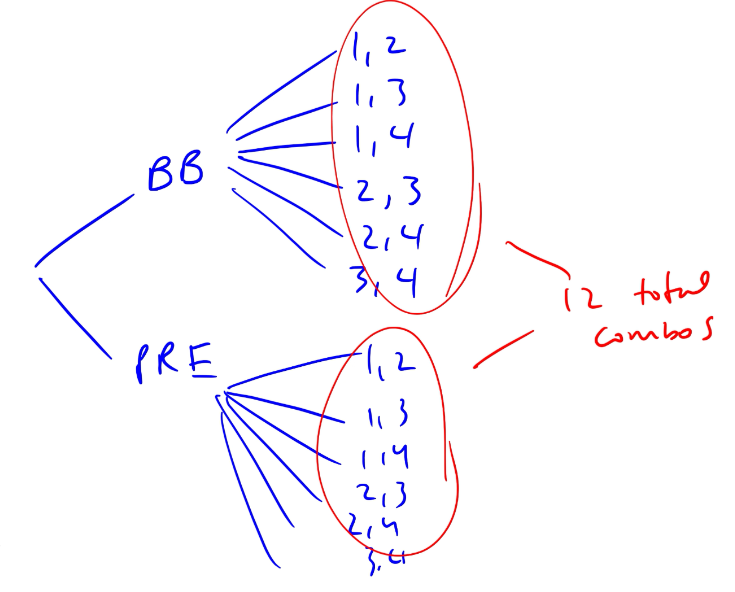
(b) Suppose the spa package has been modified:
- Choose one of: (A) bubble bath or (B) pure rain experience; and
- Choose two of: (1) pawdicure, (2) massage, (3) Reiki, (4) acupuncture (must specify order)
Determine how many possible treatment combos she can select from.
There are 7 candidates from the West and 3 candidates from the East. Three of them will be elected.
Practice: Permutation or Combination?
For each question, determine if it is a permutation or a combination and select the correct numerical answer.
(a) You have homework to do for your history, chemistry, math, and geography classes. How many different ways can you do all four homework? (2 answers)