Wize University Statistics Textbook > Discrete Probability Distributions
Poisson Distribution
Popular Courses
Statistics
General Course
Intro to Statistics
University Study Guides
STAT 213
University of Calgary
STA 100
University of California - Davis
Grade 12 Data Management
Ontario High School
Intro to Statistics
University Study Guides
STATS 2035
Western University
STAT 161
University of Alberta
QMS 210
Toronto Metropolitan University
STAT 263
Queen's University
STAT*2040
University of Guelph
ENDG 319
University of Calgary
ECON 221
Concordia University
STAT 251
University of British Columbia
STATS 2B03
McMaster University
COMM 162
Queen's University
Grade 12 Statistics
Canada High School
ECON 227
McGill University
MATH 203
McGill University
STAT*2060
University of Guelph
0:00 / 0:00
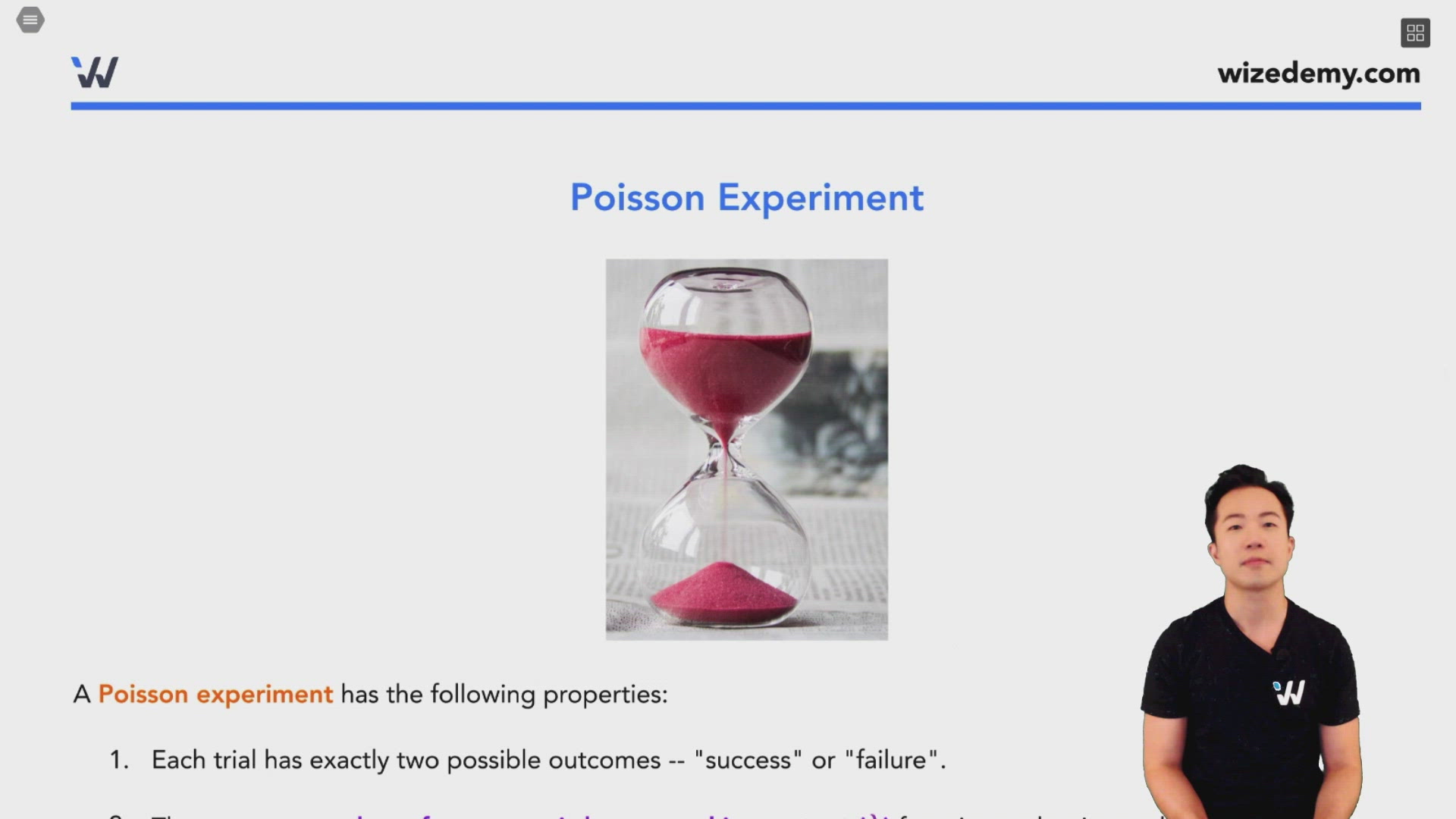
Poisson Experiment

A Poisson experiment has the following properties:
- Each trial has exactly two possible outcomes -- "success" or "failure".
- The average number of successes is known and is constant () from interval to interval of time or space
- i.e. the number of occurrences from one "block" to another "block" is independent but have the same constant average
- The number of occurrences must be uniformly distributed over the entire interval
- i.e. the probability of success in a small interval is proportional to the size of the entire interval of time or space
- i.e. The probability that a success will occur in an extremely small region is virtually zero
Watch Out!
"Success" just denotes the outcome that you are interested in.
"Failure" just denotes the opposite outcome (i.e. complement).
For example, these could be "male or female", "win or lose", "greater than 1 or not greater than 1", etc.
Examples
Determine if the following are Poisson experiments:
1. A certain realtor sells on average 3 houses per month, and you want to find the probability that he sells 4 houses next month →
YES
Let "success" = sold a home and "failure" = didn't sell a home.
The average number of successes in a given interval (month) is 3 (it is known and is a constant).
The probability that a success will occur (the realtor sells a house) is proportional to the interval of time (i.e. the longer the interval, the higher the probability of success)
2. A certain realtor sells on average 1 house during the 1st week of the month, 2 houses during the 2nd week of the month, 3 houses during the 3rd week of the month, and 4 houses during the 4th week of the month -- so on average, he sells houses per week. You want to find the probability that she sells 3 houses in the next week →
NO
Depending on which week of the month it is, the probability of success varies -- the average rate of success is not constant and the probability of success is not directly proportional to the size of the time interval (number of weeks). Therefore, this is NOT a Poisson experiment.
0:00 / 0:00
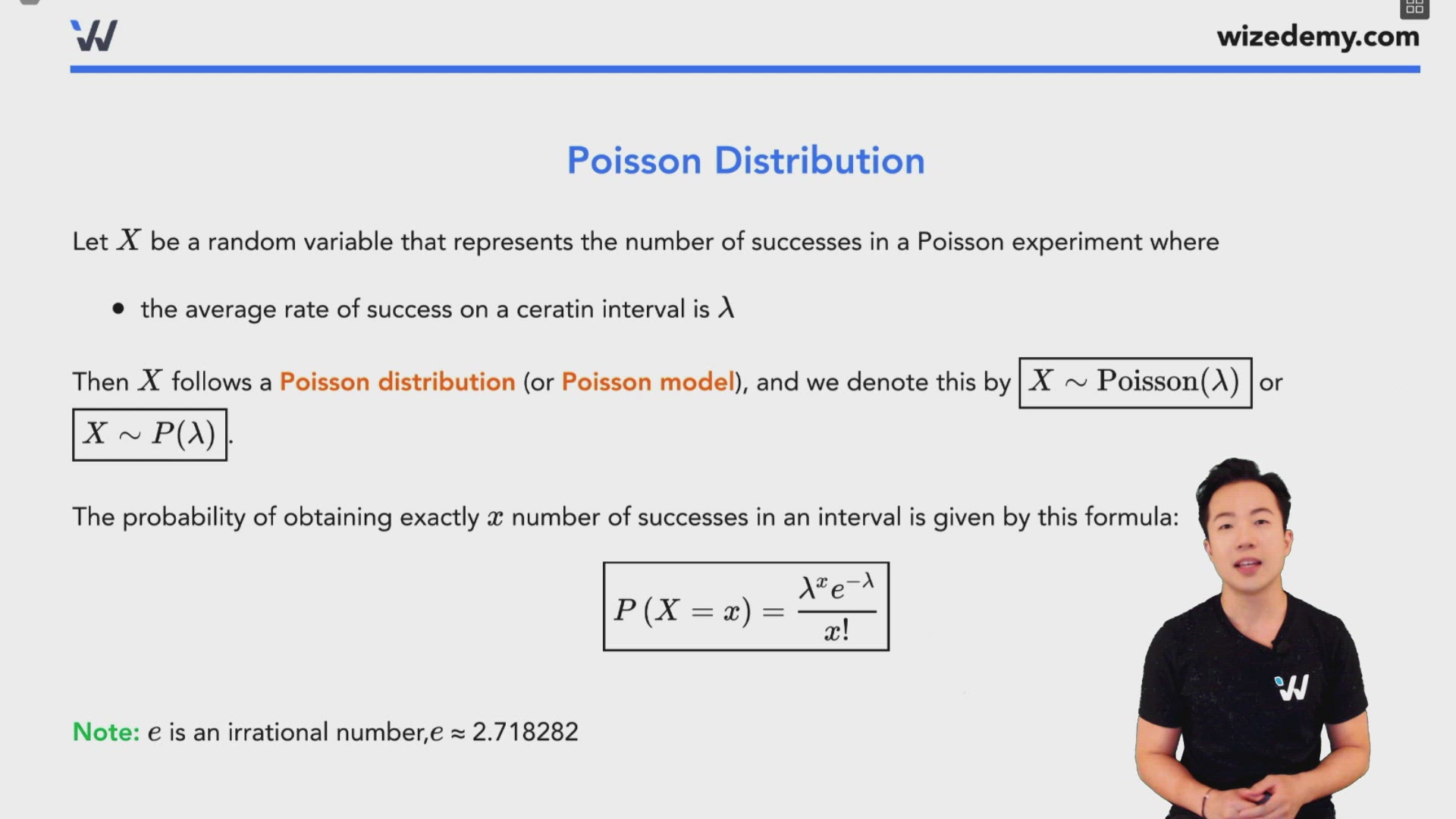
Poisson Distribution
Let be a random variable that represents the number of successes in a Poisson experiment where
- the average rate of success on a ceratin interval is
Then follows a Poisson distribution (or Poisson model), and we denote this by or .
The probability of obtaining exactly number of successes in an interval is given by this formula:
Note: is an irrational number, ≈ 2.718282
Mean, Variance, and Standard Deviation
- Mean:
- Variance:
- Standard deviation:
0:00 / 0:00
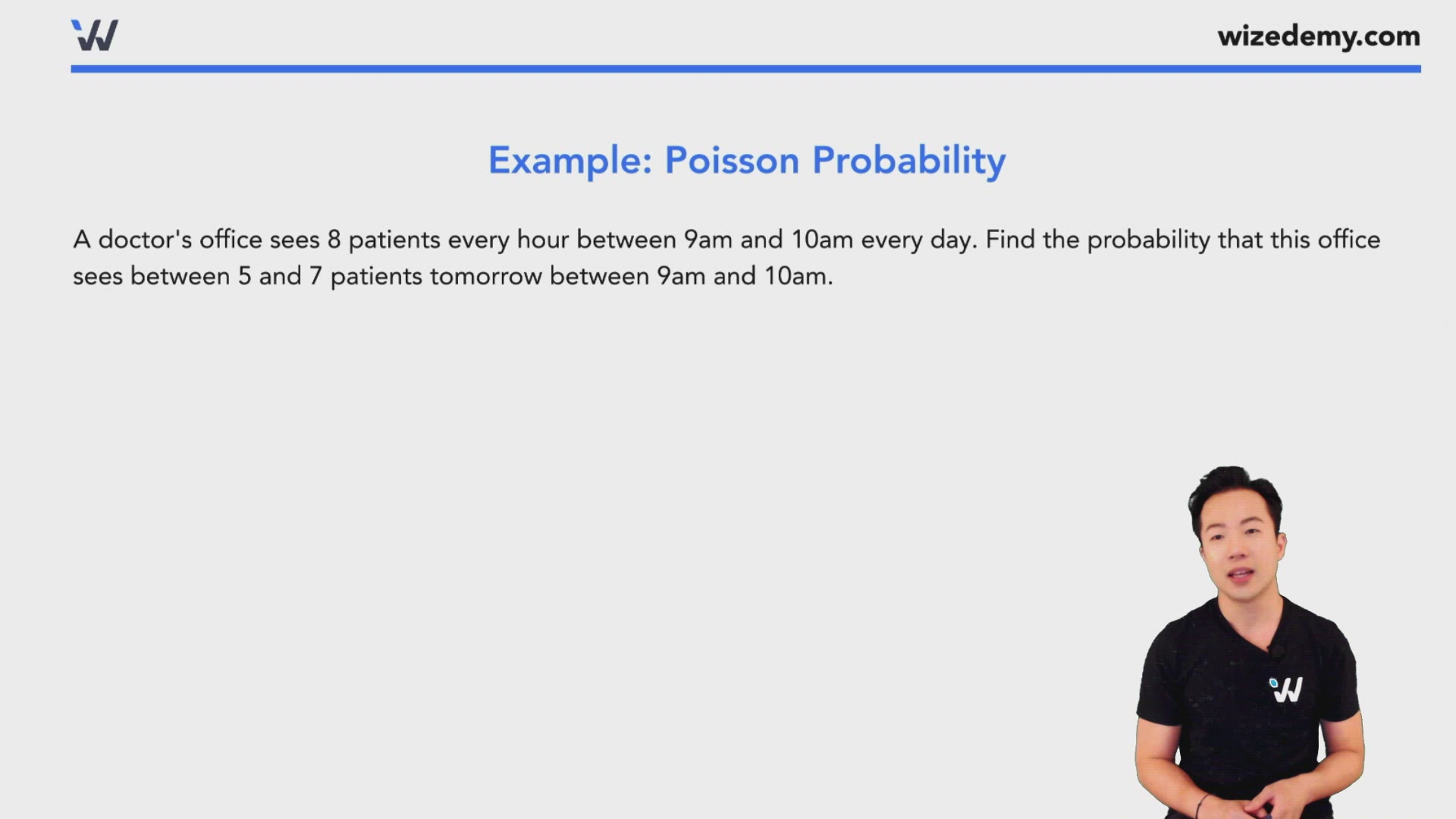
Example: Poisson Probability
A doctor's office sees 8 patients every hour between 9am and 10am every day. Find the probability that this office sees between 5 and 7 patients tomorrow between 9am and 10am.
Let "success" = a patient is seen by the doctor and "failure" = a patient is not seen by the doctor.
The average number of patients in this one hour interval is constant -- .
The probability of success is proportional to the size of the interval (i.e. the probability of a patient being seen by the doctor increases proportionately with the number of day you perform this experiment)
So, this is a Poisson experiment.
Using our formula:
Therefore, the probability of getting between 5 and 7 patients tomorrow between 9am and 10am is approximately 0.353.
Andy is a rude bank teller. He gets an average of 3 complaints per 8-hour shift.
a) Determine the mean and standard deviation for the number of complaints in one hour.
b) What is the probability that he will get one complaint in the first hour?
c) What is the probability of Andy receiving no complaints during an 8-hour shift?
The average number of homes sold by Jon Jennings, a top realtor, is 14 homes per week. Assume he works all 7 days and all days are the same.
a) What is the probability that exactly 3 homes will be sold tomorrow?
b) What is the probability that at least 3 homes will be sold tomorrow?
c) Jon wishes to take 2 days off next week but he still wants to sell 14 homes. What is the likelihood that he can achieve this?