
Approximating the Binomial Distribution with Poisson
Suppose that is binomial with trials and a probability of success .
We can approximate the binomial distribution with a Poisson distribution if the following conditions hold:
- or (some textbooks say 10)
- is very large (most textbooks say 20)
Then, the Poisson mean is approximately equal to the Binomial mean:
And the formula becomes:
Example: Approximating Binomial with Poisson
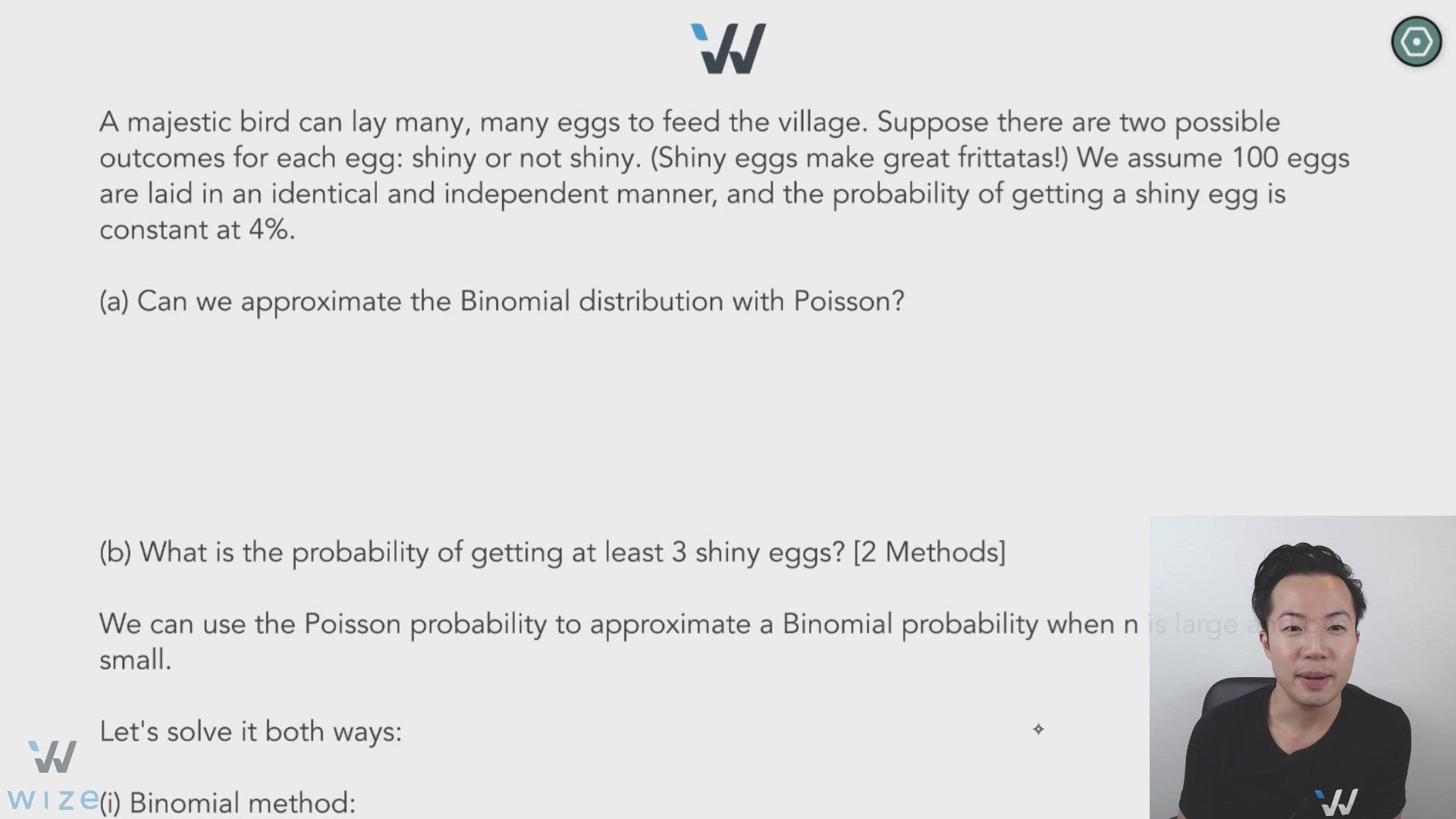
A majestic bird can lay many, many eggs to feed the village. Suppose there are two possible outcomes for each egg: shiny or not shiny. (Shiny eggs make great frittatas!) We assume 100 eggs are laid in an identical and independent manner, and the probability of getting a shiny egg is constant at 4%.
(a) Can we approximate the Binomial distribution with Poisson?
Yes, because .
(b) What is the probability of getting at least 3 shiny eggs? [Use the binomial formula]
Using the binomial formula:
(c) What is the probability of getting at least 3 shiny eggs? [Use the Poisson formula]
Using the binomial formula:
Very close answers!