Wize University Statistics Textbook > Discrete Probability Distributions
Hypergeometric Probability
Popular Courses
Statistics
General Course
Intro to Statistics
University Study Guides
STAT 213
University of Calgary
STA 100
University of California - Davis
Grade 12 Data Management
Ontario High School
Intro to Statistics
University Study Guides
STATS 2035
Western University
STAT 161
University of Alberta
STAT 263
Queen's University
STAT*2040
University of Guelph
ENDG 319
University of Calgary
ECON 221
Concordia University
STAT 251
University of British Columbia
Grade 12 Statistics
Canada High School
ECON 227
McGill University
MATH 203
McGill University
STAT*2060
University of Guelph
STA 2391
University of Ottawa
STAT-2910
University of Windsor
Stats 8
Oregon State
0:00 / 0:00
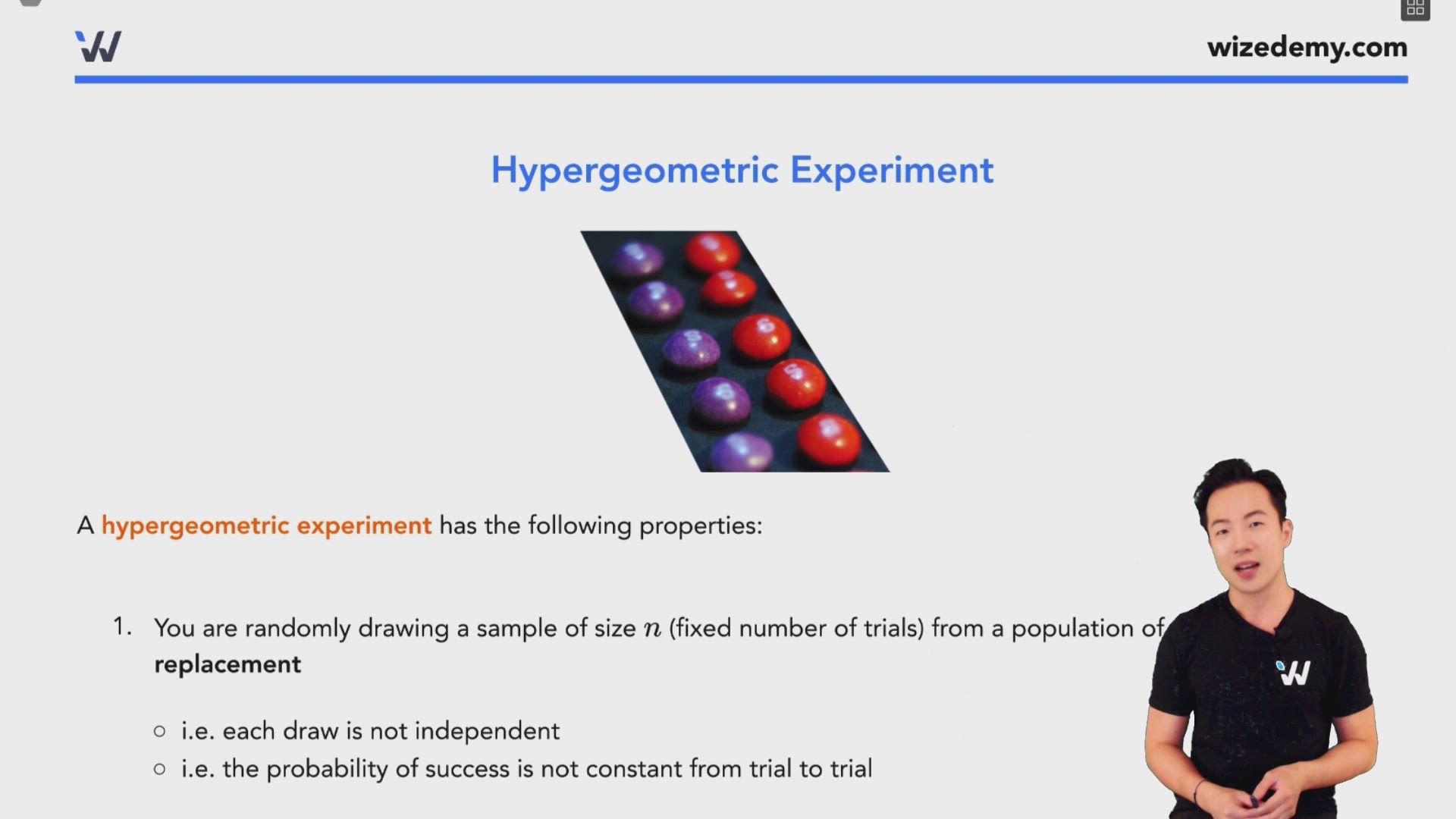
Hypergeometric Experiment
A hypergeometric experiment has the following properties:
- You are randomly drawing a sample of size (fixed number of trials) from a population of size without replacement
- i.e. each draw is not independent
- i.e. the probability of success is not constant from trial to trial
- of the objects in the population are considered "success" (a.k.a. favorable)
Watch Out!
"Success" just denotes the outcome that you are interested in.
"Failure" just denotes the opposite outcome (i.e. complement).
For example, these could be "male or female", "win or lose", "greater than 1 or not greater than 1", etc.
Examples
Determine if the following are hypergeometric experiments:
1. You draw coins from a bag containing 3 red coins and 5 blue coins and note the colour of the coin drawn. You repeat this experiment 4 times with replacement →
NO
This is NOT hypergeometric since each trial is independent from the other ones because you are doing this with replacement (the bag starts off with the same coins at the start of every trial.
2. You draw coins from a bag containing 3 red coins and 5 blue coins and note the colour of the coin drawn. You repeat this experiment 4 times without replacement →
YES
This is hypergeometric since each coin can either be success - red or failure -blue (you could switch these labels as well), there's a fixed number of draws from a total population of objects with replacement (each draw is not independent)
- (total number of coins)
- if red is favorable; if blue is favorable (the number of objects considered as "successes")
- (the number of draws or trials)

0:00 / 0:00
Hypergeometric Distribution
Let be a random variable that represents the number of successes in a hypergeometric experiment where
- number of all available items (population size)
- number of trials or number of items drawn from (sample size)
- number of favorable items available in (successes)
Then follows a hypergeometric distribution (or hypergeometric model), and we denote this by or .

Then the probability of obtaining exactly number of successes is given by this formula:
Notes:
- must be less than or equal to the smaller of the numbers and
- i.e. you can't have more "successes" than there are number of "success" objects/favorable objects
- i.e. you can't have more "successes" than the number of objects drawn
Mean, Variance, and Standard Deviation
- Mean:
- Variance:
- Standard deviation:

0:00 / 0:00
Practice: Hypergeometric Distribution
There are seven people in Molly’s family -- 4 women and 3 men. If I select three of them at random, what is the probability that I will get exactly two men and one woman?
Let men be "success"
Alternative method - Let women be "success"
Same answer!
There are 10 balls in a bag; 3 of them are gold balls. To win a prize, you must draw all three gold balls. You get to draw five balls. What is the probability you will win a prize?
Practice: Hypergeometric Distribution
Ivan supervises employees at Walmart. Interestingly, 15 of his night shift employees called in sick today. Ivan believes that some of them are lying about their sickness to go to the Rhianna concert tonight.
An employee knows that 6 of these 15 employees have Rhianna concert tickets and are not sick – but Ivan doesn’t know this! Ivan hires a detective to randomly spy on 5 of his employees. What is the probability that exactly 2 of the 5 selected employees will be caught with Rhianna tickets?