Wize University Statistics Textbook > Continuous Probability Distributions
Continuous Probability Distribution
Popular Courses
COMM 214
Concordia University
STAT 151
University of Alberta
Statistics
General Course
Intro to Statistics
University Study Guides
COMM 215
Concordia University
COMM 191
University of British Columbia
STAT 213
University of Calgary
STA 100
University of California - Davis
Grade 12 Data Management
Ontario High School
High School Statistics
US High School
STATS 2244A/B
Western University
STAT 200
University of British Columbia
Intro to Statistics
University Study Guides
STATS 2035
Western University
STAT 161
University of Alberta
QMS 210
Toronto Metropolitan University
STAT 263
Queen's University
STAT*2040
University of Guelph
ENDG 319
University of Calgary
ECON 221
Concordia University

0:00 / 0:00
Continuous Probability Distribution
A continuous random variable takes on infinitely many values in a given interval of numbers.
Examples
- The midterm grade of a random student
- The time it takes a random student to finish an assignment
- A randomly selected patient's blood pressure
- A randomly selected company's advertising budget
Probability Distribution/Density Function
A probability distribution function (a.k.a. probability density function or PDF) of a continuous random variable shows the probability associated with the continuous random variable .
A PDF has the following properties:
- The probability that a continuous random variable will take any particular value is zero.
- i.e. for any value .
- The PDF of a continuous random variable cannot be expressed as a table with discrete values.
- The PDF of a continuous random variable is expressed as a function
- The probability is calculated by finding the area under the probability density curve between the points and
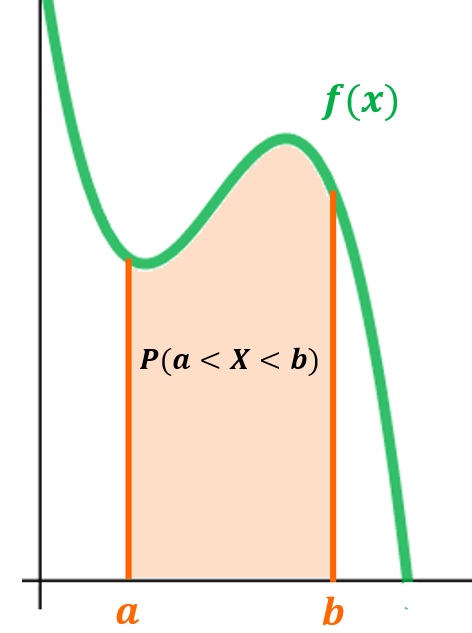
- Every point on the density curve has a vertical height between 0 and 1 since the probability must be a value between 0 and 1
- The total area under the density curve equals 1 since the total probability of all possible outcomes must equal 1