Wize University Calculus 2 Textbook > Parametric & Polar Curves
Calculus w/ Polar Coordinates
Popular Courses
Calculus 2
University Study Guides
AP Calculus (BC) Exam Prep Course
AP Exam Prep
Calculus 2
General Course
CALCULUS 1301A/B
Western University
Calculus 2
University Study Guides
MATH 267
University of Calgary
MATH 101
University of Alberta
SC/MATH 1014 3.00
York University
MATH 117
University of Waterloo
NMM 1414A/B
Western University
MATH 101
University of Victoria
MAT187H1
University of Toronto
MTH 240
Toronto Metropolitan University
MATH 118
University of Waterloo
MATH*1210
University of Guelph
MATH 1700
University of Manitoba
MATH 119
University of Waterloo
MATH 1226
Virginia Tech
MATH 1010
Dalhousie University
MATH 20B
University of California - San Diego

0:00 / 0:00
Tangents of Polar Curves (Derivatives)
First Derivative
(a.k.a slope of the tangent to the curve)
*Recall that ,
The polar curve has
- A Horizontal Tangent when
- and
- A Vertical Tangent when
- and
*If both and , use L'Hosputal's rule
Practice Question
Find the slope of the tangent line to the curve at
Practice: Tangents
Consider the polar curve where .
a) Find the slope of the tangent line to the curve at .
b) Find all points at which the tangent line to the curve is horizontal.
c) Find all points at which the tangent line to the curve is vertical.
0:00 / 0:00
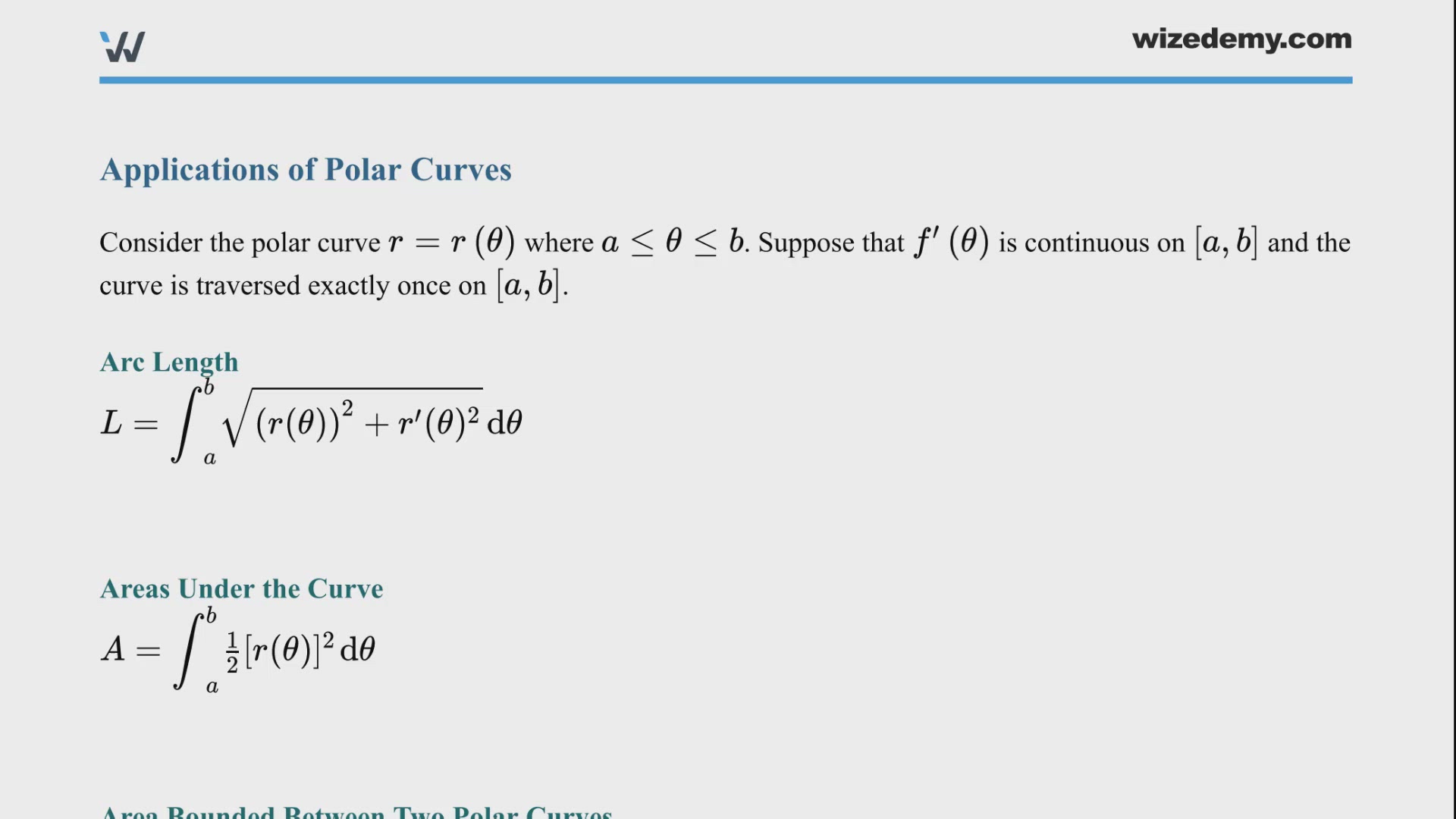
Applications of Polar Curves
Consider the polar curve where . Suppose that is continuous on and the curve is traversed exactly once on .
Arc Length
Areas Under the Curve
Area Bounded Between Two Polar Curves
Wize Tip
Always graph the curves before using the formula!
Practice: Arc Length
Compute the total length of the curve for and
Practice: Area Under Polar Curve
Find the area inside .
Practice Question
Write the integral representing the area of the inner loop of
Practice: Area Between Polar Curves
Find the area of the region lying inside the limacon curve of equation , but outside the circle = 2.