Important Elements that Make Up Life
The main elements that make up living organisms are carbon (C), hydrogen (H), oxygen (O), phosphorous (P), sulphur (S), and nitrogen (N) in addition to a few ions and trace elements (e.g. magnesium (Mg), manganese (Mn), iron (Fe)).
Carbon
When differentiating organic versus inorganic chemistry, we often refer to organic chemistry as that involving carbon-based molecules. Some of carbon's unique properties are:
- Can bind to 4 other atoms (often hydrogen).
- When it is bound to 4 atoms, the molecule forms a tetrahedral shape.
- Can bind to other carbon atoms to form chains (polymers).
- Can form various different bond types (i.e. single, double, triple).
- Carbon-Hydrogen (C-H) bonds are non-polar, where electrons are shared equally because carbon and hydrogen have similar electronegativities.

Photo by Rice University / CC BY
Unique Properties of Water
Water is the solvent of life. Naturally, our cells are mainly composed of water. Some of its special properties are:
- Polar molecule (uneven distribution of electrons).
- Oxygen is electronegative
- It pulls electrons to itself in its covalent bond with hydrogen having a partial positive charge;
- This uneven distribution of electrons creates a dipole.
- Water molecules can interact with each other via hydrogen bonding (aka H-bonds). Due to H-bonds:
- Water molecules are cohesive;
- Water has a high heat capacity and boiling point;
- Water will associate with other uncharged molecules that have polar covalent bonds and/or full charges on ions.

Photo by Rice University / CC BY
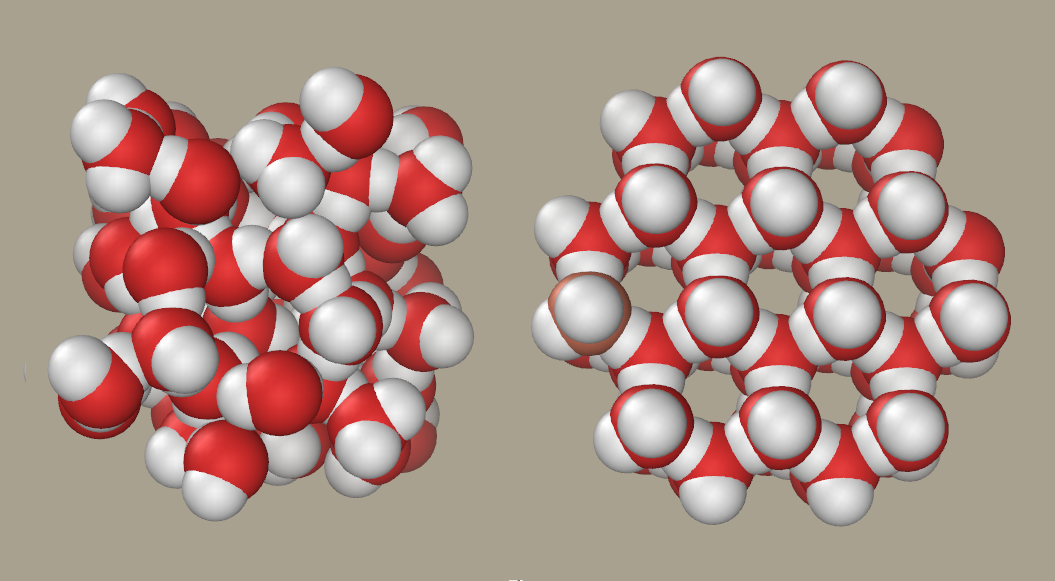
- Solid less dense than liquid
- Water assumes a lattice structure when solid;
- This orderly arrangement allows for spaces between molecules;
- Ice is 10% less dense than water.
- "Universal solvent"
- Water can surround polar or charged molecules to dissolve them. Example: in water, NaCl is broken into Na+ and Cl- ions, with water's negative partial charge surrounding the Na+, and positive partial charge surrounding the Cl-.
- Substances that easily dissolve in water are hydrophilic: water loving.
- Substances that do not dissolve well in water are hydrophobic.
