Osmosis and Osmolarity
Simply put, osmosis is the diffusion of water.
- Water is a polar molecule that diffuses into the cell through aquaporins (channels).
- There must exist a concentration gradient. Example: Solute is added to intracellular or extracellular space.
- Degree to which the concentration of water is decreased depends on the number of particles of solute.
- Osmolarity is the number of particles a solute dissociates into when in solution (per liter).
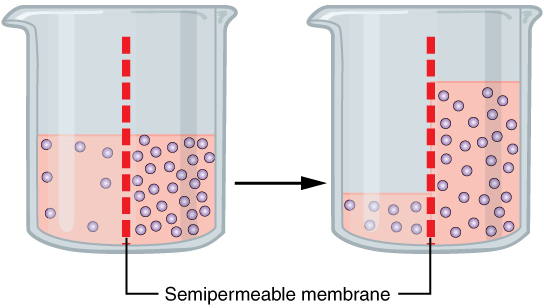
Photo by Rice University / CC BY
Osmolarity and Cell Volume
Water can always diffuse through the membrane to establish diffusion equilibrium (intracellular = extracellular osmolarity).
- In an isotonic solution: the movement of water is even across the membrane in either direction (cell volume maintained).
- In a hypertonic solution: a gradient created by a molecule results in a net movement of water out of the cell resulting in shriveling. Example: a cell is put in a solution with a lot of salt.
- In a hypotonic solution: a gradient created by a molecule results in a net movement of water into the cell resulting in swelling. Example: a cell is put in a solution with no salt.