Wize University Biology Textbook > The Plasma Membrane
Active Transport
Popular Courses
MCAT
General Course
AP Biology Exam Prep Course
AP Exam Prep
Biology
General Course
General Biology
University Study Guides
BIOLOGY 1002B
Western University
BIOL 211
University of Calgary
BIOL 107
University of Alberta
BIOL 102
Queen's University
BIOL 112
University of British Columbia
Grade 12 Biology
Canada High School
DAT
General Course
High School Biology
US High School
BIOL*1090
University of Guelph
General Biology
University Study Guides
BIOL 130
University of Waterloo
SC/BIOL 1000 3.00
York University
BIO 1141
University of Ottawa
BLG 143
Toronto Metropolitan University
BIOL 112
McGill University
BIOL 186
University of Victoria

0:00 / 0:00
Active Transport
Also involves a carrier or transporter. There are two types: primary and secondary active transport.
- Can transport solutes against its concentration gradient.
- Therefore, requires the input of energy.
- When there's no energy available, this cannot occur.
Primary Active Transport
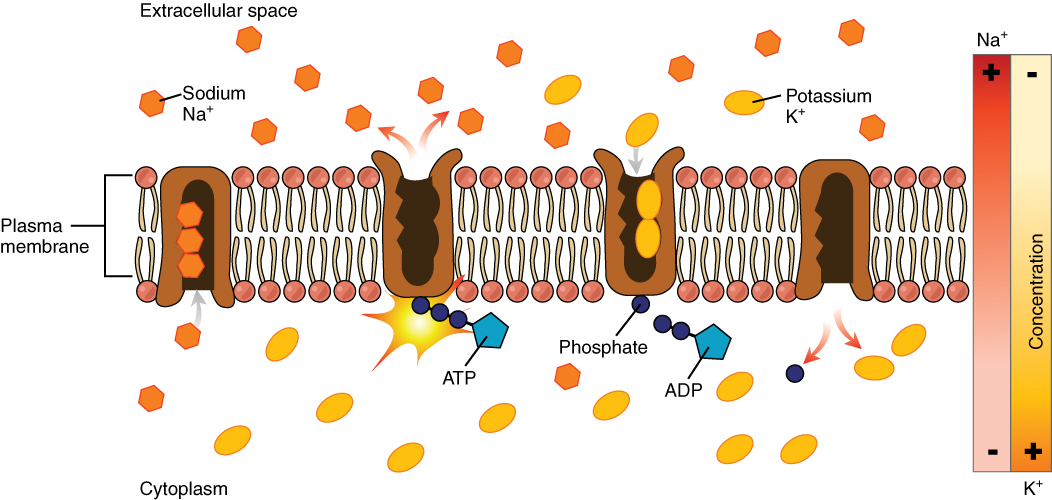
- ATP is used as the source of energy.
- The transporter/carrier itself is an ATPase enzyme.
- Carrier takes a phosphate from ATP, changing its conformation. Examples: Na+/K+ ATPase, Ca2+ ATPase, H+ ATPase, H+/K+ ATPase
Secondary Active Transport
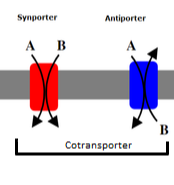
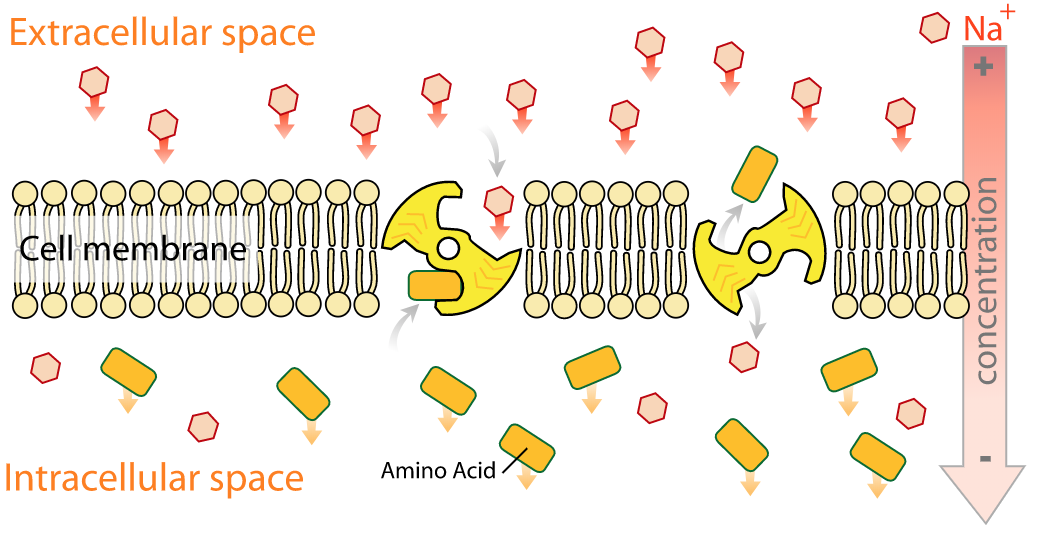
- Also known as co-transport. Energy used is from the movement of one ion down its electrochemical gradient, while another ion moves up its gradient.
- When both solutes move in the same direction, the carrier molecule is called a symporter (hitching a ride). Example: Na+/glucose cotransporter, Na+/amino acid cotransporter.
- When solutes move in opposite directions, the carrier molecule used is called an antiporter (club is at capacity). Example: Na+/H+ exchanger, Cl-/HCO3-exchanger, Na+/Ca2+ exchanger.
Summary
- Both require input of energy.
- Both move solutes against their electrochemical gradients
- Primary active transport uses ATPases.
- Secondary active transport uses another molecule that moves down its gradient.
0:00 / 0:00
Example: Build Your Own Transporter
Imagine you have to design a carrier to transport molecule X into a cell against its concentration gradient (it cannot cross the membrane through the phospholipid bilayer or a channel). The cellular environment in question has low ATP but abundant levels of Na+ ions in the extracellular space. How would you design this carrier to transport this molecule? What kind of transport would this be? Do you know any examples of this type of transport?
To design this carrier, several things should be considered:
1) The molecule to be transported will go against its concentration gradient: this will require active transport
2) The cell is low on ATP, but has lots of Na+: the sodium gradient can be used as the energy to transport the molecule
3) Since Na+ is abundant extracellularly, it will be going into the cell: the carrier should be a symporter
Therefore, designing a Na+/molecule X symporter would be a great solution to this problem. This carrier would be doing secondary active transport. Examples of this include the Na+/glucose or Na+/amino acid cotransporters.

Mark Yourself Question
- Grab a piece of paper and try this problem yourself.
- When you're done, check the "I have answered this question" box below.
- View the solution and report whether you got it right or wrong.
Practice: Predict Entry Method
By what method would you predict that these molecules would enter the cell?
a) Oxygen:
b) Potassium:
c) Water:
d) Glucose: