Popular Courses
MCAT
General Course
AP Biology Exam Prep Course
AP Exam Prep
Biology
General Course
General Biology
University Study Guides
BIOLOGY 1002B
Western University
BIOL 211
University of Calgary
BIOL 107
University of Alberta
BIOL 102
Queen's University
BIOL 112
University of British Columbia
Grade 12 Biology
Canada High School
High School Biology
US High School
DAT
General Course
BIOL*1090
University of Guelph
General Biology
University Study Guides
BIOL 130
University of Waterloo
SC/BIOL 1000 3.00
York University
BLG 143
Toronto Metropolitan University
BIOL 112
McGill University
BIOL 186
University of Victoria
BIOL 1010
Dalhousie University

0:00 / 0:00
Osmosis and Osmolarity
Simply put, osmosis is the diffusion of water.
- Water is a polar molecule that diffuses into the cell through aquaporins (channels).
- There must exist a concentration gradient. Example: Solute is added to intracellular or extracellular space.
- Degree to which the concentration of water is decreased depends on the number of particles of solute.
- Osmolarity is the number of particles a solute dissociates into when in solution (per liter).
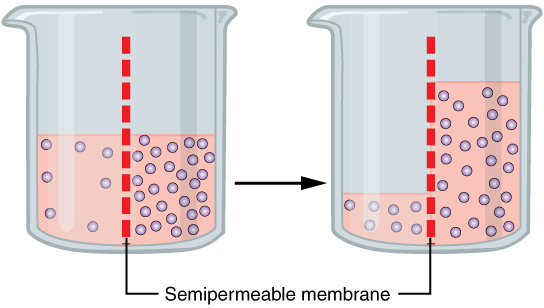
Osmolarity and Cell Volume
Water can always diffuse through the membrane to establish diffusion equilibrium (intracellular = extracellular osmolarity).
- In an isotonic solution: the movement of water is even across the membrane in either direction (cell volume maintained).
- In a hypertonic solution: a gradient created by a molecule results in a net movement of water out of the cell resulting in shriveling. Example: a cell is put in a solution with a lot of salt.
- In a hypotonic solution: a gradient created by a molecule results in a net movement of water into the cell resulting in swelling. Example: a cell is put in a solution with no salt.

Practice: Shrink or Not to Shrink?
Sea urchin eggs are isotonic to seawater. Consider these conditions:
a) Eggs are in seawater.
b) Eggs are in 65% seawater (35% distilled water).
c) Eggs are in pure distilled water.
True or False?
i. Under condition b, the egg will not change size.
ii. Under condition a, the egg will not shrink.
iii. Under condition c, the egg will increase in size.
Practice: Change in Cell Volume
When a cell (osmolarity = 300 mOsm) is placed in a solution containing 300 mOsm KCl and 200 mOsm NaCl (osmolarity = 500 mOsm). Which of the following are true?