Steps of Glycolysis: Intro and Stage I
The glycolytic pathway by which glucose is degraded to pyruvic acid (pyruvate) occurs in 9 steps (9 reactions) and involves 10 enzymes catalyzing the reactions. The whole process can be broken down into three stages:
- Stage I: Glucose → Fructose-1,6-Bisphosphate
- Stage II: Fructose-1,6-Bisphosphate → Glyceraldehyde 3-phosphate
- Stage III: Glyceraldehyde 3-phosphate → Pyruvate
Stage I: Glucose → Fructose-1,6-Bisphosphate
In the first stage of glycolysis, glucose is converted from an aldose sugar to a ketose fructose sugar.
- Energy is consumed in this part of glycolysis.
- The phosphoryl groups of ATP are transferred to the hydroxyl groups on the sugar.
- This transfer is mediated by 2 kinases (phosphate transfer enzymes).

Photo by YassineMrabet / CC BY
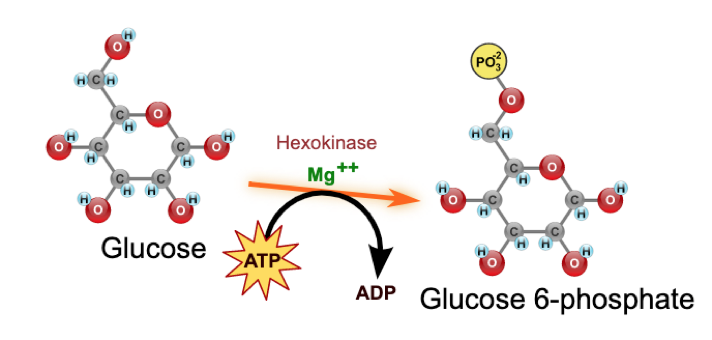
1st step: Glucose → Glucose-6-phosphate (G6P)
- Hexokinase transfers a phosphate from ATP to glucose;
- The hexokinase reaction traps glucose inside the cell;
- This reaction is considered irreversible.
Photo by YassineMrabet / CC BY
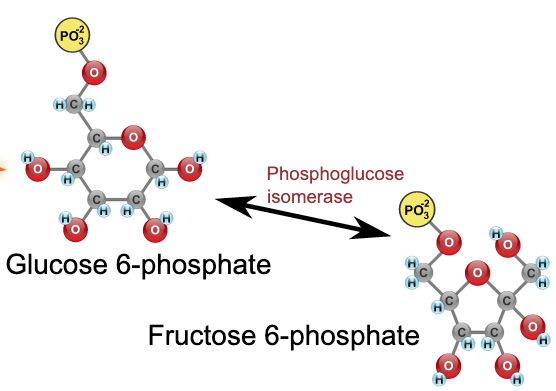
2nd step: Interconversion to Fructose-6-phosphate (F6P)
- Conformational change (rearrangement) of G6P → F6P is catalyzed by phosphoglucose isomerase.
- An isomerase is an enzyme that catalyzes the change of a molecule into its isomer.
Photo by YassineMrabet / CC BY
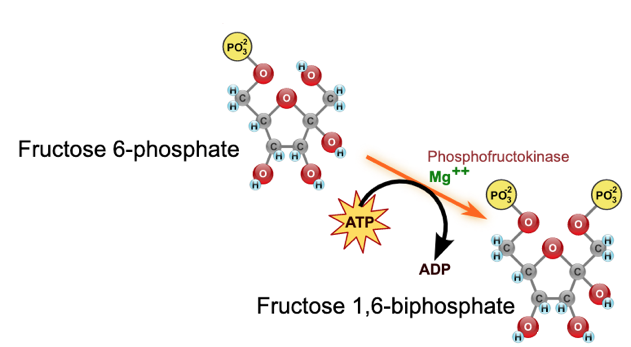
3rd step: Fructose-6-phosphate (F6P) → Fructose-1,6-Bisphosphate (F-1,6-BP)
- Phosphofructokinase transfers a phosphate from ATP to F6P.
- The product is fructose-1,6-bisphosphate (F-1,6-BP).
- Phosphofructokinase activity is highly regulated (considered a “rate limiting enzyme”).
- Less active when ADP is low and ATP is high (no need to make more ATP!).
- This reaction is also considered irreversible.
Photo by YassineMrabet / CC BY
Steps of Glycolysis: Stages II and III

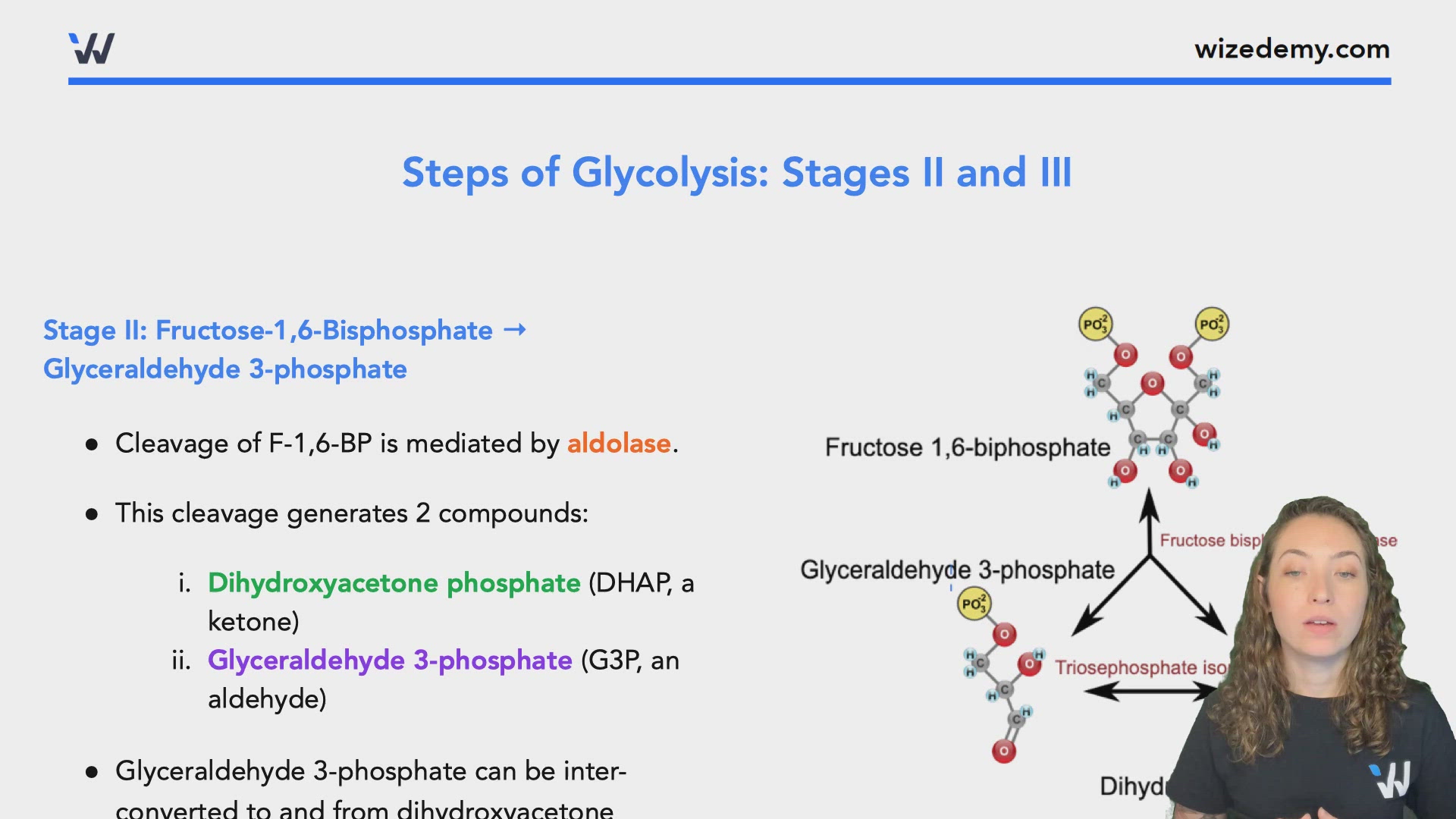
Stage II: Fructose-1,6-Bisphosphate → Glyceraldehyde 3-phosphate
- Cleavage of F-1,6-BP is mediated by aldolase.
- This cleavage generates 2 compounds:
- Dihydroxyacetone phosphate (DHAP, a ketone)
- Glyceraldehyde 3-phosphate (G3P, an aldehyde)
- Glyceraldehyde 3-phosphate can be inter-converted to and from dihydroxyacetone phosphate by triose phosphate isomerase.
- The interconversion is in equilibrium (therefore reversible);
- Only G3P can be used in glycolysis.
Stage III: Glyceraldehyde 3-phosphate → Pyruvate
- Happens twice for every glucose molecule (1 glucose makes 2 G3P).
- Produces 2 molecules of ATP per G3P.
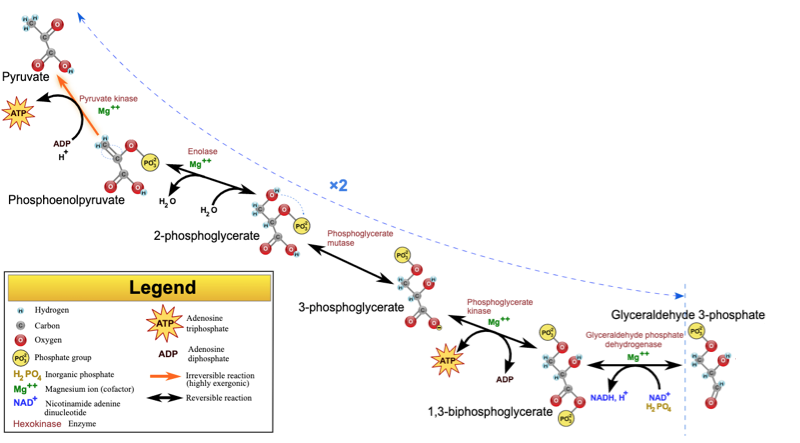
Photo by YassineMrabet / CC BY
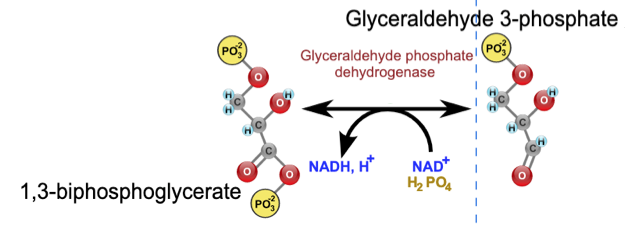
1st step: Glyceraldehyde 3-phosphate → 1,3-Bisphosphoglycerate
- Catalyzed by glyceraldehyde 3-phosphate dehydrogenase.
- Aldehyde group is oxidized. During oxidation, electrons are transferred to Pi, NAD+ to form NADH and H+.
- This is a potentially limiting step as NAD+ must be always regenerated to form NADH.
- A phosphate group also gets transferred to glyceraldehyde.
Photo by YassineMrabet / CC BY

2nd step: Formation of ATP and 3-Phosphoglycerate
- Catalyzed by phosphoglycerate kinase.
- 1,3-biphosphoglycerate transfers phosphate group to ADP, generating ATP.
Photo by YassineMrabet / CC BY

3rd step: Formation of 2-Phosphoglycerate
- Catalyzed by phosphoglycerate mutase.
- Mutase is an enzyme that catalyzes the transfer of a phosphoryl group from one hydroxyl group to another.
- The phosphate is moved to the 2nd carbon.
Photo by YassineMrabet / CC BY
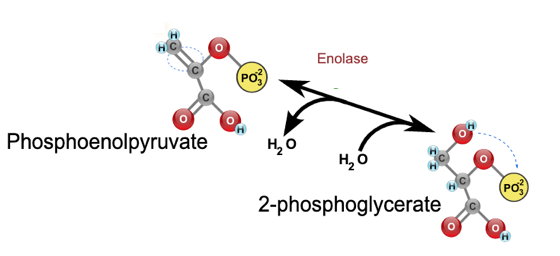
4th step: Formation of Phosphoenolpyruvate (PEP)
- Catalyzed by enolase.
- Enolase carries out the dehydration of the C3 and a double bond is formed.
- This double bond increases the potential energy of the molecule, making PEP the highest energy phosphate bond found in living things.
Photo by YassineMrabet / CC BY
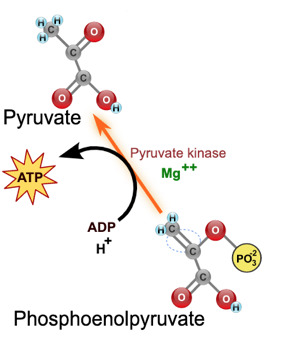
5th step: Formation of Pyruvate
- Pyruvate kinase catalyzes the transfer of the phosphoryl group from PEP to ADP to form ATP and pyruvate.
- Silly mnemonic: pyruvate is a quiet molecule, it doesn't say a PEeP!
Photo by YassineMrabet / CC BY