
What happens at the Neuromuscular Junction (NMJ)?
- action potential in motor neuron – induces release of acetylcholine into neuromuscular junction.
- muscle cell is depolarized, creating an end plate potential (EPP)
- opening of Na+ voltage gated channels causes a muscular action potential.
- this causes voltage-gated channels in sarcoplasmic reticulum to release into cytosol which bind troponin and pull off tropomyosin
- pumped back into sarcoplasmic reticulum after muscle contraction
1 Motor neuron AP will ALWAYS cause at least 1 AP on the muscle cell

Excitation Coupling
- This is the relationship between excitation of a muscle and the actual contraction itself.
- The connection between the two is done using Ca+ ions
- Important terms to know:
- Sarcoplasmic Reticulum: an organ that covers the myofibril like a sock. It reacts to voltage changes in the T-tubules.
- T-tubule: a ring that goes around the myofibril. This is where the AP can propagate.
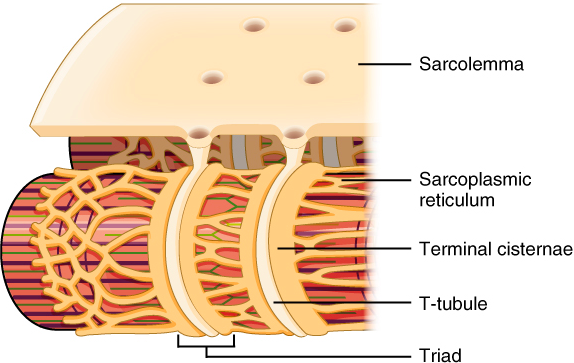
en.wikipedia.org