There are two main types of carrier-mediated transport systems: (1) Facilitated Diffusion and (2) Active Transport. Mediated transport has 3 key characteristics: a) specificity, b) saturation and c) competition.
Several factors are important when it comes to how much solute flows through these systems:
- Number of transporters
- Solute concentration
- Affinity of the transporter for the molecule
- Rate of conformational change


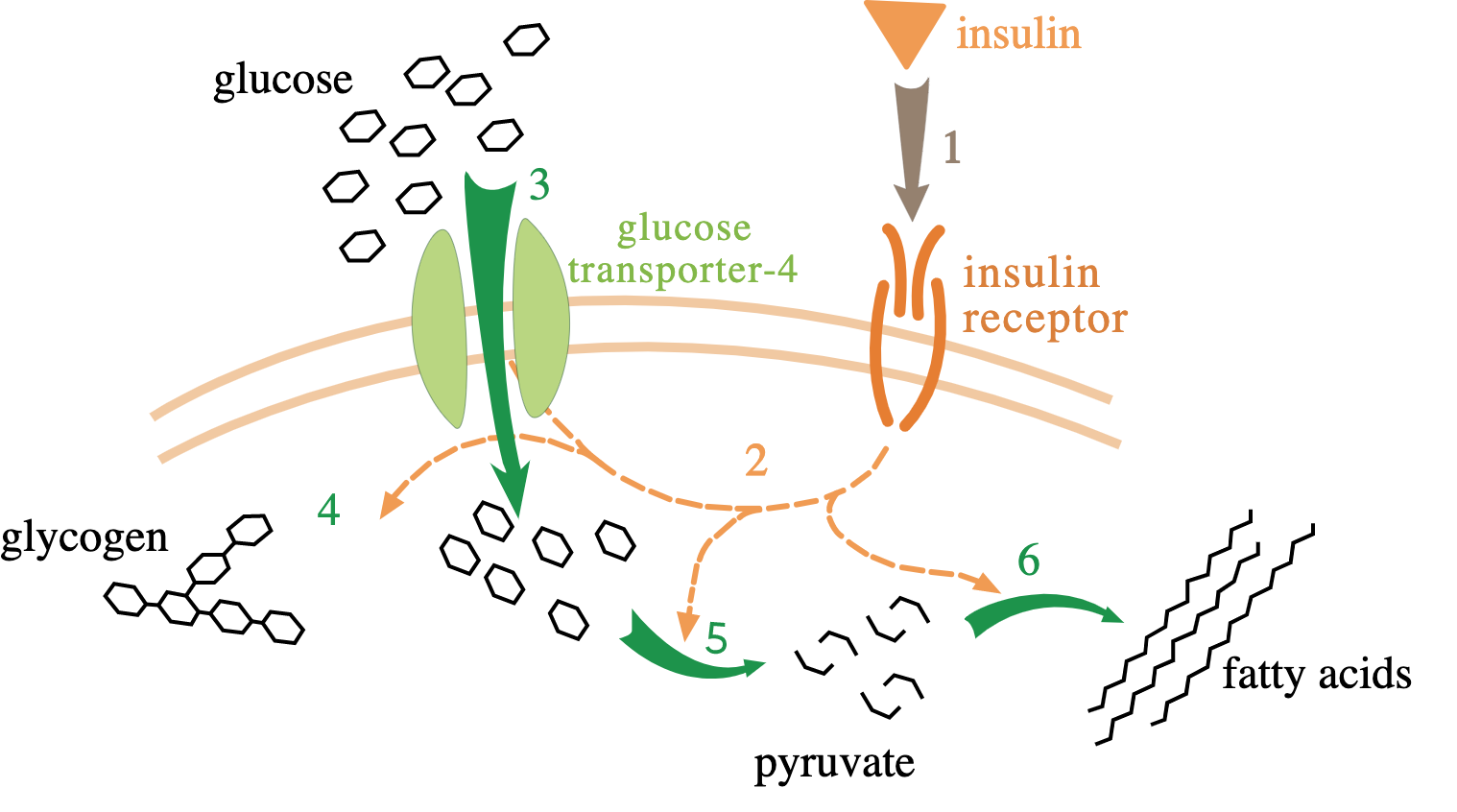
(1) Facilitated Diffusion
Involves a carrier or transporter protein that facilitates the movement of a molecule through the membrane.
- Requires a conformational change of the carrier upon binding, which then returns to its original configuration.
- Requires no energy as it occurs down the concentration gradient
- Example: GLUT4 transporter of glucose
(2) Active Transport
Also involves a carrier or transporter. There are two types: primary and secondary active transport.
- Can transport solutes against its concentration gradient
- Therefore, requires the input of energy
- When there's no energy available, this cannot occur
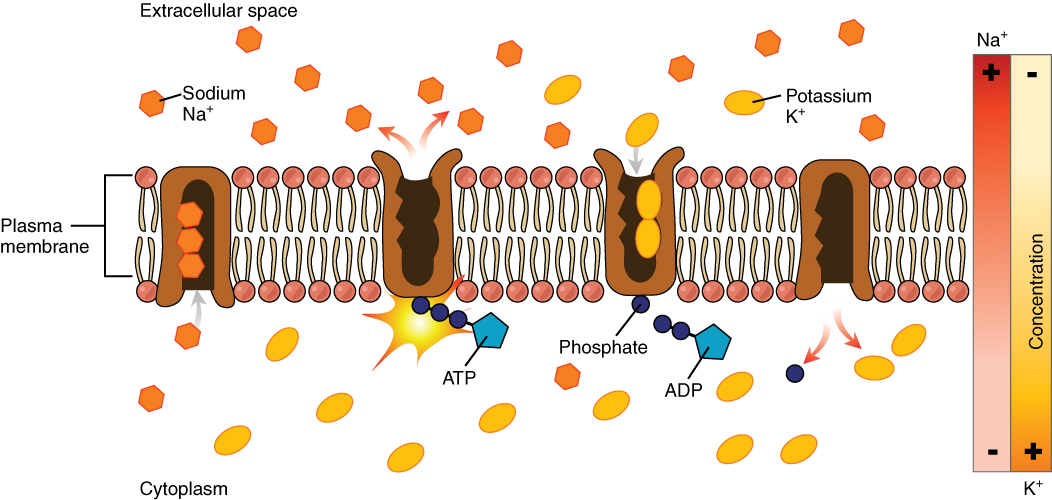
a) Primary Active Transport
- ATP is used as the source of energy
- The transporter/carrier itself is an ATPase enzyme
- Carrier takes a phosphate from ATP, changing its conformation
- Examples: Na+/K+ ATPase, Ca2+ ATPase, H+ ATPase, H+/K+ ATPase
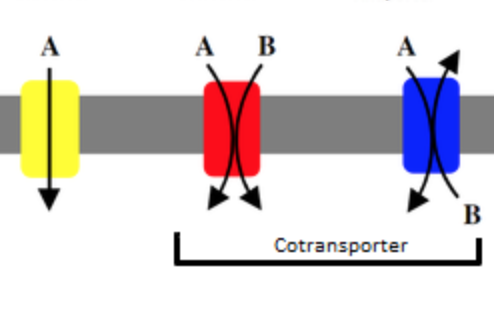
b) Secondary Active Transport
- Energy used is from the movement of one ion down its electrochemical gradient, while another ion moves up its gradient
- When both solutes move in the same direction, this is called cotransport (hitching a ride)
- When solutes move in opposite directions, this is called countertransport (club is at capacity)
- Examples:
- Cotransport: Na+/glucose cotransporter, Na+/amino acid cotransporter
- Countertransport: Na+/H+ exchanger, Cl-/HCO3-exchanger, Na+/Ca2+ exchanger
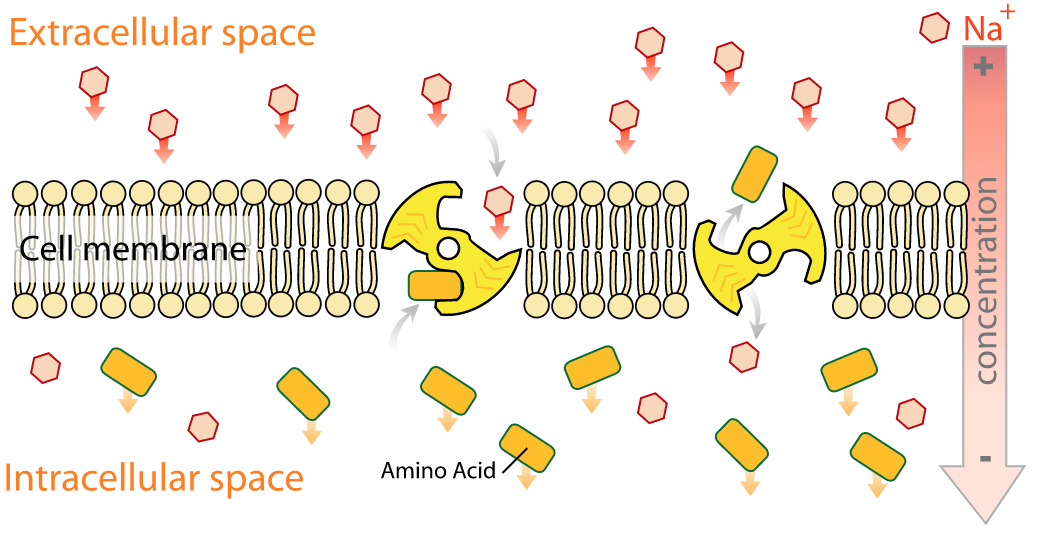
Summary
- Both require input of energy
- Both move solutes against their electrochemical gradients
- Primary active transport uses ATPases
- Secondary active transport uses another molecule that moves down its gradient
Imagine you have to design a carrier to transport molecule X into a cell against its concentration gradient (it cannot cross the membrane through the phospholipid bilayer or a channel). The cellular environment in question has low ATP but abundant levels of Na+ ions in the extracellular space. How would you design this carrier to transport this molecule? What kind of transport would this be? Do you know any examples of this type of transport?
To design this carrier, several things should be considered:
1) The molecule to be transported will go against its concentration gradient: this will require active transport
2) The cell is low on ATP, but has lots of Na+: the sodium gradient can be used as the energy to transport the molecule
3) Since Na+ is abundant extracellularly, it will be going into the cell: the carrier should be cotransporter
Therefore, designing a Na+/molecule X cotransporter would be a great solution to this problem. This carrier would be doing secondary active transport. Examples of this include the Na+/glucose or Na+/amino acid cotransporters.