Popular Courses
MCAT
General Course
Intro to Physiology
University Study Guides
PHYSIOL 1021
Western University
PHYS*1080
University of Guelph
PHYSIOL 2130
Western University
Intro to Physiology
University Study Guides
PSL300H1
University of Toronto
PHYSL 210
University of Alberta
PHGY 210
McGill University
PHGY 215
Queen's University
KNES 259
University of Calgary
PHGY 216
Queen's University
BIOL 273
University of Waterloo
BIOL 260
University of British Columbia
PHYSIOL 3120
Western University
KNES 260
University of Calgary
BIOL 116
Case Western Reserve University
PPT 301
University of North Dakota
ANAT 212
McGill University
HTHSCI 2FF3
McMaster University

0:00 / 0:00
There are different types of transport of molecules across the cell membrane. Which one a particular molecule undergoes depends on what the molecule is:
- Charge
- Size
- Chemical composition (lipid solubility)
- Availability of channels

(Simple) Diffusion
Simple diffusion occurs due to random thermal motion of molecules. When you add a drop of red dye to a glass of water, some time later the drop will have spread and the entire water will be pink. This is diffusion!
- Diffusion always occurs from high to low concentration regions (driving force).
- When the concentrations are equal throughout, this system will be at equilibrium.
- At equilibrium, the net flux is is zero. That is, even though the particles are still moving back and forth, this movement is equal in either direction.
- It can occur even in the presence of a membrane if it is permeable to the solute.
-- Fick's Law of Diffusion
J = net flux
P = permeability/diffusion coefficient
A = surface area; for a cell (sphere) =
Co = extracellular concentration
Ci = intracellular concentration
The permeability coefficient is an experimentally determined number for a particular molecule at a certain temperature; it describes the "ease" with which a molecule can diffuse through a membrane: the greater this number, the greater the flux.
Wize Tip
Do not memorize the following formula and numbers! Use them to help you understand the concepts.
Another relevant formula is diffusion time. Differently from the previous formula, this deals with the diffusion of a solute in a free medium (e.g. water). That is, how long it will take for a particular solute to diffuse through a particular medium.
D = diffusion coefficient
x = mean distance traveled in time t
t = elapsed time since diffusion began

For example, it would take O2 about 23.8 ms to diffuse 10 um (roughly the size of a cell); however, it takes O2 27.56 days to diffuse 10 cm.

0:00 / 0:00
Types of Simple Diffusion
1) Diffusion of non-electrolytes: crossing through lipid bilayer
- Small, uncharged
- Lipophilic
- Example: lipids, fatty acids, O2, CO2
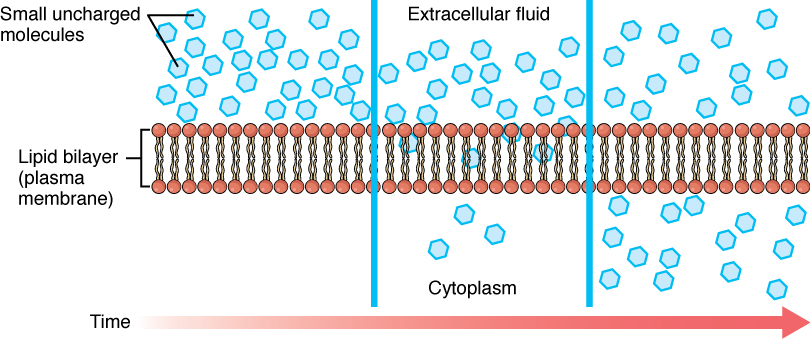
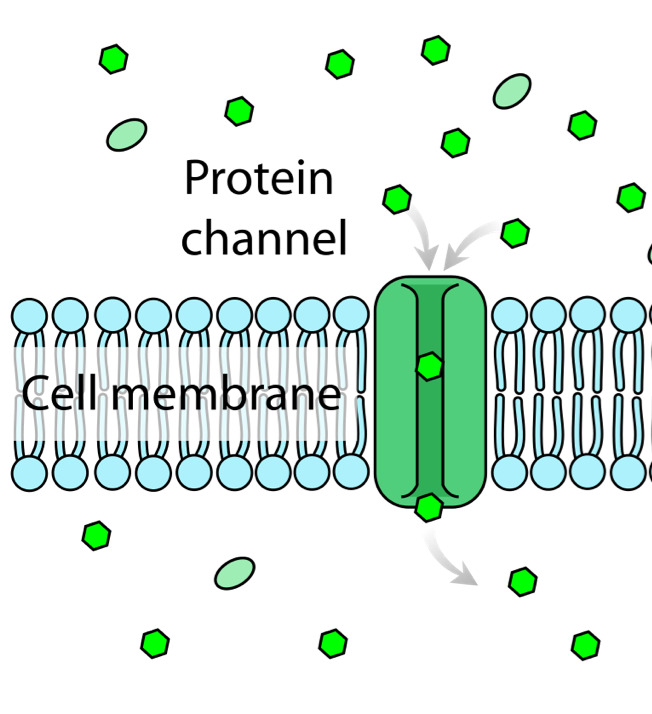
2) Diffusion of electrolytes (charged): requires channel and create an electrochemical gradient
- Ion channels are selective to allow for only specific molecules.
- The fact that electrolytes are charged has additional consequences for this transport.
- For example, the movement of K+ ions in or out of a cell will be slowed if K+ is moving into an area that already has a lot of positive charge.
- Since there are a lot of ions both in the ICF and the ECF, these effects are important factors for the cell.
- The presence of both a gradient of concentration and charge across the cell membrane creates the electrochemical gradient.
- Ion channels can be open or closed at a given time depending on several factors (gating)
- Voltage-gated
- Ligand-gated
- Mechanically-gated
- Examples: Na+, K+, Cl- and Ca2+ channels
0:00 / 0:00
Given Fick's Law of Diffusion, how would (1) doubling the concentration gradient and (2) halving the membrane radius affect the net flux?
According to Fick's Law of Diffusion:
Usually, the cell can be approximated as a sphere, for which A = , where r is the radius of the cell.
(1) Doubling the concentration gradient is equivalent to doubling Co - Ci. Since the concentration gradient is directly proportional to net flux, this would cause the net flux to double as well.
(2) Halving the membrane radius will affect the surface area available for diffusion. Since A = , the net flux trends with the square of the surface area; therefore, halving the radius will decrease the net flux by 1/4.
Which of the following statement(s) are FALSE?
Which of the following is false regarding diffusion?