Mass Spectrometry (MS)
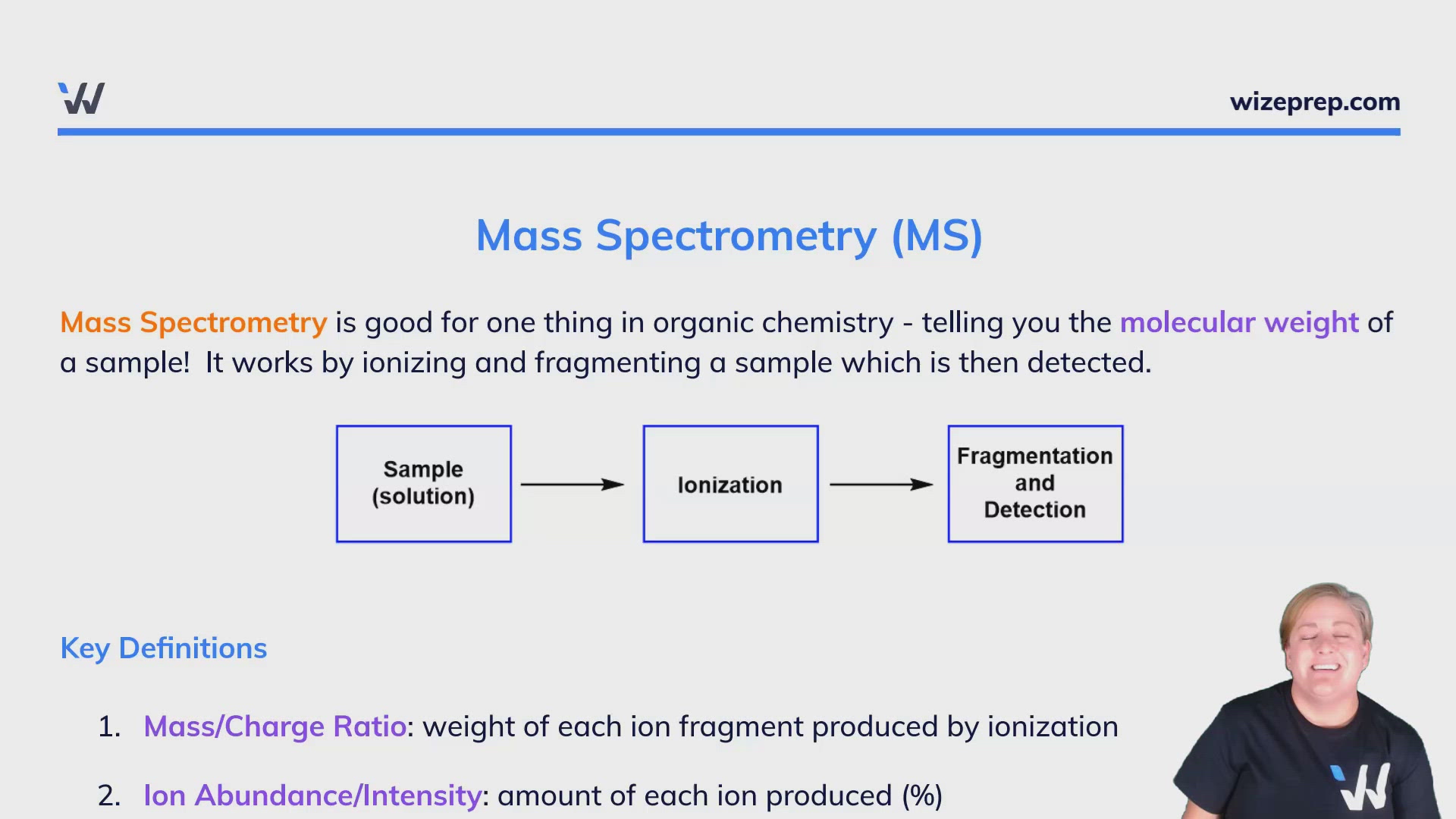
Mass Spectrometry is good for one thing in organic chemistry - telling you the molecular weight of a sample! It works by ionizing and fragmenting a sample which is then detected.

Key Definitions
- Mass/Charge Ratio: weight of each ion fragment produced by ionization
- Ion Abundance/Intensity: amount of each ion produced (%)
- Base Peak: tallest peak in spectrum (most stable)
- Molecular Ion: peak of original starting compound
- Isotope Peaks: ions containing heavier isotopes (12C vs. 13C)
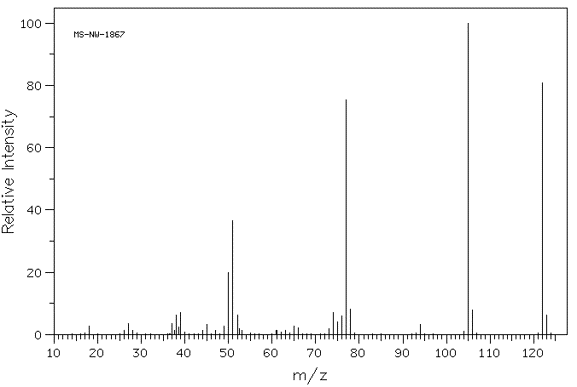
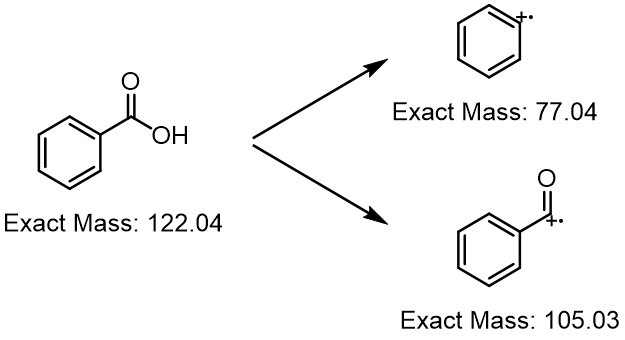
Example: mass Spectrum of Benzoic Acid
Isotopes in Mass Spectrometry
Different isotopes of atoms will be seen in a mass spectrum. In some cases, these isotope peaks are fairly large and can serve as diagnostic tools. For example, Boron, Chlorine and Bromine have very distinct isotope patterns.
Carbon: 12C (99%), 13C (1%)
Boron: 10B (20%), 11B (80%)
Chlorine: 35Cl (76%), 37Cl (24%)
Bromine: 79Br (51%), 81Br (49%)
Using MS to determining # of Carbons
We can use MS to estimate the number of carbon atoms in a compound. It uses the ratio of the mass peak for the 13C isotope to the mass peak of the 12C isotope. The equation we use is as follows:
Example: Mass Spectrometry
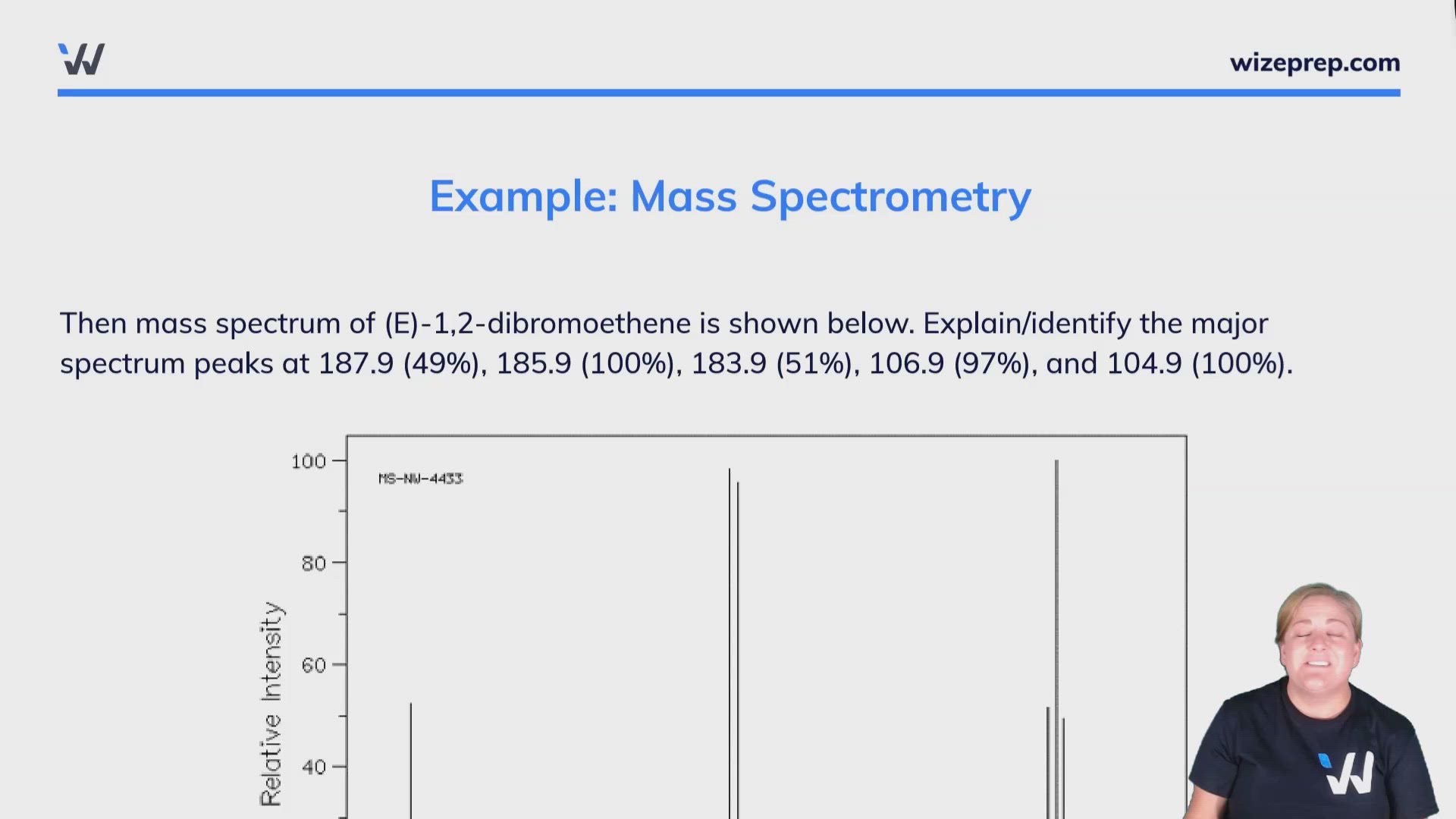
Then mass spectrum of (E)-1,2-dibromoethene is shown below. Explain/identify the major spectrum peaks at 187.9 (49%), 185.9 (100%), 183.9 (51%), 106.9 (97%), and 104.9 (100%).
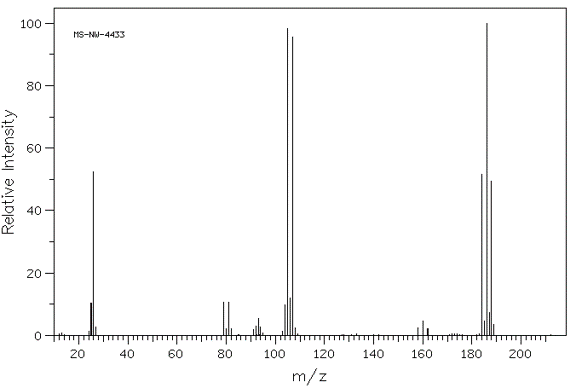
- bromine has two isotopes, Br-79 and Br-81 which are both 50% abundant
- the peaks at 188/186/184 in 50%/100%/50% ratios are the parent molecule (C2Br2H2) with the different isotopes of bromine
- the peak at 188 is Br-81/Br-81
- the peak at 184 is Br-79/Br-79
- the peak at 186 is Br-79/Br-81 and Br-81/Br-79
- this gives the 1:2:1 ratio
- the peaks at 107/105 are from the lost of a single bromine atom leaving one behind with its two isotopes in a 50:50 mixture
Example: Mass Spectrometry
Below is the mass spectrum of 2-pentene. Label the molecular ion and base peak. Provide the structure of the base peak and explain its formation.
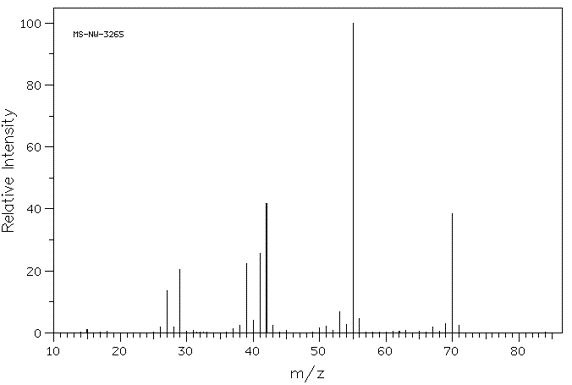
- the molecular ion peak is for the molecule before fragmentation - this is found at m/z = 70 as its molecular weight is 70 g/mol
- the base peak is the tallest peak and is found at m/z = 55 (i.e., the molecular weight is 55 g/mol)
- this is from the loss of a methyl (CH3) group which generates a carbon radical which is stabilized through resonance
Example: Mass Spectrometry
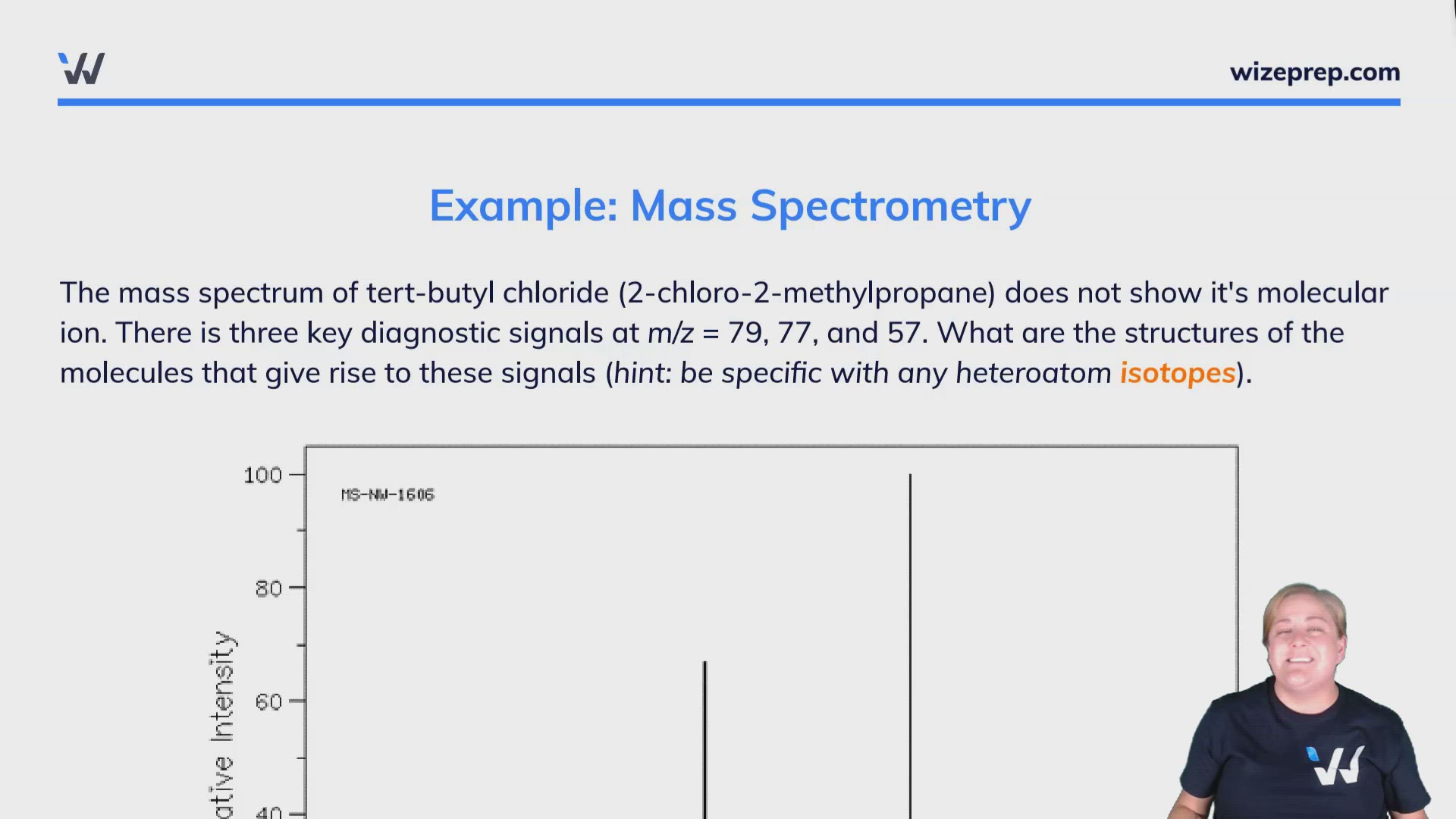
The mass spectrum of tert-butyl chloride (2-chloro-2-methylpropane) does not show it's molecular ion. There is three key diagnostic signals at m/z = 79, 77, and 57. What are the structures of the molecules that give rise to these signals (hint: be specific with any heteroatom isotopes).
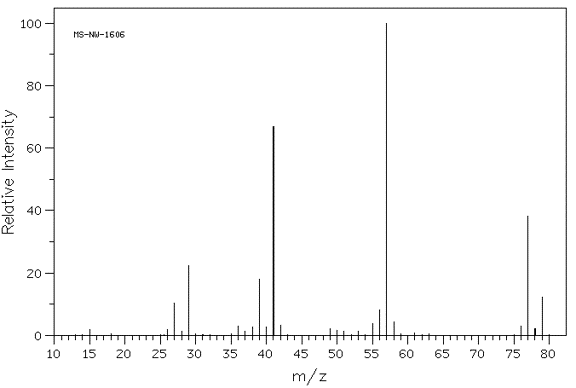
- the peak at 57 is a result of loss of the chlorine atom (the radical generated is stabilized on a tertiary sp3 hybridized carbon atom)
- the peaks at 77/79 are from the loss of a methyl (CH3) group
- there are two isotopes of chlorine Cl-37 and Cl-35 in a 75%:25% ratio