Create a free account to get started

Unlock full course notes by signing up

  • Video lessons taught by top educators
  • Practice questions with guided solutions
  • Written review notes for reference
  • Expert answers anytime from course tutors

Hydrogen (1H) NMR

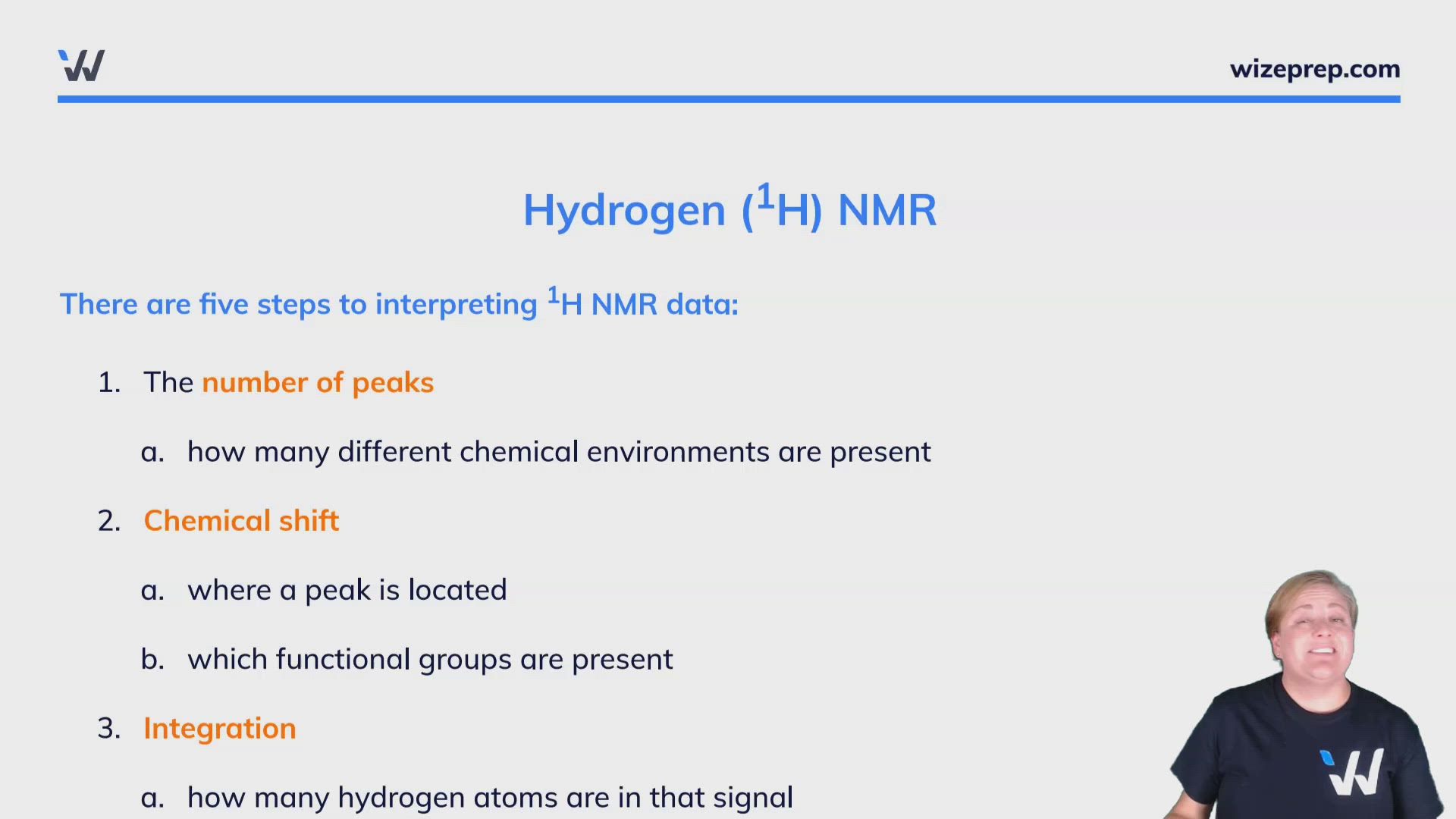
There are five steps to interpreting 1H NMR data:

  1. The number of peaks
  2. how many different chemical environments are present
  3. Chemical shift
  4. where a peak is located
  5. which functional groups are present
  6. Integration
  7. how many hydrogen atoms are in that signal
  8. Multiplicity
  9. how many neighbours a hydrogen atom has
  10. Coupling constant
  11. distance between the multiplet lines

Example: chemical equivalence labeled with letters


Image illustrating Hydrogen (1H NMR)


Chemical Shift

The important chemical shifts that you should know are shown below.


Image illustrating Hydrogen (1H NMR)


Multiplicity

The multiplicity of a signal is calculated using the 2nI + 1 rule where n = number of chemically inequivalent neighbours and I = spin quantum number. For 1H, I = 1/2.


Example: different multiplets that are seen in the 1H NMR



Image illustrating Hydrogen (1H NMR)


Coupling Constant

The coupling constant is the distance between lines in a signal. It is most useful with alkene functional groups. Important coupling constants are listed below.
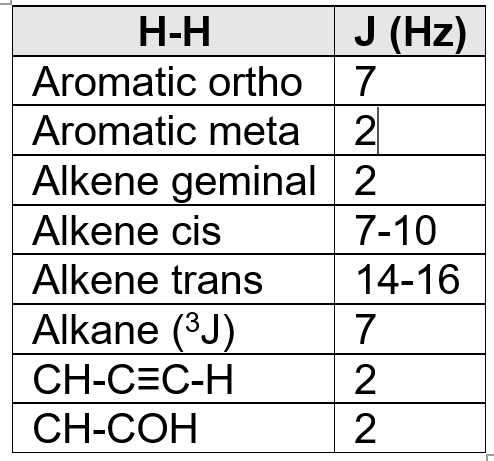
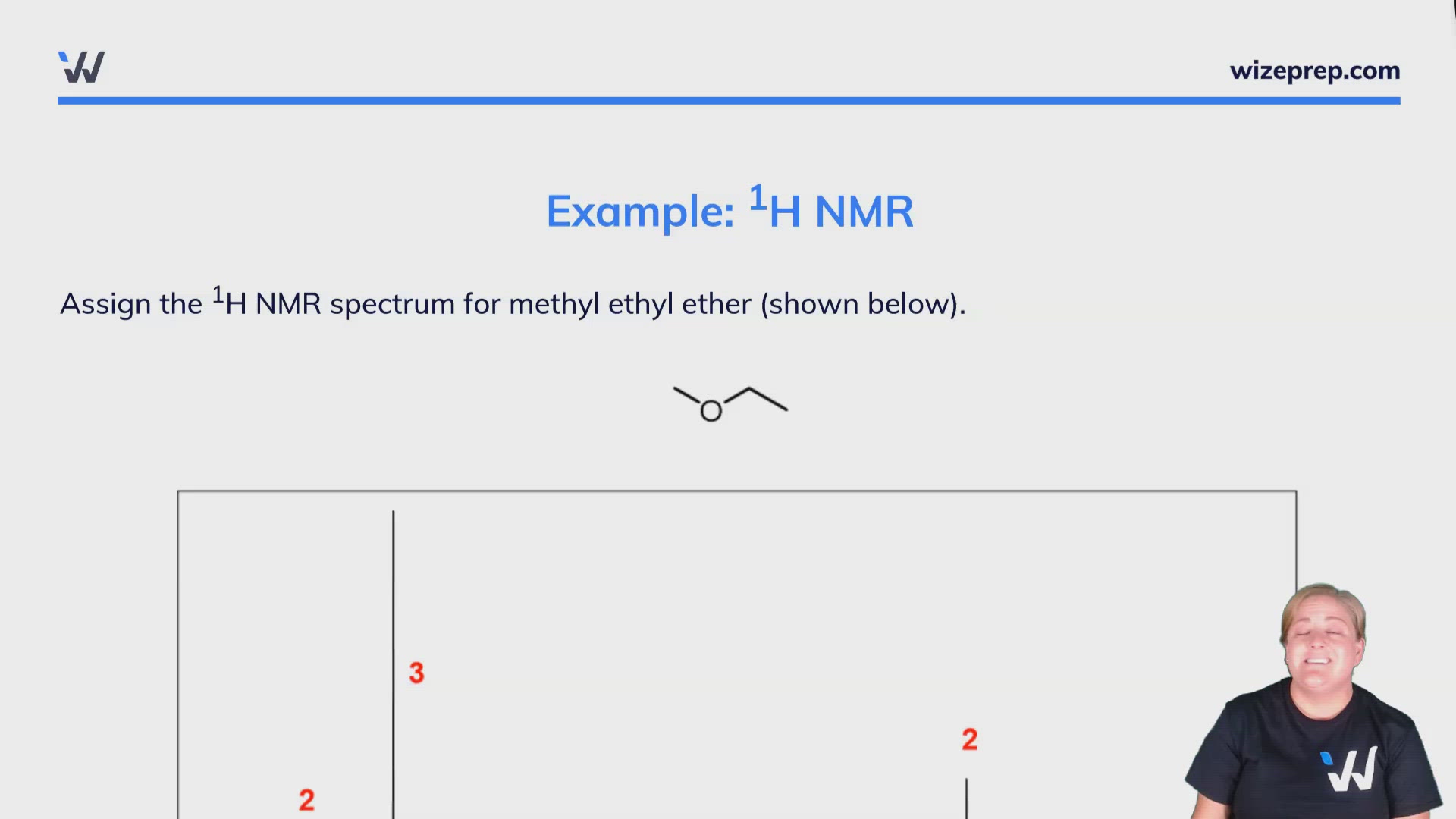
Image illustrating Hydrogen (1H NMR)


Create a free account to get started

Unlock full course notes by signing up

  • Video lessons taught by top educators
  • Practice questions with guided solutions
  • Written review notes for reference
  • Expert answers anytime from course tutors

Example: 1H NMR

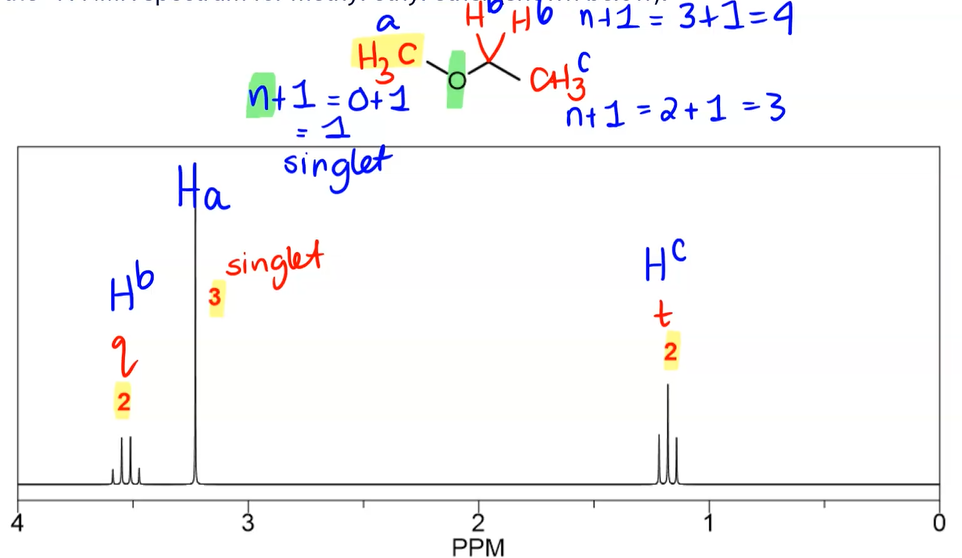
Assign the 1H NMR spectrum for methyl ethyl ether (shown below).


Image illustrating Example: 1H NMR


Image illustrating Example: 1H NMR


Create a free account to get started

Unlock full course notes by signing up

  • Video lessons taught by top educators
  • Practice questions with guided solutions
  • Written review notes for reference
  • Expert answers anytime from course tutors

Example: 1H NMR

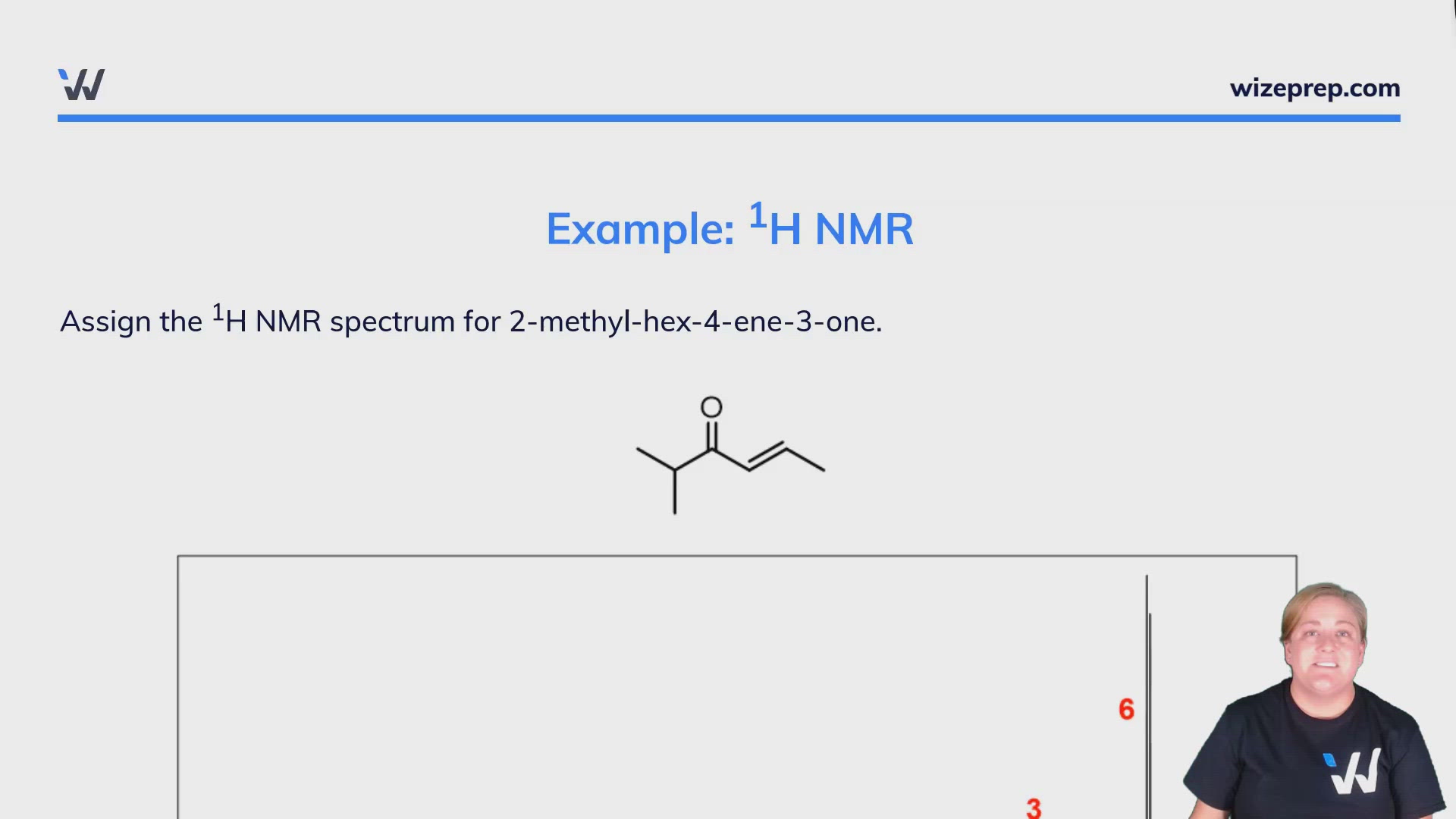
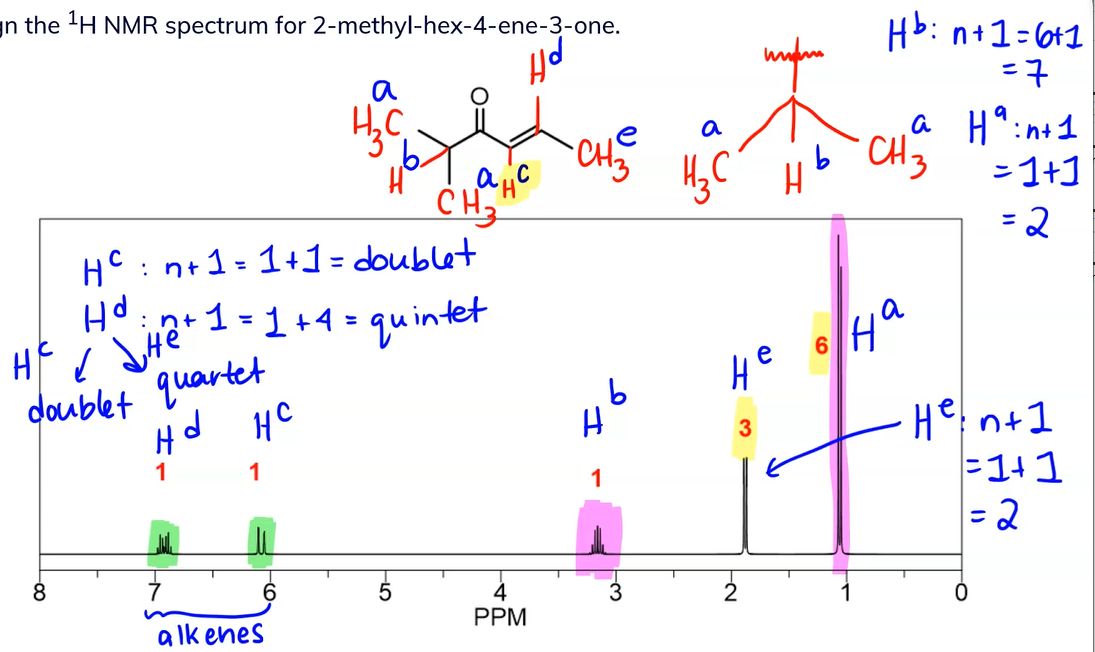
Assign the 1H NMR spectrum for 2-methyl-hex-4-ene-3-one.
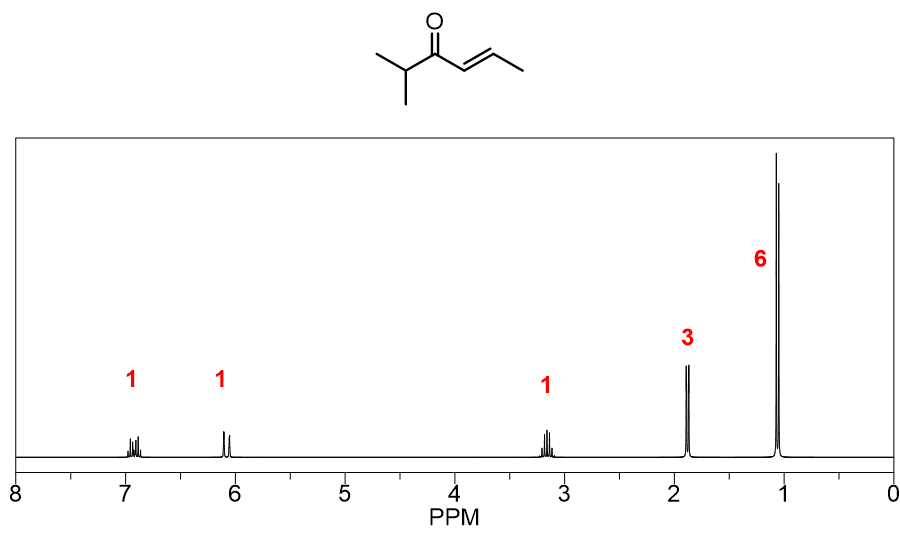

Image illustrating Example: 1H NMR


Image illustrating Example: 1H NMR


Mark Yourself Question

  1. Grab a piece of paper and try this problem yourself.
  2. When you're done, check the "I have answered this question" box below.
  3. View the solution and report whether you got it right or wrong.


The 1H NMR spectrum belongs to which of the following molecules?


Illustration for practice question: Lab techniques: 1H NMR


Create a free account to get started

Unlock full course notes by signing up

  • Video lessons taught by top educators
  • Practice questions with guided solutions
  • Written review notes for reference
  • Expert answers anytime from course tutors


The 1H NMR spectrum provided belongs to which of the following molecules?

Illustration for practice question: Lab techniques: 1H NMR


Choose an answer

Create a free account to get started

Unlock full course notes by signing up

  • Video lessons taught by top educators
  • Practice questions with guided solutions
  • Written review notes for reference
  • Expert answers anytime from course tutors

Mark Yourself Question

  1. Grab a piece of paper and try this problem yourself.
  2. When you're done, check the "I have answered this question" box below.
  3. View the solution and report whether you got it right or wrong.

Determine the structure for C10H12O the 1H NMR spectrum shown and labeled below.


Illustration for practice question: NMR Spectra


Create a free account to get started

Unlock full course notes by signing up

  • Video lessons taught by top educators
  • Practice questions with guided solutions
  • Written review notes for reference
  • Expert answers anytime from course tutors