Create a free account to get started

Unlock full course notes by signing up

  • Video lessons taught by top educators
  • Practice questions with guided solutions
  • Written review notes for reference
  • Expert answers anytime from course tutors

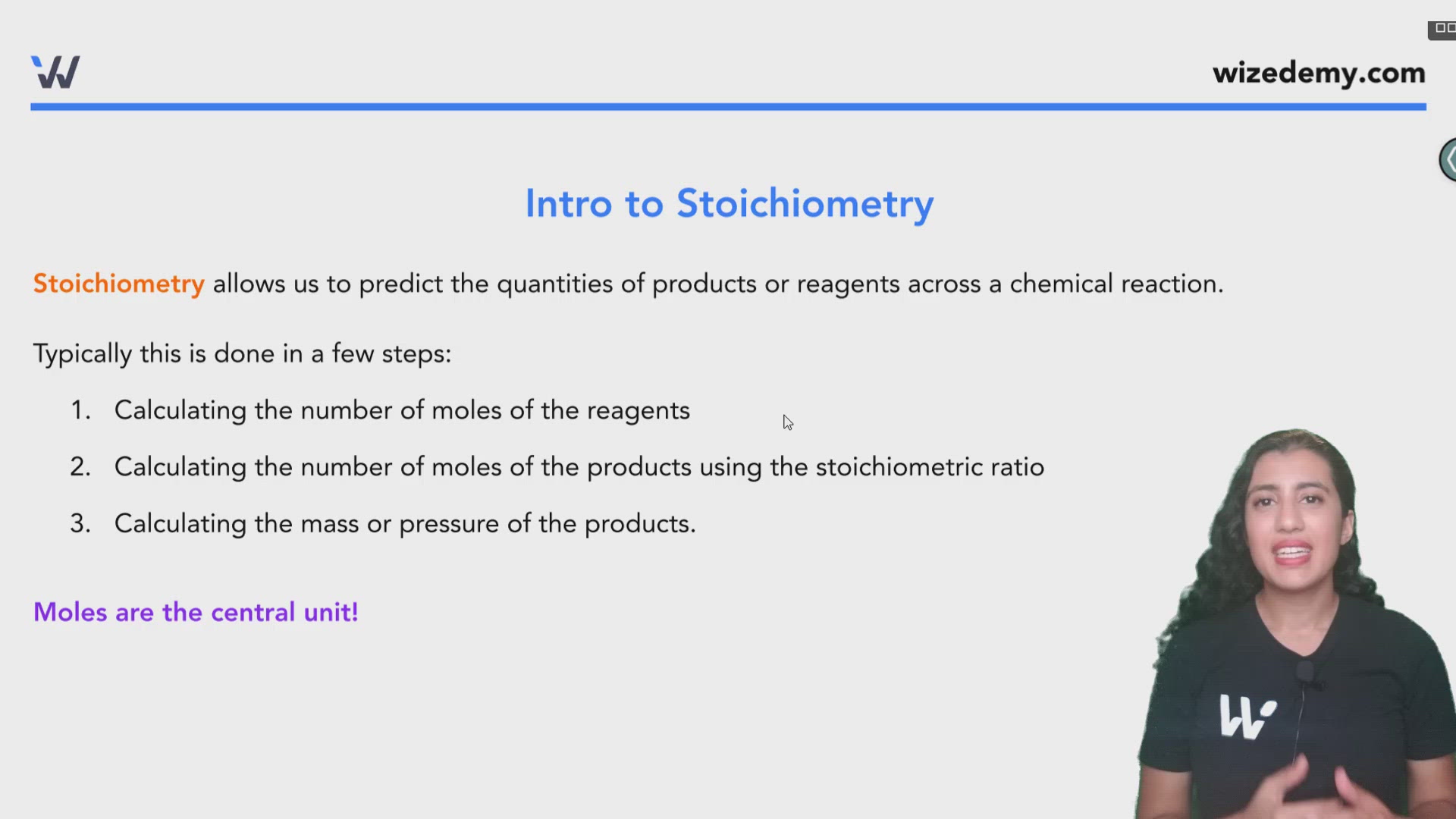
Intro to Stoichiometry

Stoichiometry allows us to predict the quantities of products or reagents across a chemical reaction.


Typically this is done in a few steps:

  1. Calculating the number of moles of the reagents
  2. Calculating the number of moles of the products using the stoichiometric ratio
  3. Calculating the mass or pressure of the products.


Moles are the central unit!


Image illustrating Intro to Stoichiometry


In addition we can convert between mass and volume of a pure substance by looking at it's density,
δ=m/V\boxed{\delta=m/V}


Create a free account to get started

Unlock full course notes by signing up

  • Video lessons taught by top educators
  • Practice questions with guided solutions
  • Written review notes for reference
  • Expert answers anytime from course tutors

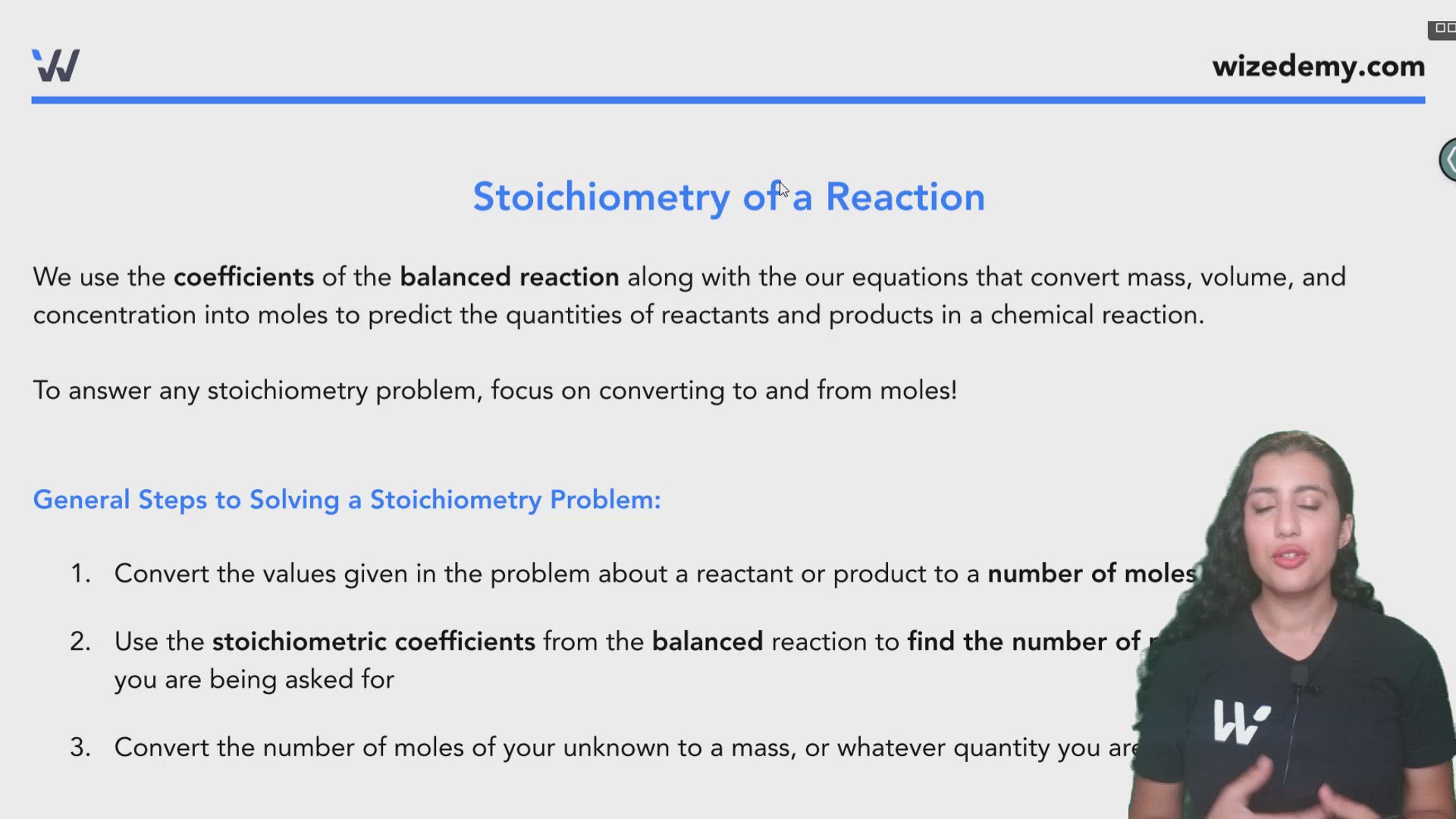
Stoichiometry of a Reaction

We use the coefficients of the balanced reaction along with the our equations that convert mass, volume, and concentration into moles to predict the quantities of reactants and products in a chemical reaction.


To answer any stoichiometry problem, focus on converting to and from moles!


General Steps to Solving a Stoichiometry Problem:

  1. Convert the values given in the problem about a reactant or product to a number of moles
  2. Use the stoichiometric coefficients from the balanced reaction to find the number of moles of the unknown you are being asked for
  3. Convert the number of moles of your unknown to a mass, or whatever quantity you are being asked for


Example

2.6g of sodium metal (Na) reacts with water to form NaOH and H2 according to the unbalanced reaction below. Once the reaction is complete how many grams of NaOH are formed?

Na(s)+  H2O(g)→  NaOH(s)+  H2(g)Na_{(s)}+\ \ H_2O_{(g)}\rightarrow\ \ NaOH_{(s)}+\ \ H_{2(g)}


Step 1: Balance the reaction

2 Na(s)+2 H2O(g)→2 NaOH(s)+H2(g)2\ Na_{(s)}+2\ H_2O_{(g)}\rightarrow 2\ NaOH_{(s)}+H_{2(g)}


Step 2: Find the number of moles of sodium

nNa=mMW=2.6 g22.990 g/mol=0.113 moln_{Na}=\dfrac{m}{MW}=\dfrac{2.6\ g}{22.990\ g/mol}=0.113\ mol


Step 3: Find the number of moles of NaOH

nNaOH=nNa×coefficient NaOHcoefficient Na=0.113 mol×22=0.113 moln_{NaOH}=n_{Na}\times \dfrac{coefficient\ NaOH}{coefficient\ Na}=0.113\ mol\times \dfrac{2}{2}=0.113\ mol


Step 4: Convert the number of moles of NaOH to a mass

n=mMn=\frac{m}{M}

mNaOH=n×MW=0.113 mol×39.997 g/mol=4.520 g=4.5 gm_{NaOH}=n\times MW=0.113\ mol \times 39.997\ g/mol=4.520\ g = 4.5\ g


Create a free account to get started

Unlock full course notes by signing up

  • Video lessons taught by top educators
  • Practice questions with guided solutions
  • Written review notes for reference
  • Expert answers anytime from course tutors

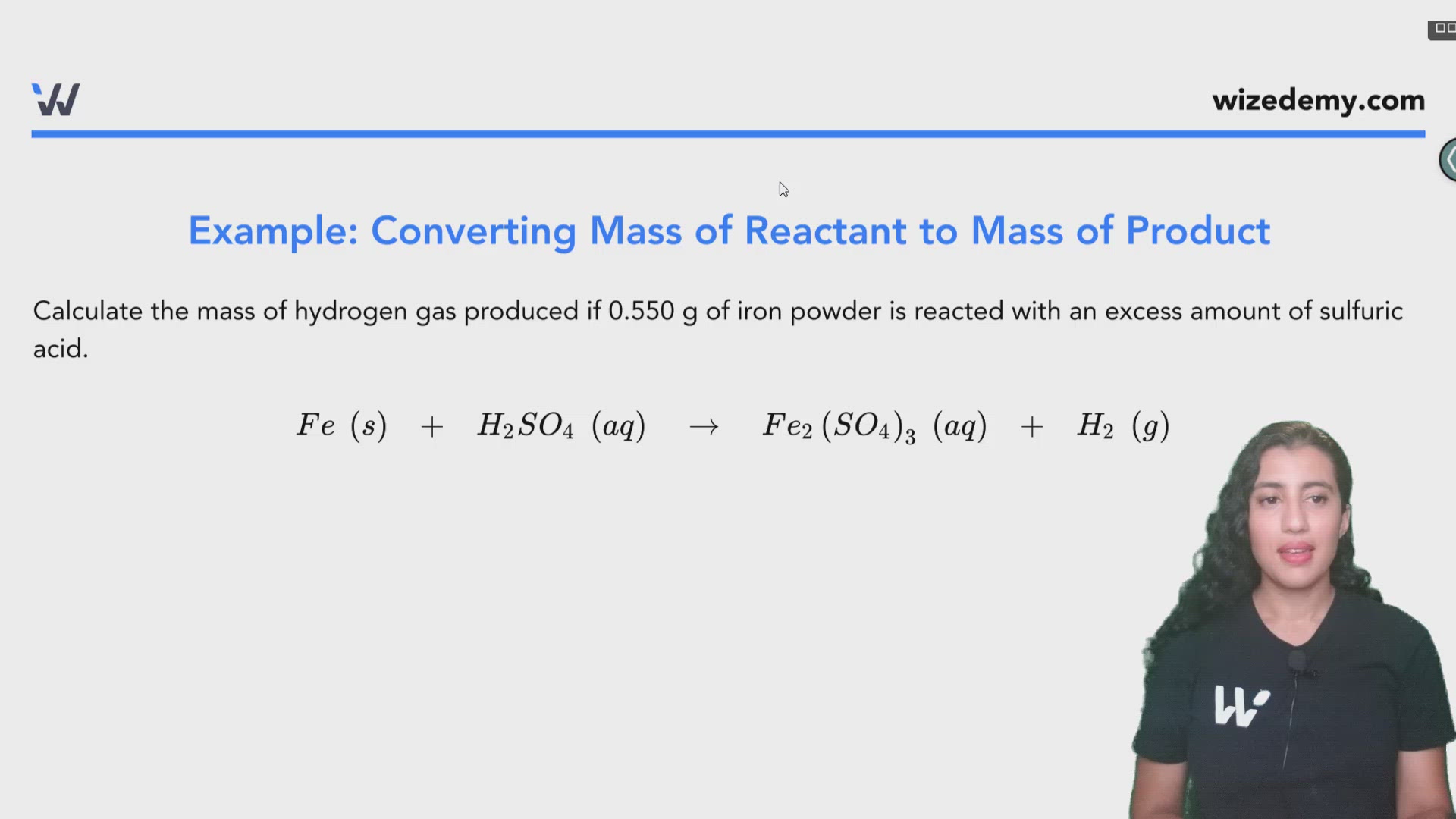
Example: Converting Mass of Reactant to Mass of Product

Calculate the mass of hydrogen gas produced if 0.550 g of iron powder is reacted with an excess amount of sulfuric acid.


 Fe (s)   +   H2SO4 (aq)    →    Fe2(SO4)3 (aq)   +   H2 (g)\ Fe\ \left(s\right)\ \ \ +\ \ \ H_2SO_4\ \left(aq\right)\ \ \ \ \rightarrow\ \ \ \ Fe_2\left(SO_4\right)_3\ \left(aq\right)\ \ \ +\ \ \ H_2\ \left(g\right)


Step 1-Balance the equation

 2Fe (s)   +   3H2SO4 (aq)    →    Fe2(SO4)3 (aq)   +   3H2 (g)\ 2Fe\ \left(s\right)\ \ \ +\ \ \ 3H_2SO_4\ \left(aq\right)\ \ \ \ \rightarrow\ \ \ \ Fe_2\left(SO_4\right)_3\ \left(aq\right)\ \ \ +\ \ \ 3H_2\ \left(g\right)


Step 2- Calculate the moles of iron (Fe(s))

n=m/M

n=0.550g/55.845g/mol

n=0.00985 mol


Step 3-Using the stoichiometric coefficients from the balanced chemical reaction, determine the number of moles of H2(g)


0.00985 mol Fe x 3 moles of H22 moles Fe=moles of H2(g)0.00985\ mol\ Fe\ x\ \frac{3\ moles\ of\ H_2}{2\ moles\ Fe}=moles\ of\ H_2\left(g\right)

moles H2(g)=0.01477 moles


Step 4-Calculate the mass of hydrogen gas

n=m/M

m=nM

m=(0.01477moles)(2.02g/mol)

m=0.0298g
Create a free account to get started

Unlock full course notes by signing up

  • Video lessons taught by top educators
  • Practice questions with guided solutions
  • Written review notes for reference
  • Expert answers anytime from course tutors

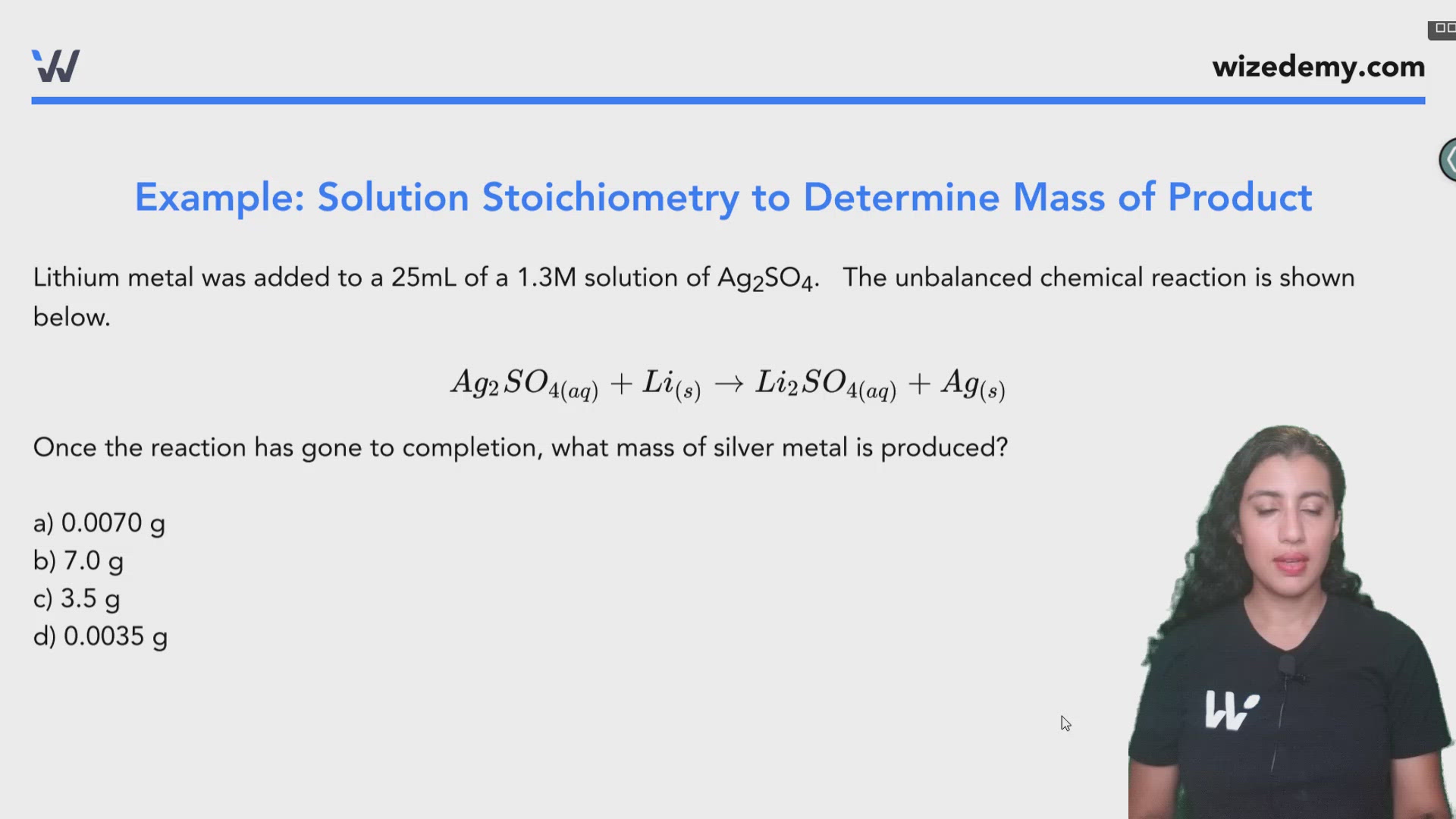
Example: Solution Stoichiometry to Determine Mass of Product

Lithium metal was added to a 25mL of a 1.3M solution of Ag2SO4. The unbalanced chemical reaction is shown below.

Ag2SO4(aq)+Li(s)→Li2SO4(aq)+Ag(s)Ag_2SO_{4(aq)}+Li_{(s)}\rightarrow Li_2SO_{4(aq)}+Ag_{(s)}

Once the reaction has gone to completion, what mass of silver metal is produced?


a) 0.0070 g

b) 7.0 g

c) 3.5 g

d) 0.0035 g


1. Balance the reaction

Ag2SO4(aq)+2 Li(s)→Li2SO4(aq)+2 Ag(s)Ag_2SO_{4(aq)}+2\ Li_{(s)}\rightarrow Li_2SO_{4(aq)}+2\ Ag_{(s)}


2. Find the number of moles of Ag2SO4 originally in solution

  • Recall n=cv
  • c must be in mol/L =M
  • V must be in L
  • Volume here is 25mL
  • 1000mL=1L
  • 25mL=0.025L
nAg2SO4=CV=(1.3 mol/L)(0.025L)=0.0325 moln_{Ag_2SO_4}=CV=(1.3\ mol/L)\left(0.025L\right)=0.0325\ mol


3. Use the stoichiometric coefficients to find the number of moles of Ag produced

nAg=nAg2SO4×21=0.065 moln_{Ag}=n_{Ag_2SO_4}\times \dfrac{2}{1}=0.065\ mol


4. Find the mass of silver from the moles

n=m/M

Rearrange to solve for m.

m=n×MW=(0.065 mol)(107.87 g/mol)=7.01 gm=n\times MW=(0.065\ mol)(107.87\ g/mol)=7.01\ g


Answer: B

Practice: Calculate Mass of Product

16.0 mL of Hg (mp = –38.8oC, density = 13.56 g/mL) reacts with fluorine gas and the reaction goes to completion as shown below.

Hg(l)+F2(g)→HgF2(s)Hg_{(l)}+F_{2(g)}\rightarrow HgF_{2(s)}


Once the reaction has gone to completion, what mass of mercury fluoride, HgF2 is produced?

Choose an answer

Create a free account to get started

Unlock full course notes by signing up

  • Video lessons taught by top educators
  • Practice questions with guided solutions
  • Written review notes for reference
  • Expert answers anytime from course tutors

Practice: Stoichiometry Calculations Application

A solution that is 183 mM (millimolar) NaCl(aq) is isoosmotic with plasma. This means that cells don't swell or shrink when in this solution. How many grams of sodium chloride are required to make 150 mL of isoosmotic NaCl(aq)? The molar mass of NaCl is 58.44 g/mol.

Choose an answer

Create a free account to get started

Unlock full course notes by signing up

  • Video lessons taught by top educators
  • Practice questions with guided solutions
  • Written review notes for reference
  • Expert answers anytime from course tutors

Extra Practice