Create a free account to get started

Unlock full course notes by signing up

  • Video lessons taught by top educators
  • Practice questions with guided solutions
  • Written review notes for reference
  • Expert answers anytime from course tutors

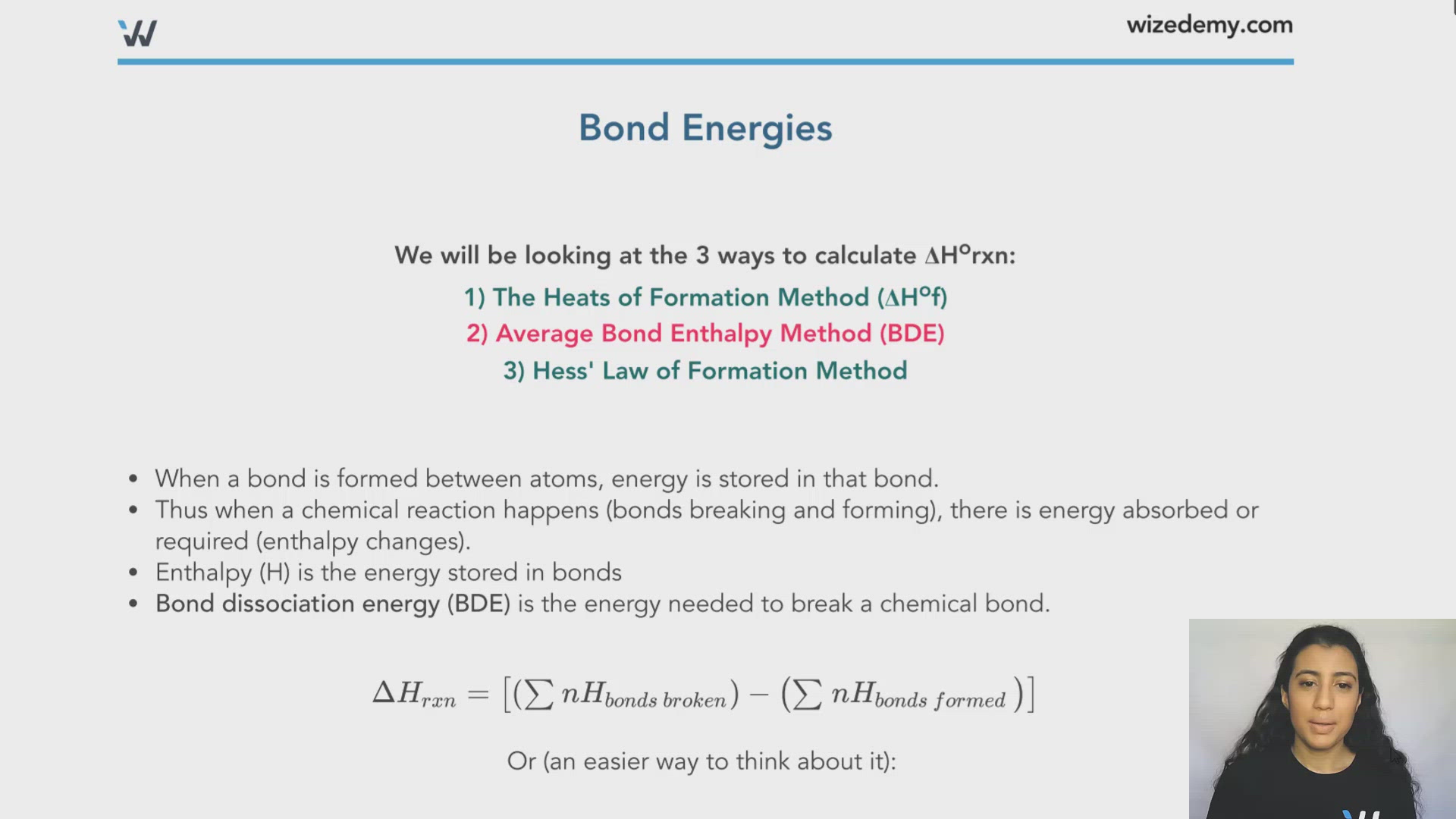
Bond Energies

Enthalpy (H) is the energy stored in bonds.


Bond dissociation energy (BDE) is the energy needed to break a chemical bond.


ΔHrxn=[(∑nHbonds broken)−(∑nHbonds formed )]\Delta H_{rxn}=\left[\left(\sum_{ }^{ }nH_{bonds\ broken}\right)-\left(\sum_{_{ }}^{ }nH_{bonds\ formed\ }\right)\right]


Or (an easier way to think about it):


ΔHrxn=[(∑nBDEreactants)−[(∑nBDEproducts)]\boxed{\Delta Hrxn=[(\sum n BDE_{reactants})-[({\sum nBDE_{products})]}}


ΔHrxn=\Delta H_{rxn}= enthalpy change for the reaction (kJ/mol)

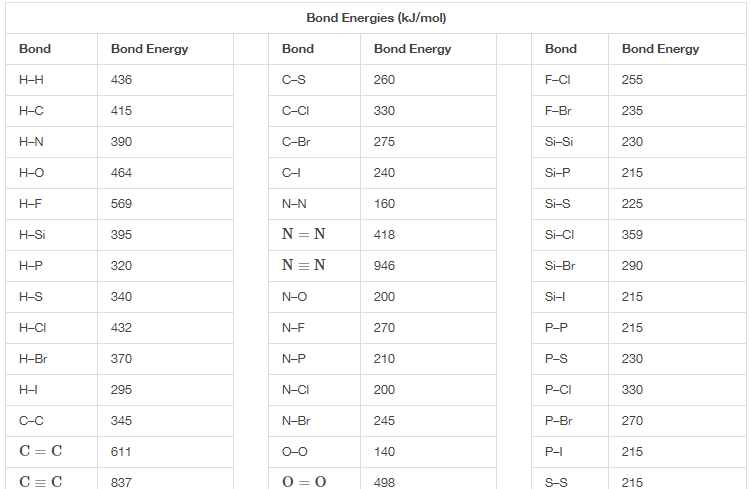
BDE = bond energy per mole of bonds (kJ/mol), always positive


ΔHrxn=[(∑nBDEreactants)−[(∑nBDEproducts)]\boxed{\Delta Hrxn=[(\sum n BDE_{reactants})-[({\sum nBDE_{products})]}}


Image illustrating Bond Energies


Photo by Rice University / CC BY


Practice: Bond Dissociation Energies

Predict the overall change in enthalpy (i.e. change in enthalpy, change in heat, ΔHrxn in kJ/mol) for the reaction:


N2 (g) + 3 H2 (g) → 2 NH3 (g)


BDE:

NN = 945 kJ/mol

H–H = 436 kJ/mol

N–H = 391 kJ/mol

Choose an answer

Create a free account to get started

Unlock full course notes by signing up

  • Video lessons taught by top educators
  • Practice questions with guided solutions
  • Written review notes for reference
  • Expert answers anytime from course tutors