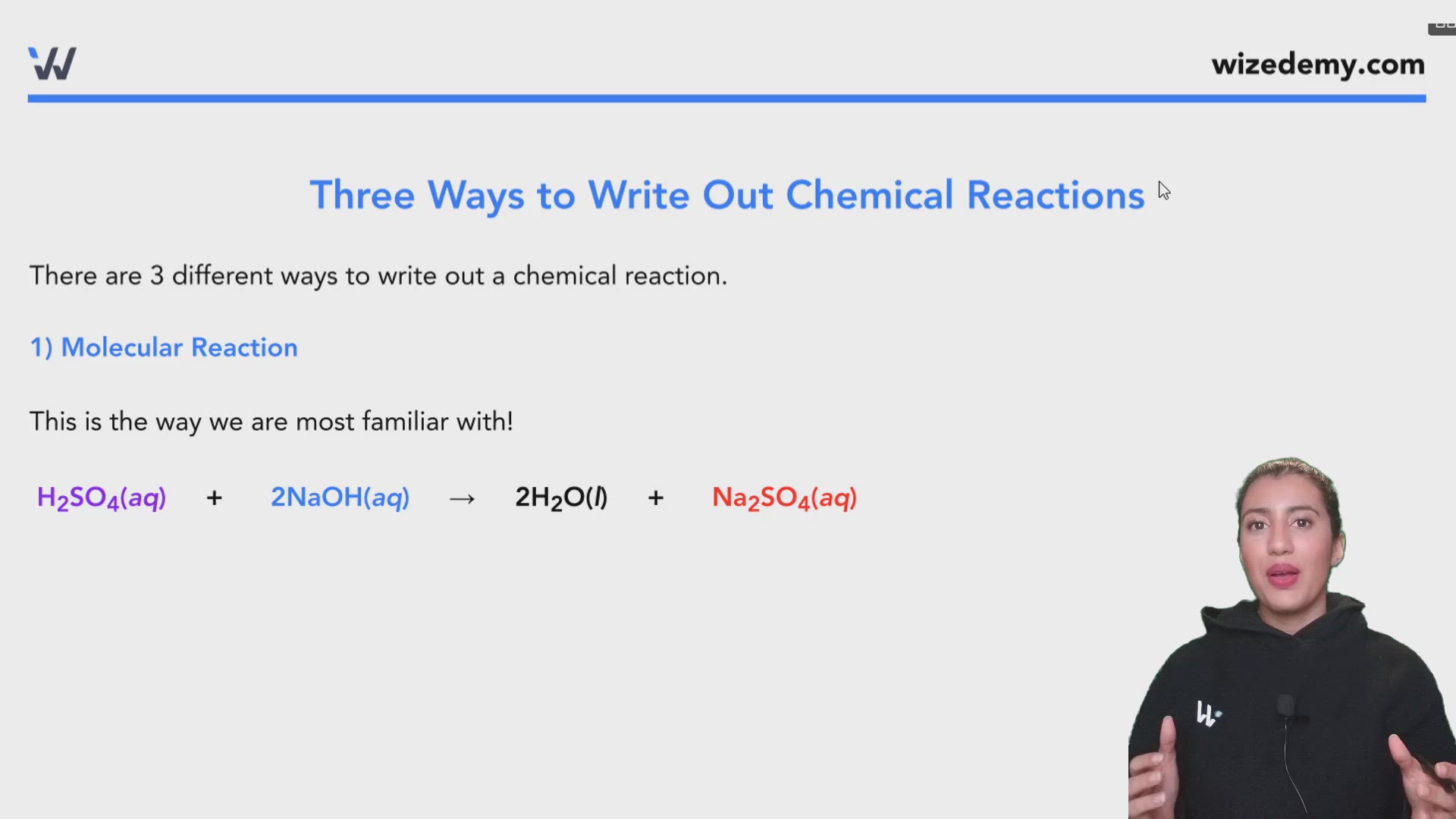
Three Ways to Write Out Chemical Reactions
There are 3 different ways to write out a chemical reaction.
1) Molecular Reaction
This is the way we are most familiar with!
H2SO4(aq) + 2NaOH(aq) → 2H2O(l) + Na2SO4(aq)
2) Complete Ionic Equation
To write the complete ionic equation, we need to look at the molecular reaction and identify which of the molecules can dissociate into ions. Then write out the equation with all of the ions.


Next, since we figured out all the molecules that dissociate and balanced the equations, we just put all the ions into the equation so they replace the aqueous molecules:
2H+(aq) + SO42-(aq) + 2Na+(aq) + 2OH-(aq) → 2H2O(l) + 2Na+(aq) + SO42-(aq)
3) Net Ionic Equation:
For this equation, we just take the complete ionic equation and cross anything out that appears in equal quantities on both sides so that we are left with the net equation.
Complete Ionic Equation:
2H+(aq) + SO42-(aq) + 2Na+(aq) + 2OH-(aq) → 2H2O(l) + 2Na+(aq) + SO42-(aq)
2H+(aq) + 2OH-(aq) --> 2H2O(l)
and this can be further simplified to get the net ionic equation:
H+(aq) + OH-(aq) --> H2O(l)

Relating Net Ionic Equations to Ionization of Acids and Bases
Part 1
This is a molecular reaction between a (strong/weak) ________ acid and a (strong/weak) ________base.
Review: What type of reaction is this? ________
If we were asked for the Net Ionic Equation (NIE), then we would need to see which species in the reaction can fully dissociate into ions.
Will HCl(aq) fully dissociate?
Yes because strong acids fully dissociate.
Will NaOH(aq) fully dissociate?
Yes because strong bases fully dissociate.
Will NaCl(aq) fully dissociate?
Yes because it is a compound that has a group 1 ion in it (Na+), which makes it soluble and it will fully dissociate.
Will H2O(l) fully dissociate?
No because liquids do not dissociate.
Now we can write out the Complete Ionic Equation:
Finally, we just cross out anything that appears in equal amounts on both sides to get NIE:

Part 2

Now what about if we were asked to write the NIE for this reaction between a ________ Acid and ________ Base:
Review: What type of reaction is this? ________
Will KOH fully dissociate? ________
Will HNO2 fully dissociate? ________
Will KNO2 fully dissociate? ________
Will H2O(l) fully dissociate? ________
So let's write out our Complete Ionic Equation:
(only change the species that can fully dissociate into ions, leave things that cannot fully dissociate as they are!)

Now just cross out what appears on both sides to get the NIE:
