Properties of Covalent Bonds
Bonds can have various bond lengths and bond energies. There can also be a different number of bonds between different atoms. We will take a look at some of these terms and properties of bonds now.
Bond Length

Photo by Rice University / CC BY
- When 2 atoms get bound together, there are repulsion forces and attractive forces
- The electrons from one atom are attracted to the other atom's nucleus (attraction)
- But the nuclei from both atoms can't get too close (repulsion because of + charges)
- When the forces balance out we form a bond!
Circle the most stable bond in the diagram above (this is how the bond will exist).
Bond length: this is the distance between two nuclei that are bound together when they are at their lowest possible energy state
- Note: In the graph, energy rises when atoms have a shorter or longer bond length than what is optimal
- When atoms with larger atomic radii bind together, the bond length (distance between their nuclei) is (shorter/longer) ________
Bond Dissociation Energy (BDE)
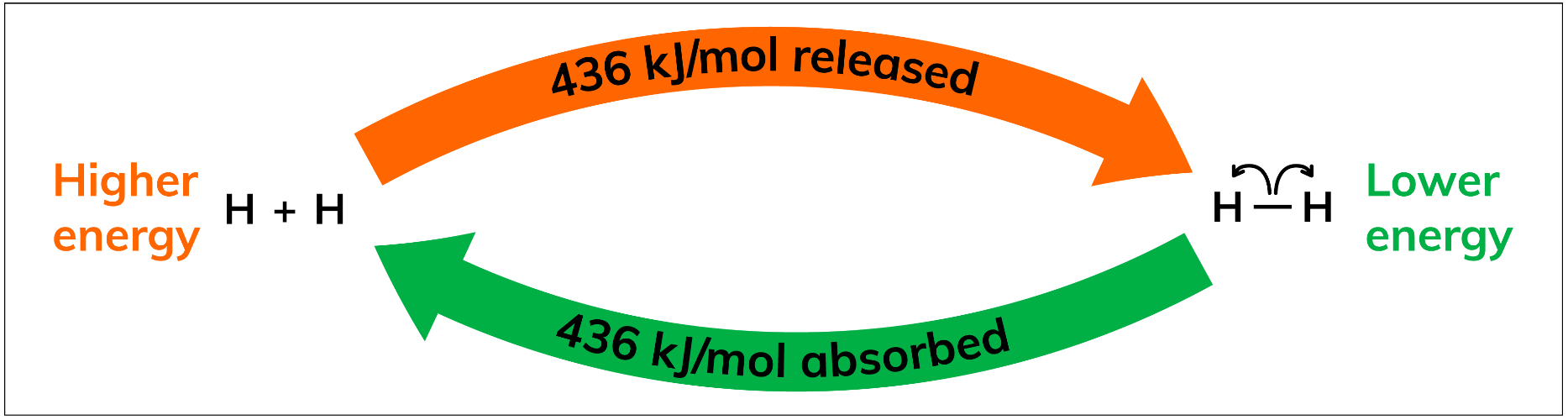
Bond dissociation energy: is the amount of energy needed to break a bond homolytically
In the diagram, this is represented by the blue arrow. Indicate where the BDE can be found on the graph above.
The higher the BDE the stronger/weaker the bond: ________
Bond Order
Bond order: the number of bonds between adjacent atoms
Examples:
The bond order of H-F is ________
The bond order of C=O is ________
The bond order of  is ________
How are Bond Order, Bond Length, and Bond Energy Related?
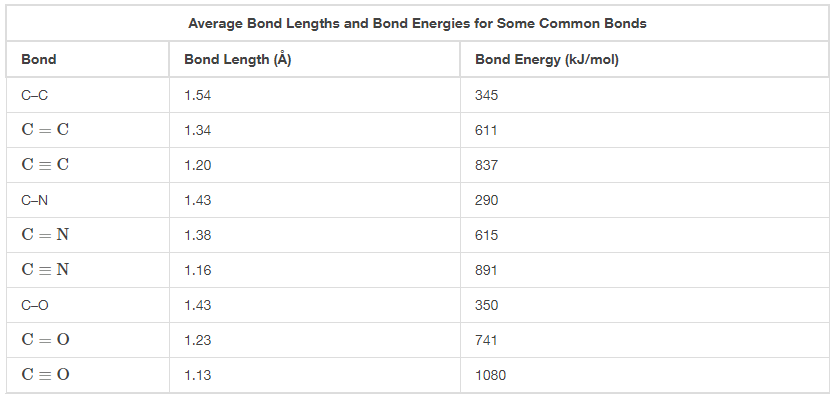
- For bonds between the same elements, the higher the bond order, the shorter the bond length and the stronger the bond (higher BDE)
- Bond length is given in units angstroms (Å) where 1 Å=10-10m
Example: Bond Order
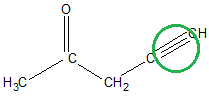
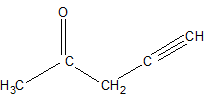
What is the bond order of each bond in this molecule?
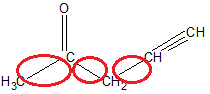
If it is a single bond, it has a bond order of 1.
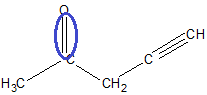
If it is a double bond, it has a bond order of 2.
If it is a triple bond, it has a bond order of 3.